
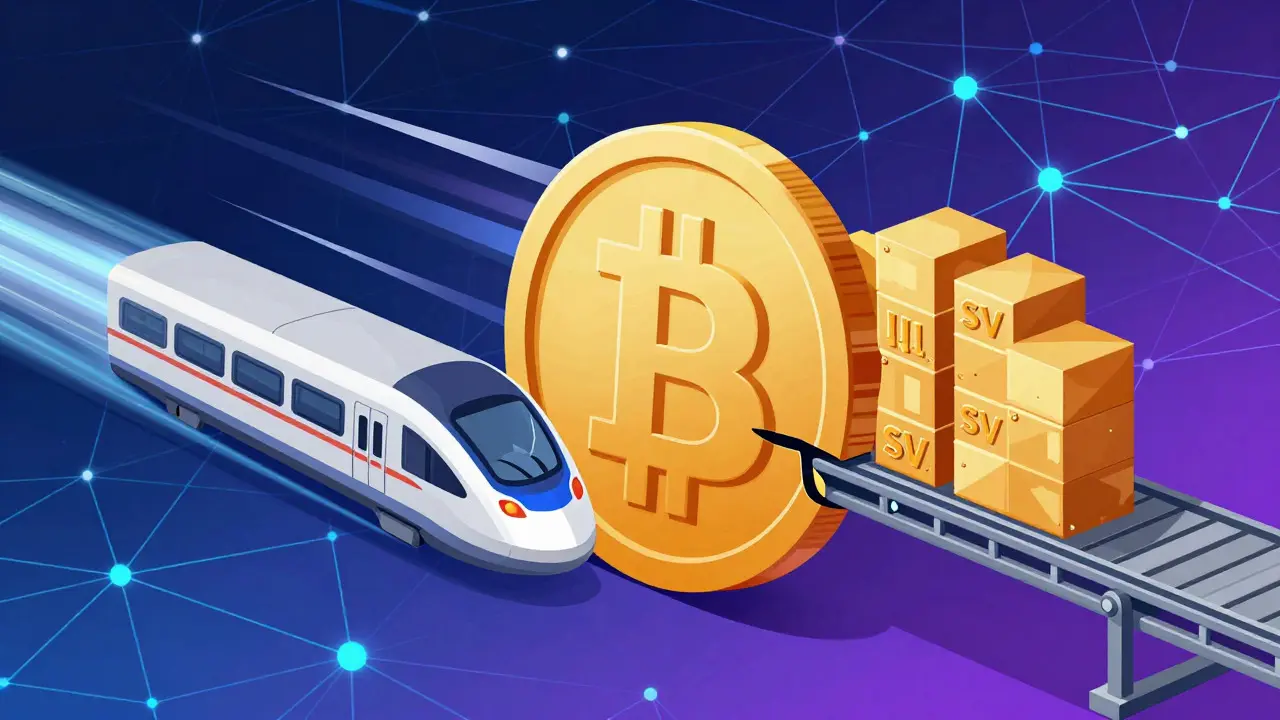
It started with a simple disagreement about block size. In the early days of Bitcoin is a decentralized digital currency created in 2009 by an anonymous entity known as Satoshi Nakamoto, the network could handle every transaction easily. But as adoption grew, fees spiked and confirmation times slowed. This bottleneck sparked a philosophical split that birthed two major alternatives: Bitcoin Cash (BCH) is a cryptocurrency forked from Bitcoin in August 2017 to increase block size limits for faster transactions and Bitcoin SV (BSV) is a cryptocurrency forked from Bitcoin Cash in November 2018 aiming to restore Satoshi Nakamoto's original vision of electronic cash.
If you have ever wondered why there are multiple versions of Bitcoin, or if you are trying to decide which chain offers better utility for payments, this guide breaks down the history, technology, and current state of these famous forks.
The Root of the Conflict: Scalability Wars
To understand the forks, you need to understand the problem they tried to solve. By mid-2017, Bitcoin’s blockchain was congested. The protocol had a hard limit of 1 megabyte (MB) per block. When demand outstripped supply, users bid up transaction fees to get their transactions included. Some fees soared over $50 USD during peak periods, making Bitcoin impractical for buying coffee.
The community fractured into two camps:
- The On-Chain Scaling Camp: They believed the solution was to simply increase the block size limit. If blocks were bigger, more transactions could fit, keeping fees low. This group felt Bitcoin was failing its promise as "peer-to-peer electronic cash."
- The Off-Chain Scaling Camp: Led by core developers, this group argued that increasing block sizes would centralize the network. Larger blocks require more powerful hardware and bandwidth to store and validate, pushing small node operators out. Instead, they favored Segregated Witness (SegWit) is a protocol upgrade to Bitcoin that separates signature data from transaction data to improve capacity and fix malleability and second-layer solutions like the Lightning Network is a Layer 2 payment protocol built on top of Bitcoin that enables instant, low-cost microtransactions.
This deadlock led to the first major fork.
Bitcoin Cash (BCH): The First Major Split
In August 2017, the Bitcoin Cash network launched. It was a hard fork, meaning it created a new blockchain that shared Bitcoin’s history up to that point but diverged in rules going forward. The most significant change was increasing the block size limit from 1 MB to 8 MB, and later to 32 MB.
The goal was clear: make Bitcoin usable for everyday payments again. With larger blocks, BCH could theoretically process many more transactions per second than Bitcoin Core. For years, BCH maintained lower average transaction fees and faster confirmation times than BTC during moderate usage periods.
However, BCH did not just copy Bitcoin’s code. It introduced specific changes to support its vision. One key addition was the OP_CHECKDATASIG opcode, which extended scripting capabilities to allow for more complex smart contracts and multi-signature setups directly on-chain. This positioned BCH as a platform for both payments and lightweight applications.
| Feature | Bitcoin (BTC) | Bitcoin Cash (BCH) | Bitcoin SV (BSV) |
|---|---|---|---|
| Block Size Limit | 1 MB (effective ~4 MB with SegWit) | 32 MB | Unlimited (theoretically), typically >100 MB |
| Primary Scaling Method | Off-chain (Lightning Network) | On-chain (Larger Blocks) | On-chain (Massive Blocks + Data Storage) |
| Consensus Algorithm | SHA-256 | SHA-256 | SHA-256 |
| OP_RETURN Limit | 80 bytes | Increased limits | No limit |
| Governance Model | Distributed Community/Core Devs | Community/Developer Proposals | Centralized Development Team |
Bitcoin SV (BSV): The Escalation
If Bitcoin Cash was a disagreement, Bitcoin SV was a revolution within a revolution. Launched in November 2018, BSV forked from Bitcoin Cash itself. The team behind BSV, heavily influenced by Craig Wright (who claims to be Satoshi Nakamoto), argued that Bitcoin Cash had strayed from the original whitepaper. They believed BCH’s introduction of new opcodes like OP_CHECKDATASIG violated the principle of minimalism.
BSV’s philosophy was radical: remove all artificial constraints. They increased the block size limit dramatically, initially to 128 MB, and eventually removed the cap entirely. More importantly, they eliminated restrictions on OP_RETURN transactions. In Bitcoin, OP_RETURN allows users to attach arbitrary data to a transaction (like a timestamp or a hash). BSV allowed unlimited data storage on-chain.
This shift changed BSV’s identity. While BCH focused on being a payment network, BSV began marketing itself as a global data platform. Proponents argued that storing data on the blockchain provided immutable proof of existence, useful for healthcare records, land titles, and enterprise databases. Critics, however, saw this as bloating the blockchain with irrelevant data, turning it into a distributed hard drive rather than a ledger of value.
The Hash War: A Costly Battle for Security
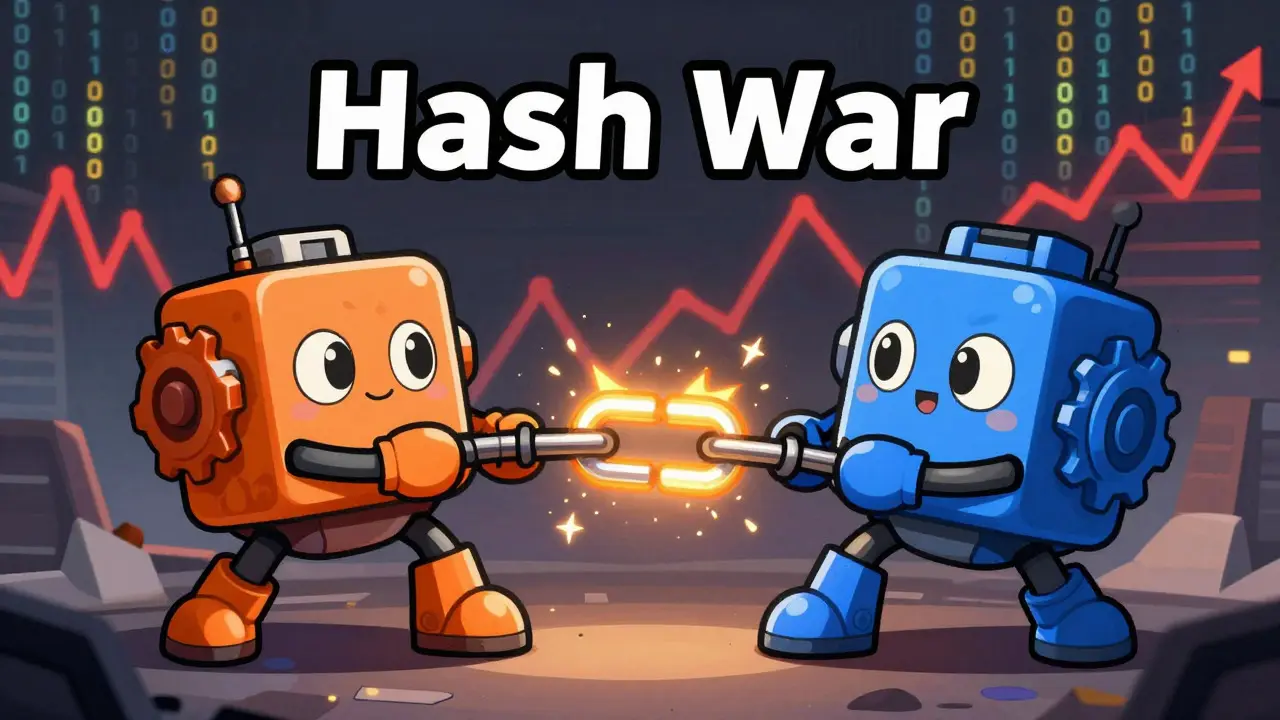
One of the most dramatic events in crypto history occurred immediately after the BSV fork. Because both BCH and BSV use the same SHA-256 mining algorithm as Bitcoin, miners could switch their hardware between chains instantly. This led to the "Hash War."
Miners, driven by profit, moved their hash power back and forth between BCH and BSV. This instability made both networks vulnerable to 51% attacks, where a majority of miners could rewrite recent transactions. To stabilize the network, miners essentially subsidized each other, running at a loss to ensure security. Research from BitMEX estimated that BCH miners lost $3.45 million and BSV miners lost $2.49 million during this ten-day period.
The war ended when the BSV team implemented replay protection, formally separating the chains. However, the aftermath left a lasting imbalance. Bitcoin Cash retained significantly higher hash rate dominance, often maintaining five times the mining power of BSV. This disparity raised questions about BSV’s long-term security relative to its smaller node and miner base.
Current State: Adoption and Market Reality
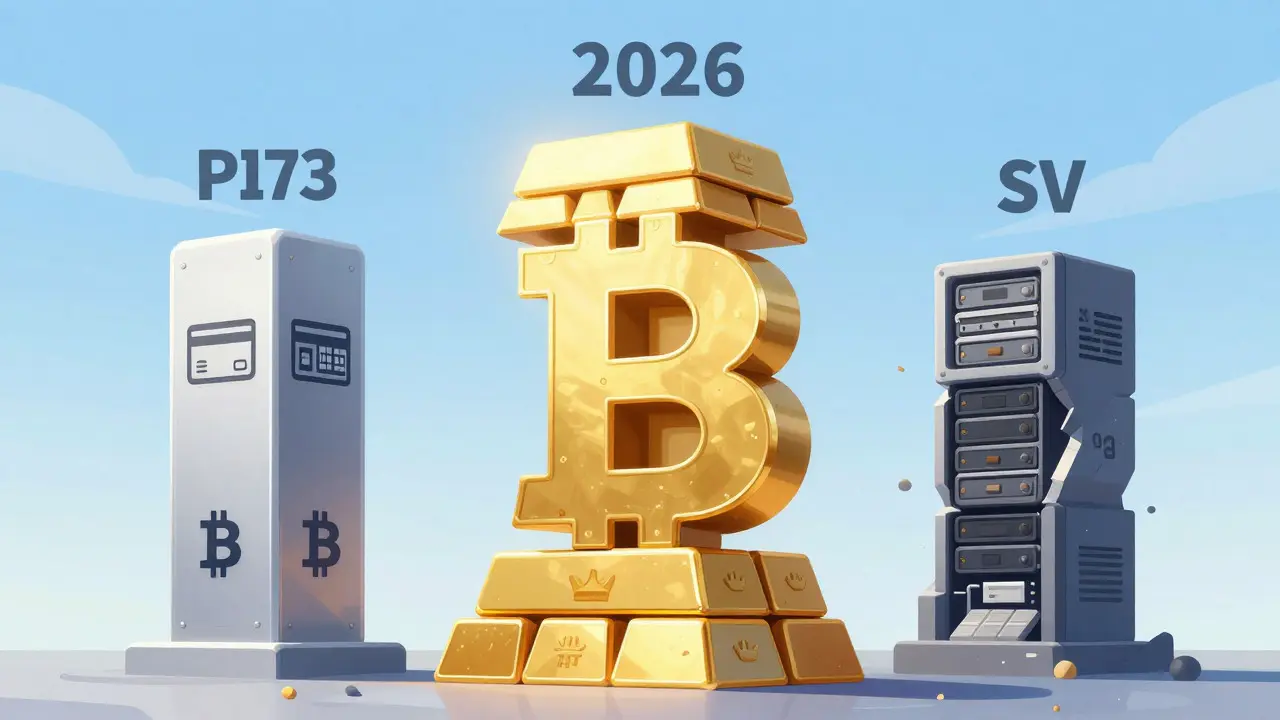
Fast forward to 2026, and the landscape has settled into distinct roles. Bitcoin remains the dominant store of value and settlement layer, commanding over 85% of the total market share in adjusted transfer value among the three assets. Its massive hash rate and widespread institutional adoption make it the safest bet for long-term holding.
Bitcoin Cash continues to serve as a viable peer-to-peer payment system. It maintains a committed user base and developer community. Transaction volumes on BCH remain steady, with median transfer values typically ranging between $1 and $10 USD, reflecting its use case for smaller, frequent transactions. It avoids the volatility seen in BSV’s metrics and maintains a more balanced ecosystem of merchants and wallets.
Bitcoin SV occupies a niche role. Its association with Craig Wright has been polarizing, leading to a fragmented community. While BSV boasts theoretical scalability with blocks occasionally exceeding 100 MB, actual daily transaction volume averages around 10,000 transactions, with occasional spikes. Much of this volume consists of data-heavy OP_RETURN transactions rather than pure value transfers. Enterprise adoption has been slower than projected, with few large-scale projects leveraging BSV’s data storage capabilities compared to traditional cloud solutions or Ethereum-based NFTs.
Which One Should You Choose?
Your choice depends on your goals. If you want the most secure, widely accepted digital gold, stick with Bitcoin. If you need a cryptocurrency for sending small amounts of money internationally with low fees and don’t mind using a less mainstream asset, Bitcoin Cash offers a functional, albeit smaller, network.
Bitcoin SV is best suited for developers or enterprises specifically interested in on-chain data storage and who believe in the "original vision" narrative. However, users should be aware of the centralized governance risks and the smaller security budget (hash rate) compared to BCH and BTC.
Is Bitcoin Cash still active in 2026?
Yes, Bitcoin Cash remains an active network with regular updates, a dedicated community of developers, and consistent transaction volume. It continues to be used for peer-to-peer payments globally, particularly in regions where remittance fees are high.
What happened to Bitcoin SV's price and adoption?
Bitcoin SV's adoption has remained limited compared to Bitcoin and Bitcoin Cash. Its price has been highly volatile, often driven by speculation around Craig Wright's legal battles and claims rather than organic network growth. While it supports large blocks, real-world transaction volume remains relatively low outside of specific enterprise data-storage experiments.
Can I mine Bitcoin Cash and Bitcoin SV with the same hardware?
Yes, because both cryptocurrencies use the SHA-256 hashing algorithm, the same ASIC miners used for Bitcoin can mine BCH and BSV. Miners can switch their devices between chains depending on which offers the highest profitability at any given moment.
Why did Bitcoin Cash fork from Bitcoin?
Bitcoin Cash forked from Bitcoin in 2017 due to disagreements over how to scale the network. Proponents of BCH believed that increasing the block size limit was necessary to keep transaction fees low and enable everyday payments. Bitcoin Core developers preferred off-chain solutions like the Lightning Network to preserve decentralization.
Is Bitcoin SV safer than Bitcoin Cash?
Generally, no. Security in Proof-of-Work networks is largely determined by hash rate. Bitcoin Cash consistently maintains a higher hash rate than Bitcoin SV, making it more resistant to 51% attacks. Additionally, Bitcoin has the highest hash rate of all three, making it the most secure option overall.

Comments
Dave Kjendal
People forget that money is just a story we all agree on. If the story changes, the value changes with it. Bitcoin Cash tried to tell a different story about being cash, but the market voted for gold instead.
Harman Singh
i mean its kinda sad how they split up like that lol. why cant people just get along? it feels like high school drama but with more zeros in the bank account. so confusing honestly
Qolbina Islami
This entire situation is a disaster!!! The American dream of financial freedom is being hijacked by these tech bros who think they know better than the free market!!! You want real innovation??? Look at our infrastructure!!! Not this digital snake oil!!! It’s pathetic!!!
Pernelia Wahkan
The technical distinction between OP_CHECKDATASIG and the removal of OP_RETURN limits is often glossed over in mainstream crypto media. BCH introduced new opcodes to enable more complex scripting directly on-chain, which fundamentally altered the UTXO model's simplicity. BSV, conversely, stripped away restrictions to allow arbitrary data storage, effectively turning the blockchain into a distributed hard drive. This isn't just a philosophical difference; it's a structural divergence in how consensus is validated and what constitutes valid state transitions. Most retail investors miss this nuance entirely, focusing only on block size metrics while ignoring the cryptographic implications of opcode expansion versus restriction.
Subhash Kashyap Dm
the whole thing is rigged from day one. satoshi was never one person it was a cabal of central bankers trying to create a backdoor for surveillance capitalism. bsv is the only honest chain because wright admits it. everyone else is lying about decentralization when really the miners are just puppet masters controlling the hash rate to manipulate prices. wake up sheeple
Billy Cunningham
lol 😂 just hold btc and ignore the noise 🤷♂️
Ed Wallace
It is fascinating to consider how the concept of 'scarcity' evolved differently across these chains. Bitcoin embraced artificial scarcity as a feature, creating digital gold. Bitcoin Cash rejected this, viewing scarcity as a bug that hindered utility. One wonders if true abundance is possible in a digital asset without sacrificing security or decentralization. Perhaps the fork itself was an inevitable outcome of conflicting definitions of value rather than mere technical disagreements.
Joshua Hofford
I actually love seeing how different cultures adapt to these technologies. In some parts of the world, Bitcoin Cash is genuinely used for daily transactions because the fees make sense. It brings hope that technology can bridge economic gaps if we just let it breathe and find its own path. Every chain has its place in the global ecosystem!
Michael Mostyn
The historical analysis provided is quite thorough. However, one must consider the long-term implications of the hash war on network security. The subsidy mechanism employed by miners was unsustainable, leading to a permanent disparity in hash rate distribution. This raises significant questions about the resilience of smaller forks against coordinated attacks in the future.
Nick Darring
You guys are all missing the point because you're too busy looking at charts instead of understanding the human element behind the code. I remember sitting in my garage watching the blocks come in during the fork, and I realized something profound about trust. We don't trust each other anymore, so we trust math. But math doesn't care about your feelings. When BCH split, it wasn't just code changing; it was communities fracturing along ideological lines that had nothing to do with technology and everything to do with ego. I've seen people lose friendships over which coin to hold, and frankly, it's hilarious yet tragic. The real value isn't in the coin, it's in the narrative control. Whoever controls the story controls the price. That's why BSV struggled despite having arguably superior scalability specs. Wright couldn't sell the dream because he was too busy arguing about legalities. Meanwhile, BTC became digital gold not because it's better tech, but because it's a better marketing story. So next time you argue about block sizes, ask yourself who benefits from you being distracted by technical minutiae while the whales move billions.
Eden Tadesse
i think its important to look at the environmental impact too. mining uses so much energy and i worry about what that means for our planet. maybe we should focus on greener alternatives?
Rita Dutta
oh please. you think anyone actually reads the whitepaper? its all hype and greed. the 'original vision' is just a buzzword for whatever makes the most money right now. typical western ignorance about how decentralized systems actually work in practice. its chaos wrapped in a pretty interface.
Paul Smith
Cool breakdown! 👍 I always found the history of these forks super interesting. It’s like a family tree gone wrong 😅 But hey, at least we have options now! 🚀💸
Rodmun Tarnowski
Indeed!! The clarity provided here is exceptional!!! It is crucial to understand the nuances of each protocol!!! Thank you for sharing this informative piece!!!
Matthew Smith
morally speaking bitcoin cash failed because it broke the social contract of the original network. sv is even worse because it relies on a single figurehead. true virtue lies in sticking to the original code without modification. anything else is hubris
Prudence Flemming
the mempool dynamics on bch are interesting. low fees mean spam transactions fill up blocks. its a tradeoff between accessibility and efficiency. not sure either side won really.
Carl Michaud
The narrative of 'decentralization' is a complete fabrication designed to dupe the plebeian masses into believing they have agency. In reality, both BCH and BSV are controlled by oligopolies of mining pools and venture capital firms. The hash rate disparity mentioned is merely a symptom of deeper systemic manipulation. Elite institutions use these forks to launder illicit funds and test regulatory frameworks before imposing them on the broader economy. The average user is simply a pawn in a grander geopolitical chess game involving currency warfare and digital hegemony.
Matt Kay
boring article. nobody cares about bsv anymore.