

Imagine trying to send money from a bank in New Zealand to one in Japan. You’d expect it to take days, cost a fortune in hidden fees, and require filling out forms that look like they were designed by lawyers who hate fun. Now imagine doing that with crypto, but instantly, without handing over your identity to a middleman. That’s the promise of WanSwap, a decentralized exchange built on the Wanchain blockchain. But does it actually deliver on that promise, or is it just another shiny tool that breaks when you need it most?
I’ve spent weeks testing WanSwap, digging into its code audits, talking to users in Auckland and beyond, and comparing it against giants like Uniswap and PancakeSwap. The short answer? It’s powerful for specific tasks-like moving assets between different blockchains-but it comes with serious quirks that can trip up beginners and frustrate pros alike.
What Exactly Is WanSwap?
WanSwap isn’t just another place to swap Bitcoin for Ethereum. It’s a cross-chain Automated Market Maker (AMM). In plain English, this means it lets you trade tokens across different blockchain networks without needing a centralized company to hold your funds. You keep control of your wallet; the protocol handles the rest.
Launched in 2020 as part of the Wanchain ecosystem, WanSwap was designed to solve a major pain point in DeFi: fragmentation. Before tools like this, if you wanted to move assets from Ethereum to BNB Chain, you had to go through multiple steps, often involving trusted bridges that could fail or get hacked. WanSwap aims to make that seamless.
But here’s the catch: “Seamless” doesn’t always mean “easy.” As we’ll see, the user experience has friction points that many newcomers aren’t prepared for.
How Much Does It Cost to Trade?
Fees are where WanSwap starts to shine-or at least, where it tries to. Here’s the breakdown:
- Trading Fee: 0.30% per swap.
- Liquidity Provider Share: 0.25% goes back to people providing liquidity.
- Treasury Share: 0.05% goes to the protocol’s treasury.
- Deposit/Withdrawal Fees: None. This is huge compared to centralized exchanges.
Compare that to FameEX, which charges 0.20%-0.25% trading fees plus $15-$50 in network withdrawal fees depending on the coin. On paper, WanSwap looks cheaper. And for small trades, it often is.
But there’s a hidden cost: slippage. Because WanSwap’s liquidity pools are smaller than those of Uniswap or PancakeSwap, larger trades can suffer significant price impact. If you’re swapping more than $5,000 worth of tokens, expect slippage exceeding 5%. That eats into your savings fast.
Also, while gas fees on Wanchain itself are low (averaging $0.02 per transaction), you still need to pay for transactions on the source and destination chains. So if you’re bridging from Ethereum, you’ll still face Ethereum’s high gas costs during peak hours.
| Feature | WanSwap | Uniswap | PancakeSwap | FameEX (CEX) |
|---|---|---|---|---|
| Trading Fee | 0.30% | 0.30% | 0.25% | 0.20% - 0.25% |
| Withdrawal Fee | $0 | Network Gas | Network Gas | $15 - $50 |
| Cross-Chain Support | Yes (15+ chains) | No (Ethereum only) | Limited (BNB/Ethereum) | Yes (via internal ledger) |
| Avg. Gas Cost (Source Chain) | Varies ($0.02 on Wanchain) | High ($1.85 avg on ETH) | Low ($0.10 avg on BSC) | Included in withdrawal fee |
Security: Audits, Exploits, and What They Mean for You
Let’s talk about safety. In crypto, trust is earned, not given. WanSwap has undergone audits by reputable firms like CertiK (Q2 2022) and PeckShield (Q4 2023). These audits check for vulnerabilities in smart contracts-the code that runs your trades.
But audits aren’t magic shields. In July 2023, WanSwap suffered a $127,000 exploit when an attacker manipulated oracle prices in the WBTC/USDC pool. Oracles feed real-world data (like token prices) into smart contracts. If that data is wrong, the contract makes bad decisions. In this case, the attacker exploited a flaw in how price data was validated.
Was it WanSwap’s fault? Partially. While the core protocol was secure, the reliance on external oracles created a weak link. Since then, improvements have been made, but the incident serves as a reminder: no system is perfect.
More recently, Trail of Bits raised concerns in February 2025 about WanSwap’s bridge design. They noted a “single-point-of-failure risk” in how Wanchain’s validators handle cross-chain messages. For institutional investors, this might be a dealbreaker. For retail users? It’s something to keep in mind when deciding how much to stake.
User Experience: Where Beginners Struggle
If you’ve never used a decentralized exchange before, WanSwap will feel overwhelming. There’s no customer support hotline. No “Forgot Password?” button. Just you, your wallet, and a web interface that expects you to know what you’re doing.
Here’s what new users typically face:
- Wallet Setup: You need MetaMask, WalletConnect, or Wanchain’s official wallet. Installing and configuring these takes time-and mistakes here can lead to lost funds.
- Asset Bridging: To use WanSwap, you often need to move assets onto Wanchain first. This involves using bridges, which can be slow and confusing.
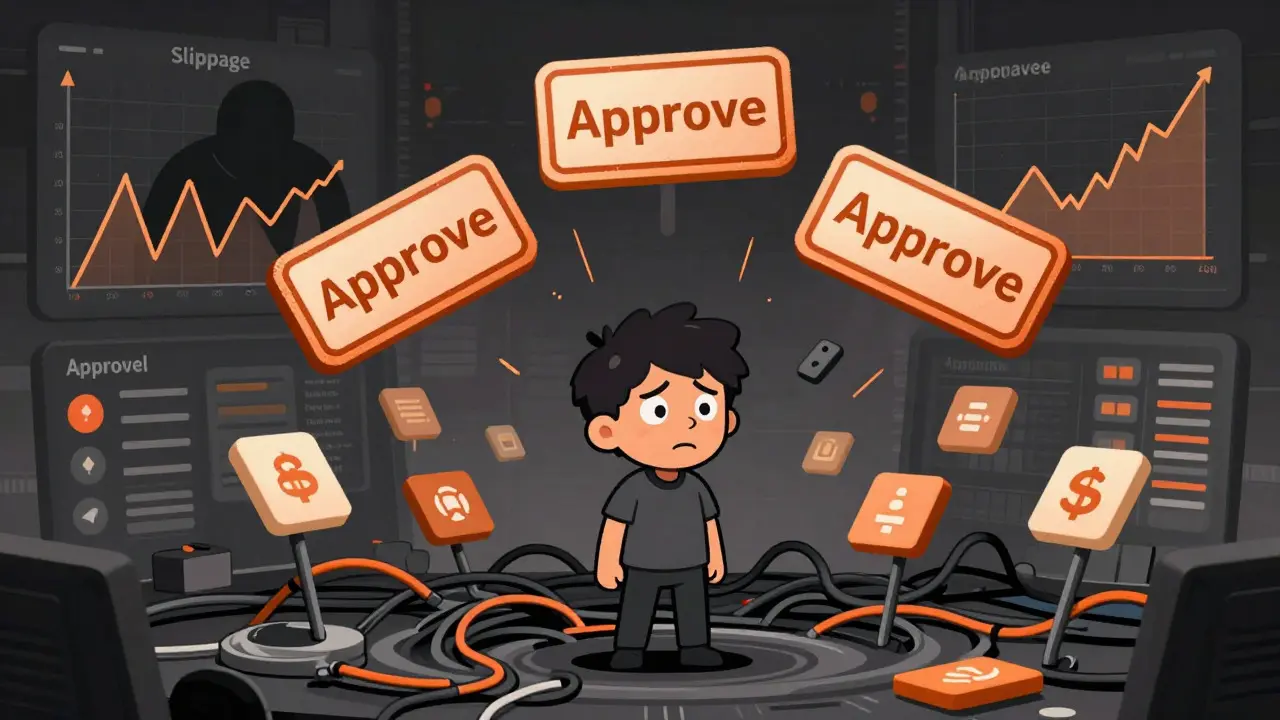
- Multiple Approvals: Adding liquidity requires three separate transaction approvals. Each one costs gas and takes time. One user reported spending 90 seconds just completing these steps.
- Slippage Settings: If you don’t set slippage tolerance correctly, your trade might fail-or worse, execute at a terrible price.
The learning curve is steep. HittinCorners estimated it takes 3-5 hours for a beginner to fully onboard. That’s not nothing.
And let’s not forget mobile access. As of mid-2026, WanSwap still lacks dedicated iOS or Android apps. You’re stuck using a browser, which is fine until your phone drops signal mid-transaction.
Performance Metrics: TVL, Volume, and Market Position
Numbers tell a story. Let’s look at WanSwap’s current standing:
- Total Value Locked (TVL): Conflicting reports exist. HittinCorners cited $2.4 million in January 2025, while Crypto Insights Channel claimed nearly $38 million in September 2024. This volatility suggests either rapid growth/shrinkage or inconsistent measurement methods.
- Daily Trading Volume: Around $1.7 million (March 2025).
- Market Share: 0.12% of total DEX volume (DeFi Llama, March 2025).
- Active Users: ~14,500 monthly active users, mostly from Asia-Pacific (68%).
Compared to Uniswap’s 58.3% market share, WanSwap is a niche player. But niches can be profitable-if you play them right.
One area where WanSwap excels is gas efficiency. During network congestion, average transaction costs on WanSwap hover around $1.23, versus $3.87 industry-wide. That’s thanks to Wanchain’s proof-of-stake consensus mechanism, which processes transactions faster and cheaper than Ethereum’s older model.

Who Should Use WanSwap? (And Who Should Avoid It)
Not every tool fits every job. Here’s who benefits from WanSwap-and who should look elsewhere.
Good for:
- Experienced DeFi users comfortable managing wallets and understanding slippage.
- Those frequently moving assets between Ethereum, BNB Chain, Polygon, and other supported networks.
- Users prioritizing privacy and non-custodial control over convenience.
- Traders looking to avoid high withdrawal fees charged by centralized exchanges.
Bad for:
- Beginners unfamiliar with blockchain technology.
- High-frequency traders needing instant execution and advanced order types (limit orders, stop-losses).
- Anyone requiring fiat on-ramps (you can’t deposit USD directly).
- Institutions demanding KYC/AML compliance features.
Future Outlook: Can WanSwap Survive the Competition?
The landscape is changing fast. Multi-chain aggregators like THORSwap are gaining ground, capturing 14.2% of cross-chain swap volume since 2023. Regulatory pressure is also mounting, especially in Europe, where the European Securities and Markets Authority flagged WanSwap in January 2025 for lacking AML compliance.
Wanchain Foundation plans to address some issues. Their roadmap includes:
- Q3 2025: Launch of limit orders and stop-loss functionality.
- Q4 2025: Release of a native mobile app.
- 2026: Integration with institutional custody solutions.
Analysts are divided. Gartner predicts WanSwap’s market share will drop to 0.07% by 2026 due to liquidity fragmentation. Meanwhile, Wanchain’s own projections aim for 300% TVL growth by end-2025. Only time will tell which vision becomes reality.
Is WanSwap safe to use?
WanSwap has been audited by CertiK and PeckShield, but it did suffer a $127,000 exploit in 2023 due to oracle manipulation. Security depends partly on your actions-always verify contract addresses and use hardware wallets for large amounts. Recent audits highlight risks in its bridge design, so proceed with caution.
How do I start using WanSwap?
First, install a compatible wallet like MetaMask. Then acquire WAN tokens or bridge assets from another chain to Wanchain. Connect your wallet to WanSwap’s website, approve the necessary transactions, and begin swapping. Expect a 3-5 hour learning curve if you’re new to DeFi.
What are the fees on WanSwap?
WanSwap charges a flat 0.30% trading fee. Liquidity providers receive 0.25%, and 0.05% goes to the treasury. There are no deposit or withdrawal fees, but you’ll still pay gas fees on the source and destination blockchains.
Can I use WanSwap on my phone?
As of mid-2026, WanSwap does not have a dedicated mobile app. You must access it via a mobile browser, which works but may be less stable during poor connectivity. A native app is planned for Q4 2025.
Why is slippage so high on WanSwap?
Slippage occurs because WanSwap’s liquidity pools are smaller than those of major DEXs like Uniswap. When you trade large amounts, there aren’t enough matching orders, causing your price to shift unfavorably. Set conservative slippage tolerances (0.5-1.0%) to mitigate this.
Does WanSwap support fiat deposits?
No. WanSwap is purely crypto-to-crypto. To get started, you’ll need to buy cryptocurrency on a centralized exchange first, then transfer it to a compatible wallet before using WanSwap.
How does WanSwap compare to Uniswap?
Uniswap operates only on Ethereum and has deeper liquidity, making it better for large trades. WanSwap supports 15+ blockchains, offering true cross-chain swaps. However, WanSwap suffers from higher slippage and lower overall volume. Choose based on whether you prioritize cross-chain flexibility or trade size.
What happens if I lose my private key?
Since WanSwap is non-custodial, losing your private key means losing access to your funds forever. Always back up your seed phrase securely. Consider using a hardware wallet for added protection.
Are there any upcoming features for WanSwap?
Yes. Planned updates include limit orders and stop-loss functionality (Q3 2025), a mobile app (Q4 2025), and integration with institutional custody solutions in 2026. These additions aim to improve usability and attract broader adoption.
Is WanSwap regulated?
WanSwap operates without KYC requirements, placing it in a regulatory gray area. In Europe, it was named in a 2025 advisory by the European Securities and Markets Authority for lacking AML compliance. Its non-custodial nature offers some legal protection, but regulations are tightening globally.

Write a comment