

Imagine you walk into a coffee shop, pay for your latte with Bitcoin, and then-before the barista even hands you the cup-you somehow erase that payment from the record and spend those same coins at the next store down the street. Sounds like magic, right? In the world of blockchain, it’s called a 51% attack, and while it sounds like something out of a cyberpunk thriller, it has happened more times than you might think.
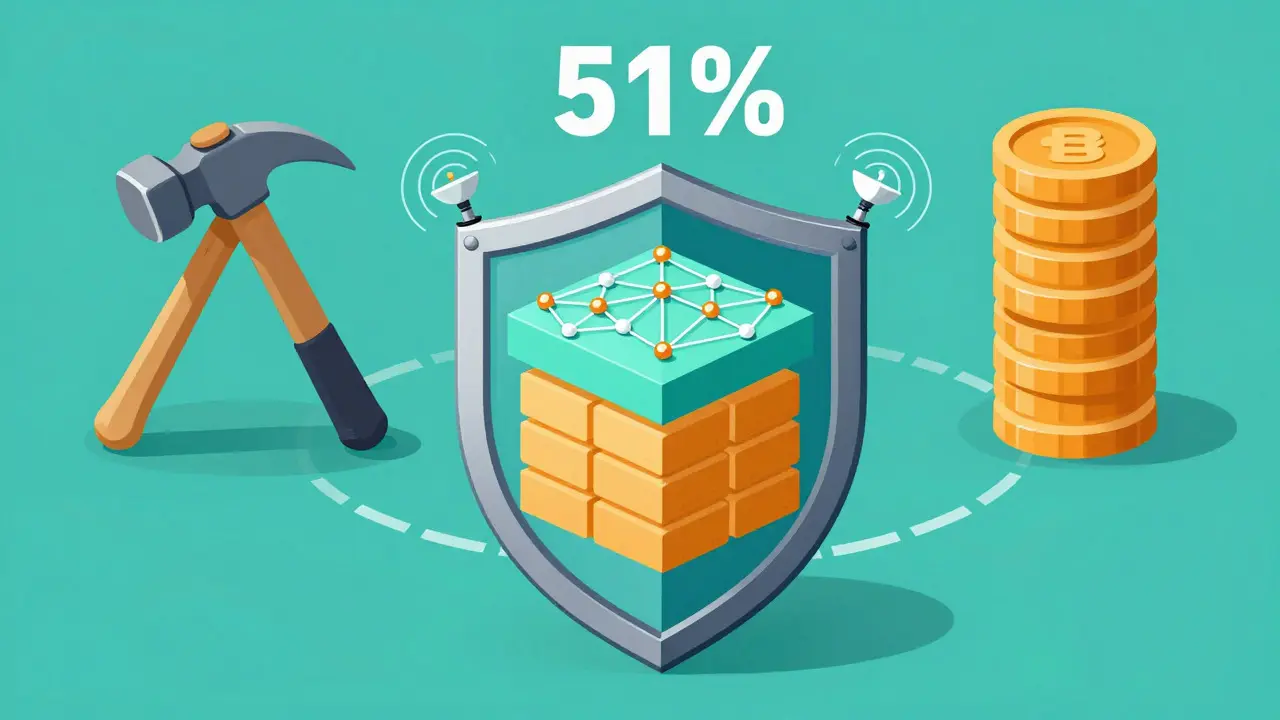
A 51% attack isn’t about hacking into a wallet or stealing passwords. It’s about brute force. It happens when a single entity or group gains control of more than half of a blockchain network’s computing power (hash rate). Once they hold that majority, they can rewrite history-specifically, the recent history of transactions on that ledger. This concept was first hinted at in Satoshi Nakamoto’s original Bitcoin whitepaper in 2009, though back then, most experts assumed acquiring such massive power would be economically impossible. Today, with specialized mining pools and rental services, the threat is very real, especially for smaller networks.
How Does a 51% Attack Actually Work?
To understand the attack, you first need to understand how blockchains agree on what is true. Most major cryptocurrencies, like Bitcoin and Ethereum Classic, use a system called Proof of Work (PoW). In this system, miners compete to solve complex mathematical puzzles to add new blocks to the chain. The rule is simple: the longest chain of blocks is considered the valid one. All nodes (computers) on the network accept this longest chain as the truth.
Here is where the attacker steps in. If a malicious group controls more than 50% of the total mining power, they can mine new blocks faster than everyone else combined. They don’t just mine openly; they mine secretly. Here is the step-by-step breakdown of a typical attack:
- The Initial Transaction: The attacker sends cryptocurrency from their own wallet to an exchange or merchant to buy goods or cash out.
- The Secret Chain: While the public network confirms this transaction, the attacker uses their superior power to mine a parallel version of the blockchain where that transaction never happened.
- The Cash Out: Once the public network shows enough confirmations (usually 3-6), the attacker takes the fiat money or assets received from the exchange.
- The Reveal: The attacker reveals their longer, secret chain to the network. Because it is longer, the network accepts it as the valid one.
- The Double Spend: The original transaction is erased. The attacker now has both the crypto (which was never spent on their private chain) and the assets they bought with it.
This process is known as Double Spending. It is the digital equivalent of photocopying a dollar bill and spending both copies. However, there are limits. An attacker cannot steal funds directly from someone else’s wallet because they still need the private keys to sign transactions. They also cannot create new coins out of thin air if the protocol rules prevent it. Their power is limited to rewriting the order and existence of transactions involving their own coins.
Real-World Examples: When Theory Became Reality
For years, 51% attacks were largely theoretical exercises discussed by academics. But reality has proven otherwise, particularly for smaller blockchain networks. The vulnerability scales inversely with market cap and hash rate. The bigger the network, the harder it is to attack. The smaller the network, the cheaper it is to buy enough power to take it over.
One of the most infamous victims was Ethereum Classic (ETC). In January 2019, ETC suffered two separate 51% attacks within days of each other. Attackers reversed thousands of transactions, causing millions of dollars in losses for exchanges. It wasn’t a one-off event; three more attacks hit ETC in August 2020. These incidents showed that attackers could rent hash power from mining pools on demand, turning security into a commodity.
Bitcoin Gold faced similar fates, being attacked multiple times between 2018 and 2020. Each time, the consensus was rewritten, and exchanges had to freeze deposits to mitigate losses.
But the shockwaves changed in August 2025. Monero, a privacy-focused coin with a significantly larger market capitalization and community than ETC or Bitcoin Gold, experienced a sustained 51% attack. This was a watershed moment. Monero uses a different algorithm (RandomX) designed to resist ASIC mining, yet attackers still managed to seize control. This demonstrated that even established, mid-tier protocols are vulnerable if a well-resourced organization decides to target them. It moved the conversation from "will this happen to small coins?" to "is any PoW chain truly safe?"
| Date | Target Network | Impact | Key Takeaway |
|---|---|---|---|
| Jan 2019 | Ethereum Classic | $11M+ lost via double-spending | Rented hash power made attacks accessible |
| Aug 2020 | Ethereum Classic | Multiple reversals, exchange freezes | Recurring threat due to low hash rate |
| 2018-2020 | Bitcoin Gold | Repeated chain reorganizations | Smaller forks are high-risk targets |
| Aug 2025 | Monero | Sustained disruption, confidence hit | Even larger, privacy-focused chains are vulnerable |

Why Doesn't Bitcoin Get Attacked?
You might wonder why Bitcoin hasn’t fallen victim to these attacks despite being the largest target. The answer lies in economics, not just technology. To attack Bitcoin, you need to control more than half of its global hash rate. As of 2026, Bitcoin’s hash rate is measured in exahashes per second (EH/s).
Acquiring that much power requires billions of dollars in specialized hardware (ASICs) and enormous amounts of electricity. Research from the MIT Digital Currency Initiative suggests that launching a successful attack on Bitcoin would cost far more than the potential profit from double-spending. Unless the attacker has sunk costs in hardware that they want to recoup, the attack is financially irrational. For Bitcoin, the cost of attack exceeds the value of the reward. For smaller chains like Verge or Zcash (at certain points in their history), the cost was often less than $10,000 per day to rent the necessary power.
Prevention and Mitigation Strategies
So, how do we protect against this? There is no silver bullet, but there are layers of defense.
1. Decentralized Hash Rate Distribution The golden rule of blockchain security is: the more distributed the mining power, the safer the network. If one mining pool controls 40% of the hash rate, the network is already risky. Monitoring tools like Hashrate Distribution Charts and Coin Dance provide real-time data on pool dominance. Users and exchanges should watch these metrics closely.
2. Increased Confirmation Requirements For large transactions, waiting for more confirmations adds safety. A 51% attacker needs to rebuild the entire chain from the point of the transaction. The deeper the transaction is buried in the blockchain, the harder and more expensive it is to overwrite. Exchanges often require 10-60 confirmations for high-value deposits to mitigate this risk.
3. Early Detection Systems Services now exist that monitor for unusual chain reorganizations. If a block appears that doesn’t follow the expected difficulty or if a sudden fork occurs, alerts are sent to exchanges to pause withdrawals. This "circuit breaker" approach can save millions during an active attack.
4. Alternative Consensus Mechanisms Many newer blockchains have moved away from Proof of Work to Proof of Stake (PoS). In PoS, validators lock up their own coins as collateral. To attack the network, they would need to acquire 51% of the total supply, which is often prohibitively expensive and would devalue the asset they are trying to attack. While PoS has its own vulnerabilities (like long-range attacks), it changes the economic incentives significantly compared to PoW.
What This Means for You
If you are holding cryptocurrency, understanding 51% attacks helps you make smarter decisions. First, be cautious with smaller-cap altcoins that use Proof of Work. Check their hash rate stability before investing or trading. Second, if you are running a business accepting crypto, implement strict confirmation policies. Don’t trust a transaction just because it says "1 confirmation." Third, stay informed. The landscape evolves quickly, as seen with the 2025 Monero incident. Security is not a static feature; it’s an ongoing battle between decentralized ideals and centralized power.
Blockchain technology promised unbreakable trust through mathematics. But as we’ve seen, math alone isn’t enough. Human behavior, economic incentives, and hardware distribution play just as big a role. A 51% attack reminds us that decentralization is fragile and must be actively maintained.
Can a 51% attacker steal money from my wallet?
No. A 51% attacker cannot directly steal funds from your wallet because they still need your private key to authorize outgoing transactions. However, they can reverse transactions where you sent money to someone else, effectively allowing them to double-spend their own coins after receiving payment from you.
Is Bitcoin vulnerable to a 51% attack?
Theoretically, yes, but practically, it is extremely unlikely. The computational power and energy required to control 51% of Bitcoin's hash rate cost billions of dollars. The economic loss from devaluing Bitcoin would likely outweigh any profit gained from an attack, making it financially irrational for most actors.
How many confirmations are safe against a 51% attack?
There is no guaranteed number, but more confirmations increase security. For small transactions, 3-6 confirmations are standard. For large sums, exchanges often wait for 10-60 confirmations. Each additional block makes it exponentially harder and more expensive for an attacker to rewrite the chain.
Did the 2025 Monero attack change blockchain security?
Yes. Before 2025, 51% attacks were mostly associated with tiny, obscure coins. The Monero attack proved that even established, mid-sized networks with strong communities could be compromised by well-funded groups. This led to increased investment in monitoring tools and a re-evaluation of Proof of Work security models across the industry.
What is the difference between Proof of Work and Proof of Stake regarding 51% attacks?
In Proof of Work (PoW), an attacker needs 51% of the computing power (hash rate). In Proof of Stake (PoS), an attacker needs 51% of the total cryptocurrency supply locked up as stake. PoS attacks are generally considered more expensive because buying that much coin drives up the price, increasing the cost of the attack itself.

Write a comment