

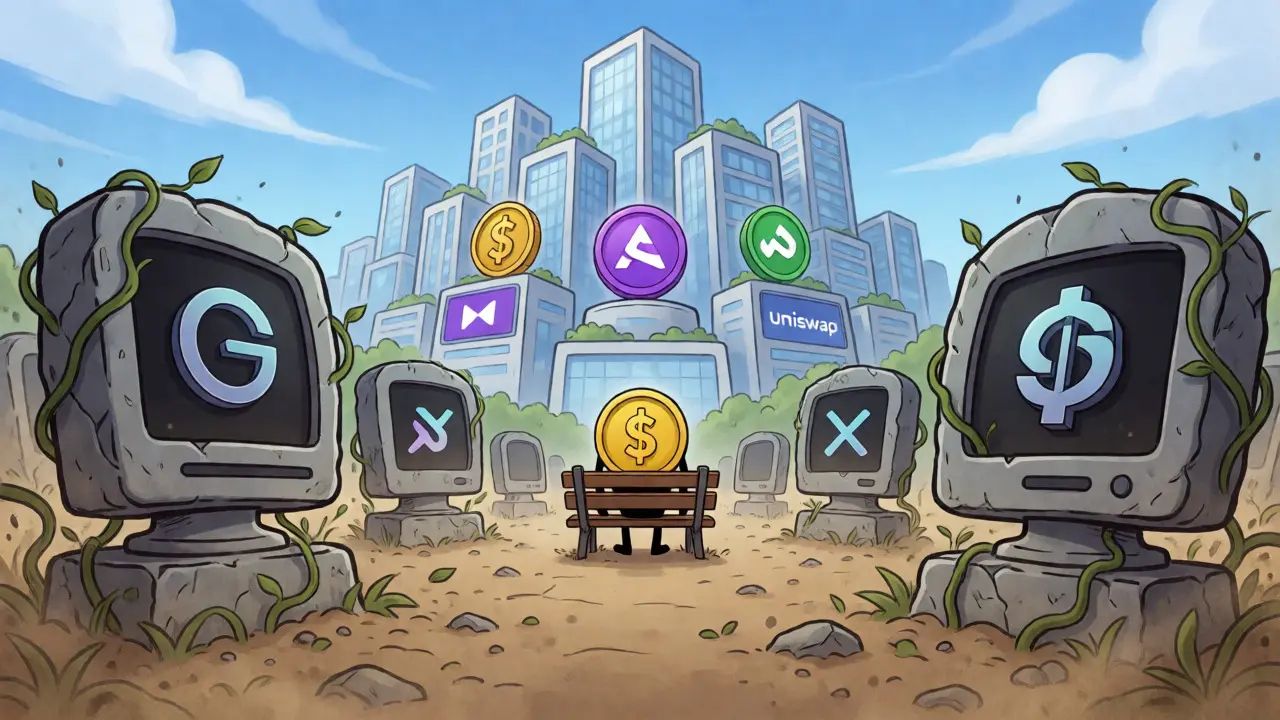
Have you ever clicked on a crypto exchange name expecting active trading pairs, only to find a ghost town? That is exactly what happens when you search for Linkswap. It’s not that the website is broken or under maintenance. The platform is simply gone. If you are digging through your old wallet history or reading outdated blog posts from 2021, you might be wondering if this decentralized exchange (DEX) still exists. Spoiler alert: it doesn’t. Linkswap was a short-lived experiment in the DeFi boom of 2021, and today, it serves as a cautionary tale about liquidity and sustainability rather than a viable trading venue.
The Rise and Fall of a DeFi Experiment
To understand why Linkswap matters today, you have to look at where it came from. It wasn’t just another random fork of Uniswap code. Linkswap was built by YF Link, a project that tried to merge the oracle capabilities of Chainlink with the yield-farming mechanics of Yearn Finance. Launched in early 2021, right at the peak of "DeFi Summer," it promised users a way to trade ERC-20 tokens while earning rewards on their governance token, $YFL. The pitch was simple: provide liquidity, earn fees, and hold a scarce token. But here is the problem-simplicity didn’t translate to longevity. By mid-2025, major data aggregators like CoinCodex list it as "no longer operational," and Holder.io reports zero cryptocurrencies traded on the platform. The lights went out quietly, leaving behind smart contracts that no one visits anymore.
How Linkswap Worked When It Was Alive
While it functioned, Linkswap operated as an Automated Market Maker (AMM). This means there was no order book with buyers and sellers waiting in lines. Instead, you traded against a pool of tokens. If you wanted to swap ETH for a specific ERC-20 token, you were essentially swapping into and out of a shared pot managed by smart contracts. The pricing followed the constant product formula ($x \times y = k$), which is standard for most AMMs. Users connected via non-custodial wallets like MetaMask or Trust Wallet. You kept your private keys; you signed your own transactions. There was no KYC process, no bank account verification, and no customer support team answering emails. It was pure peer-to-contract interaction.
The fee structure was straightforward but rigid. Every trade cost 0.30%, regardless of size or frequency. Unlike centralized exchanges that offer discounts for high-volume traders, Linkswap charged everyone the same rate. Of that 0.30%, 83% went to liquidity providers-the people who put their crypto into the pools-and 17% went to staking rewards for holders of the $YFL token. On paper, this looked attractive. In practice, the low total supply of $YFL (only 50,000 tokens) created artificial scarcity that failed to sustain demand once the hype cycle cooled down.

Why Did Linkswap Fail?
So, what killed it? Three main factors: lack of differentiation, poor liquidity, and market consolidation. First, Linkswap offered nothing technically unique compared to giants like Uniswap or Sushiswap. While Uniswap introduced concentrated liquidity in v3, Linkswap stuck to basic mechanics. Second, liquidity is oxygen for a DEX. Without deep pools, trades suffer from massive slippage. If you tried to sell $1,000 worth of a minor token on Linkswap, you might have moved the price significantly against yourself. Third, the broader market changed. After the 2021 bull run, capital fled to safer, more established protocols. By 2025, five dominant players control over 85% of DEX volume. Small forks like Linkswap couldn’t compete with the network effects of Uniswap or the cross-chain features of newer platforms like THORSwap.
| Feature | Linkswap (Historical) | Modern Standard (e.g., Uniswap v3) |
|---|---|---|
| Status | Defunct / No longer operational | Active with billions in TVL |
| Fee Structure | Flat 0.30% | Tiered (0.05%, 0.30%, 1%) based on volatility |
| Blockchain Support | Ethereum Mainnet Only | Multi-chain (Ethereum, Polygon, Arbitrum, etc.) |
| Tokenomics | $YFL (50k supply, buy-backs) | UNI (1B supply, governance focus) |
| User Experience | Basic Swap Interface | Advanced analytics, limit orders, LP management |
What Should You Do If You Hold YF Link Tokens?
If you are reading this because you still hold $YFL tokens in your wallet, you are likely facing a tough reality check. Since the exchange is dead, you cannot sell them on Linkswap itself. Your options are limited. First, check if the token is listed on any secondary aggregators or smaller centralized exchanges that might have picked up orphaned assets. Often, these listings have extremely low volume, meaning you might have to accept a steep discount to exit. Second, consider if the underlying project, YF Link, has migrated its community or technology elsewhere. Sometimes, teams abandon the original site but continue development on GitHub or Discord. However, without active trading venues, the utility of holding the token diminishes rapidly. For most users, the practical move is to assess the remaining value and decide whether to hold for potential future revival or cut losses.
Lessons from the Linkswap Graveyard
Linkswap isn’t unique. Hundreds of DEX forks launched in 2021 and vanished by 2023. What can we learn from this? First, innovation beats imitation. Simply cloning Uniswap’s code and adding a new token isn’t enough. Successful platforms solve real problems, like reducing gas fees (Layer 2s) or enabling cross-chain swaps. Second, liquidity begets liquidity. New exchanges struggle because traders go where the depth is. Breaking that cycle requires significant incentives, often paid out in unsustainable token emissions. Finally, regulatory pressure played a role. As the SEC cracked down on unregistered securities and exchanges faced scrutiny, small projects with unclear legal structures found it harder to attract institutional capital or even retail trust.
For anyone looking to trade crypto today, Linkswap is a historical footnote, not a tool. If you are exploring decentralized finance, stick to platforms with proven track records and multi-chain support. The era of "just launch a fork" is over. Today, user experience, security audits, and sustainable tokenomics determine survival. Linkswap had none of these advantages long-term, which explains why its trading volume dropped to zero while competitors thrived.
Is Linkswap still active?
No, Linkswap is no longer operational. Data aggregators like CoinCodex confirm it has zero trading volume and no active pairs. It effectively shut down between late 2021 and early 2023.
Can I withdraw my funds from Linkswap?
Since it is a non-custodial DEX, your funds were never held by Linkswap directly; they were in your wallet or in liquidity pools. If you provided liquidity, you may need to interact with the original smart contracts to withdraw your LP tokens and underlying assets, though the interface might be broken.
What happened to the YF Link ($YFL) token?
The $YFL token lost most of its value after the platform ceased operations. With no active exchange to trade on and minimal community engagement, it became illiquid. Check current prices on aggregators like CoinGecko, but expect very low trading activity.
Was Linkswap safe to use?
Like most non-custodial DEXs, it reduced the risk of exchange hacks since users held their own keys. However, it lacked public security audits and had low liquidity, which increased risks related to smart contract bugs and price manipulation.
Are there better alternatives to Linkswap today?
Yes. Platforms like Uniswap, Sushiswap, and Curve offer deeper liquidity, better tools, and multi-chain support. For cross-chain needs, consider THORSwap or Symbiosis.finance, which support dozens of blockchains unlike Linkswap's Ethereum-only limitation.

Write a comment