

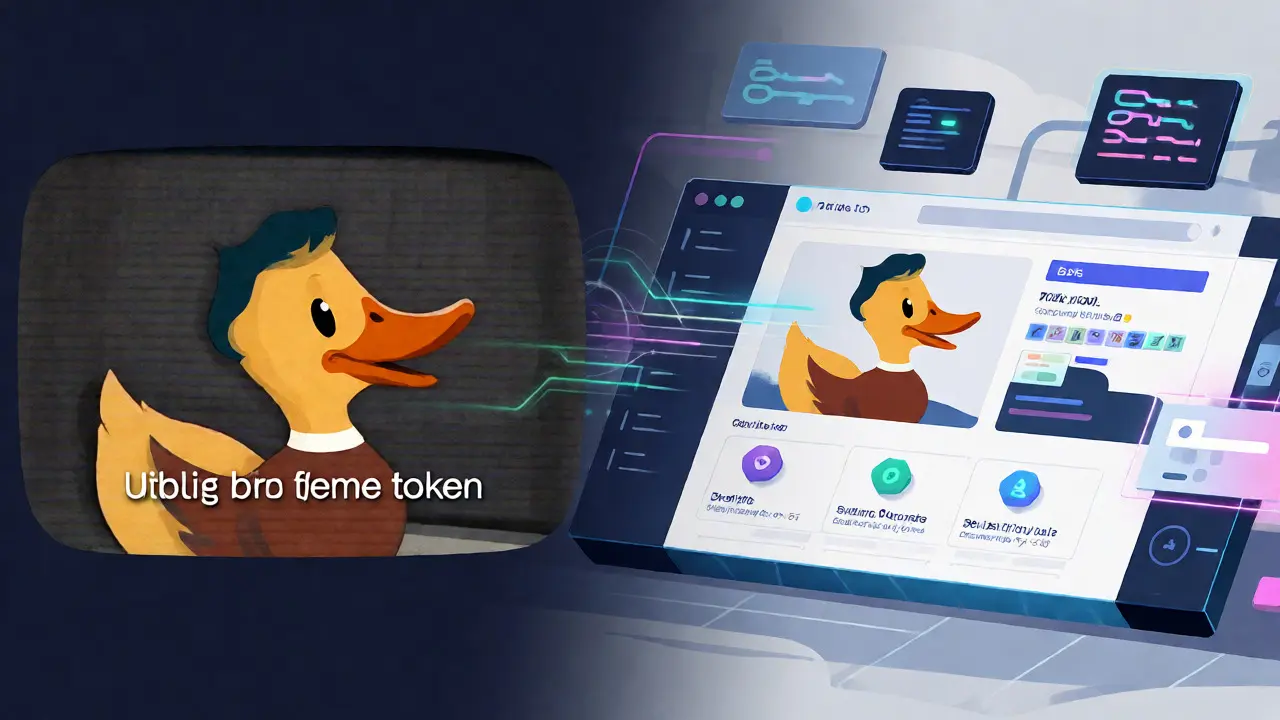
Remember that viral YouTube video where a duck gets pummeled with grapes while begging for bread? That absurd, nostalgic energy is the entire foundation of Didi Duck (DIDID). It’s not just another random animal token; it’s a Solana-based meme cryptocurrency that leans heavily into internet culture from over a decade ago. But here’s the twist: the project claims to be evolving from a pure joke into a "utility meme token." If you’re wondering whether this micro-cap asset has any legs or if it’s just floating in the deep end of the Solana ecosystem, you need to look past the cute mascot.
The Origin Story: From Pump.fun to Utility Claims
Didi Duck didn’t start life with a whitepaper full of complex blockchain jargon. It launched on Pump.fun, the Solana platform known for launching thousands of meme coins daily. The narrative is simple: tap into the nostalgia of "The Duck Song," which went viral around 2011. The developers position DIDID as a "15-year-old duck" that has finally grown up enough to handle business.
Unlike many copycat tokens that mimic Doge or Shiba Inu, Didi Duck markets itself on being "not a copy of a copy." The branding uses playful language about moving from "begging for grapes" to "having all the grapes you’ll ever need." While this sounds like marketing fluff, it serves a specific purpose in the crowded memecoin market: differentiation through cultural recognition rather than technical innovation. As of mid-2026, the project still lacks a detailed technical roadmap, but its presence on major aggregators suggests it has maintained enough community interest to stay listed.
Tokenomics and Supply Structure
If you’re looking at the numbers, Didi Duck follows a standard fixed-supply model common among Solana SPL tokens. The maximum supply is capped at 1 billion DIDID, with approximately 998.36 million currently circulating. This near-total circulation means there isn’t much hidden inflation waiting to dilute holders’ value-a common trap in newer projects.
However, data discrepancies exist. While most trackers like CoinGecko and CoinMarketCap report the ~998 million figure, some wallet interfaces like Phantom have shown significantly lower total supplies in certain snapshots. This likely reflects how different platforms index wrapped versions or partial subsets of the token. For practical purposes, assume the 1 billion cap is real, but verify your specific holding contract address.
| Metric | Value | Context |
|---|---|---|
| Circulating Supply | ~998.36 Million | Near max supply; low dilution risk |
| Max Supply | 1 Billion | Fixed cap typical of meme coins |
| Current Price Range | $0.000065 - $0.000067 | Micro-cap valuation |
| Market Cap | ~$65,000 - $66,500 | Extremely small compared to top memes |
| All-Time High (ATH) | $0.001404 | Down ~95% from peak |
| Primary Chain | Solana | Fast, low-cost transactions |

Where to Buy and Trade DIDID
You won’t find Didi Duck on every exchange. It’s primarily traded on decentralized exchanges (DEXs) within the Solana network. Raydium is the main venue, hosting the DIDID/SOL pair. Liquidity pools here are thin-often hovering around $70,000-which means buying or selling large amounts can cause significant price slippage.
Some centralized exchanges (CEXs) list it for tracking or limited trading. Bybit, LBank, and Crypto.com provide data feeds, and LBank even allows spot trading. However, volumes on these CEXs are often negligible, sometimes under $200 per day. This lack of volume is a double-edged sword: it keeps the token accessible to retail traders but makes it vulnerable to manipulation by a single whale.
To buy DIDID directly, you typically need:
- A Solana-compatible wallet like Phantom.
- Funds in SOL to swap for DIDID.
- Access to Raydium or Jupiter Aggregator.
Is There Real Utility?
This is the big question. Most sources describe Didi Duck as a "utility meme token," but what does that actually mean? Currently, public documentation is sparse. Unlike established DeFi projects with staking rewards, governance voting, or yield farming mechanisms clearly defined in a whitepaper, DIDID’s utility seems aspirational.
LBank describes it as transitioning into a "utility-focused ecosystem," implying future features might include community-driven applications or services. But as of September 2026, no major smart contract utilities beyond basic transferability are widely documented. The value proposition remains largely speculative, driven by social media hype and the hope that the team will deliver on their promise of adding functional layers to the meme.
Risks and Volatility Warning
Let’s be clear: Didi Duck is a high-risk asset. Its market cap fluctuates wildly between $65,000 and $286,000 depending on the source and date, reflecting extreme volatility. The token is down over 95% from its all-time high of $0.001404. This isn’t unusual for meme coins, but it highlights the potential for further downside.
Key risks include:
- Liquidity Risk: With daily volumes often below $200, exiting a position quickly without moving the price is difficult.
- Data Discrepancies: Different platforms report varying supply and price data, requiring careful verification.
- Lack of Fundamental Analysis: No institutional analysts cover DIDID. Decisions rely on community sentiment and social trends.
Final Verdict
Didi Duck is a classic example of Solana’s fast-moving meme coin culture. It leverages strong nostalgia and a distinct brand identity to stand out in a sea of dog and cat tokens. However, it remains a micro-cap speculative play with minimal proven utility. If you enjoy the thrill of early-stage memecoins and understand the risks of thin liquidity, DIDID offers a niche entry point. Just don’t expect it to replace Bitcoin or even larger memes like WIF anytime soon.
What is the ticker symbol for Didi Duck?
The ticker symbol for Didi Duck is DIDID. It is an SPL token built on the Solana blockchain.
Is Didi Duck a good investment?
It is a high-risk, speculative investment. With a market cap under $100,000 and low trading volume, it is highly volatile. Only invest money you can afford to lose entirely.
Where can I buy DIDID?
You can buy DIDID primarily on Raydium (a Solana DEX). Some centralized exchanges like LBank also offer trading pairs, though liquidity is very low.
Does Didi Duck have a utility token function?
The project markets itself as a "utility meme token," aiming to add functional Web3 features. However, concrete utility details are limited in public documentation as of 2026.
Why is the supply number different on Phantom?
Data discrepancies occur because wallets may display wrapped versions or partial subsets of the token. Major aggregators confirm a circulating supply of approximately 998 million DIDID.

Write a comment