
You’ve probably seen the ticker MORTY flash across your social media feed or a crypto tracker. It’s another attempt to cash in on the massive popularity of the animated series "Rick and Morty." But here is the hard truth: most tokens with this name are high-risk, low-utility speculative assets. Before you throw money at it, you need to understand exactly what you are buying, because the data suggests this is not a stable investment.
Morty (MORTY) is primarily defined as a small-cap meme cryptocurrency operating on the Solana blockchain. Launched in 2024, it aims to capture the chaotic energy of the show’s protagonist. However, unlike major cryptocurrencies with clear use cases, MORTY relies entirely on community hype and trading momentum. This guide breaks down the tokenomics, the confusing market data, and the significant risks involved.
The Basics: What Is the Morty Token?
At its core, MORTY is an SPL token. This means it follows the standard format for digital assets on the Solana network. Solana is known for its speed-transactions settle in under a second-and low fees, often costing less than a penny. This makes it a popular playground for meme coins, where traders want to buy and sell quickly without paying high Ethereum gas fees.
However, "Morty" is not just one token. The crypto space is littered with copycats. When researching MORTY, you will likely encounter three distinct entities:
- MORTY (Solana): The primary subject of this article. It launched in 2024 via platforms like pump.fun and trades on decentralized exchanges like Raydium.
- Rick And Morty (RNM): A separate token that has appeared on aggregators like Crypto.com and Binance Web3 Wallet. Do not confuse RNM with MORTY.
- Rick&Morty (Unverified): Various unverified tokens listed on explorers like Phantom, often with negligible market caps.
If you are looking at the specific ticker MORTY on Solana, you are dealing with a speculative asset that has no official licensing from Warner Bros. Discovery, the owners of the intellectual property. This lack of legal backing adds a layer of risk that regulated investments do not have.
Tokenomics and Supply Confusion
One of the biggest red flags for any new investor is inconsistent data. For MORTY, the numbers regarding supply vary wildly depending on which source you trust. This discrepancy can drastically change how you value the token.
| Data Point | Coinbase Listing | Early Launch Reports (YouTube/DexTools) |
|---|---|---|
| Total Supply | 999,994,328 (~1 Billion) | 99,990,000 (~100 Million) |
| Circulating Supply | ~998.6 Million | ~99.99 Million |
| Market Cap (Recent) | ~$41,420 | $1,000,000 (at peak launch hype) |
| Price Context | $0.000041 | $0.0097 (approx.) |
Why the difference? Early reports from launch videos claimed a supply of roughly 100 million tokens, which is common for quick launches on pump.fun. Later listings on Coinbase show a supply near 1 billion. This could indicate a token migration, a decimal adjustment error in reporting, or simply two different contracts being tracked. If you hold 1 million MORTY, its value changes significantly depending on whether the total supply is 100 million or 1 billion. Always check the contract address directly on a block explorer like Solscan to verify the decimals and total supply yourself.
Price History: The Boom and Bust Cycle
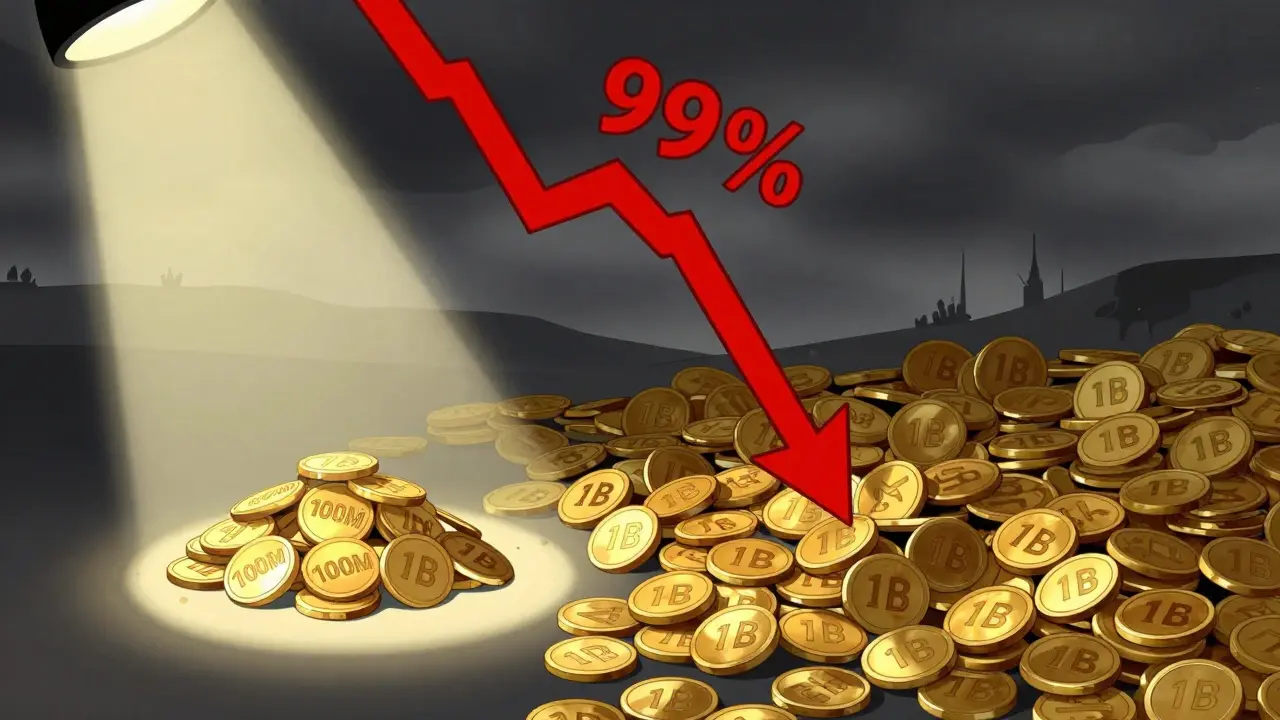
Meme coins live and die by attention. MORTY followed the classic hyper-volatile pattern. In its first 24 hours after launching on Raydium, promotional videos claimed the token saw gains of over 11,500%. The market cap reportedly hit $1 million, with daily trading volumes exceeding $45 million. That sounds impressive, but context matters. A $45 million volume against a $1 million market cap means the entire pool of money was traded back and forth dozens of times in a single day. This is pure speculation, not organic growth.
Fast forward to mid-2026, and the picture looks very different. Current data from trackers like LiveCoinWatch shows MORTY trading at near-zero values, with some records indicating prices in the range of $0.0000000009. Even the more optimistic Coinbase listing shows a market cap of around $41,000. This represents a collapse of over 99% from its initial hype peak. For latecomers, the "floor" price is extremely low, and liquidity is thin. You might find it difficult to sell large amounts without crashing the price further.
How to Buy MORTY on Solana
If you still decide to take the risk, the process is technical but straightforward if you are familiar with DeFi (Decentralized Finance). You cannot buy MORTY on major centralized exchanges like Coinbase Pro or Binance easily; you must use a decentralized exchange (DEX).
- Get a Solana Wallet: Download a wallet like Phantom or Solflare. Secure your seed phrase offline. Never share it.
- Fund Your Wallet: Buy SOL (Solana’s native token) on a reputable exchange and send it to your wallet address.
- Connect to a DEX: Go to a platform like Raydium or use an aggregator like Jupiter. Connect your wallet.
- Find the Contract Address: Search for MORTY. Be extremely careful to paste the correct contract address. There are many fake tokens with similar names designed to steal funds.
- Swap SOL for MORTY: Set your slippage tolerance. Because meme coins are volatile, you may need to set slippage between 1% and 10% to ensure the transaction goes through. Confirm the swap.
Note: Liquidity pools for MORTY are small. If you try to buy too much at once, you will pay a high "slippage" fee, meaning you get fewer tokens than expected. Start with small amounts.
Key Risks You Must Understand
Investing in MORTY is not investing in technology; it is gambling on sentiment. Here are the specific dangers:
- No Utility: MORTY does not offer staking rewards, governance rights, or access to a product. Its value is derived solely from other people believing they can sell it for more later.
- Intellectual Property Risk: The token uses the likeness and name of a character owned by Warner Bros. Discovery. While enforcement is slow in crypto, the project has no legal right to use this branding. Exchanges may delist it, or legal action could freeze development.
- Liquidity Traps: With a market cap in the tens of thousands, there isn’t enough money in the pool to support large withdrawals. If everyone tries to sell at once, the price drops to zero instantly.
- Rug Pull Potential: Although some early reports claimed liquidity was "locked," this is often unverified. Developers of anonymous meme coins can sometimes withdraw all liquidity, leaving holders with worthless tokens.
Is MORTY Worth It in 2026?
From a financial perspective, the answer is generally no for anyone seeking stability or growth. The token has already experienced its massive speculative spike and subsequent crash. It now sits in the "zombie" phase of meme coin life cycles-low volume, low interest, and high risk.
Compare MORTY to established Solana memes like BONK or dogwifhat (WIF), which have built ecosystems, integrations, and larger communities. MORTY lacks these foundations. Unless there is a sudden viral resurgence on social media, the token is likely to remain a micro-cap asset with limited upside.
Treat MORTY as entertainment money only. Only invest what you are comfortable losing entirely. If you are interested in the Solana ecosystem, consider learning about its underlying technology or investing in SOL itself, rather than betting on unlicensed fan tokens.
Is Morty (MORTY) a legitimate cryptocurrency?
MORTY is a valid SPL token on the Solana blockchain, meaning it exists technically. However, it is a speculative meme coin with no official licensing, no utility, and high volatility. It is not "legitimate" in the sense of being a regulated or fundamentally backed investment.
What is the difference between MORTY and RNM?
They are completely different tokens. MORTY is a Solana-based meme coin. RNM (Rick And Morty) is a separate token that has been listed on platforms like Crypto.com. They have different contract addresses, supplies, and price histories. Do not confuse them.
Can I buy MORTY on Coinbase?
While Coinbase may list price tracking data for MORTY, you typically cannot buy it directly on the main Coinbase exchange interface. You usually need to use a decentralized exchange (DEX) like Raydium or Jupiter via a Solana wallet.
Why is the MORTY price so low?
The price is low due to extreme dilution (high supply) and loss of investor interest after the initial hype cycle ended. Most meme coins drop 99%+ from their peak. Low price does not mean "cheap"; it reflects low demand and high supply.
Is there a whitepaper for Morty?
No. Like most meme coins launched on platforms like pump.fun, MORTY does not have a formal whitepaper, roadmap, or documented team. It relies entirely on community sentiment and marketing.

Write a comment