
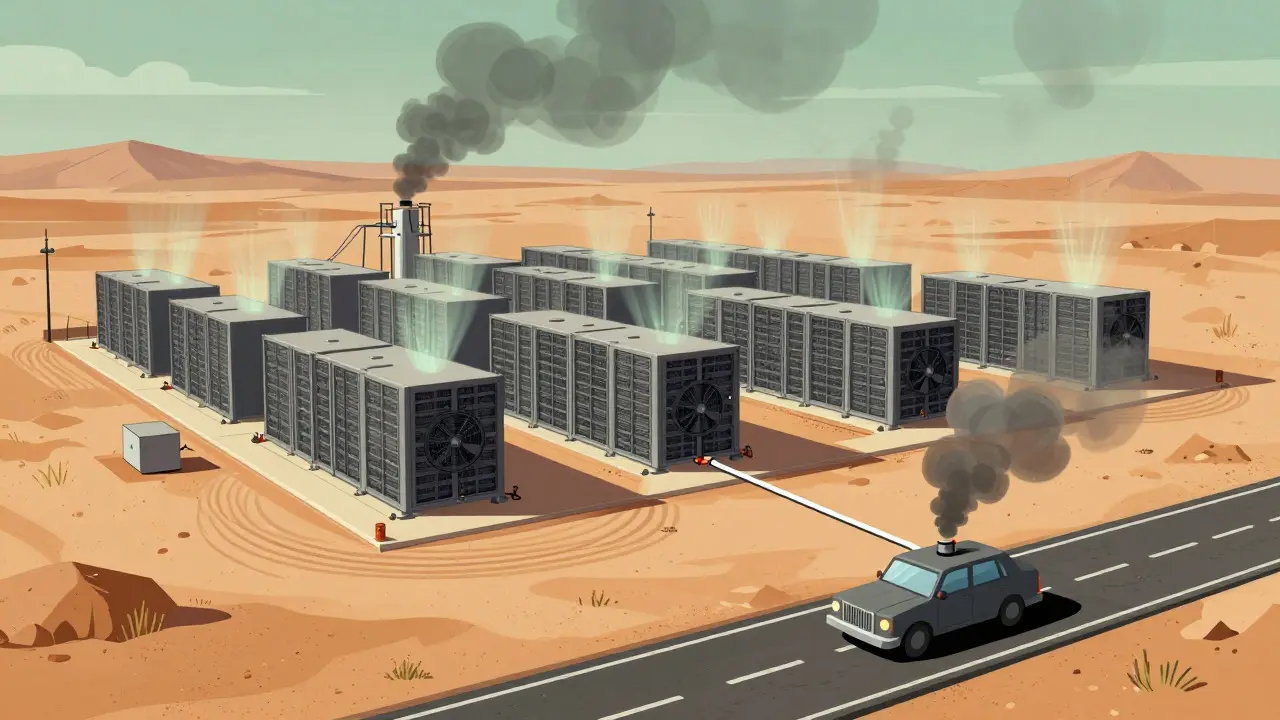
Imagine driving a gas-powered car for 1,600 kilometers. That is roughly the amount of carbon dioxide emitted by a single Bitcoin transaction, according to the Cambridge Centre for Alternative Finance's 2025 report. For many people, this number feels abstract until you realize that Bitcoin mining consumes an estimated 150 terawatt-hours (TWh) of electricity annually, comparable to the total energy usage of Mexico and Italy combined. As the global cryptocurrency market hit $2.87 trillion in early 2025, the question is no longer just about price charts or investment returns. It is about how our digital money shapes the physical world around us.
The environmental cost of cryptocurrency is not a one-size-fits-all story. It depends heavily on where the mining happens, what power source fuels it, and which consensus mechanism the network uses. While critics point to massive fossil fuel consumption, proponents highlight rapid shifts toward renewable energy. Understanding these dynamics helps you make informed decisions, whether you are an investor, a developer, or simply someone concerned about climate change.
Key Takeaways
- Bitcoin’s Carbon Footprint: Each Bitcoin transaction emits approximately 672 kg of CO₂, driven primarily by the energy-intensive proof-of-work consensus mechanism.
Bitcoin Mining Electricity Mix (2025 CCAF Report) Energy Source Percentage Renewables 43% Natural Gas 38% Nuclear 10% Coal 9% - Ethereum reduced its energy consumption by 99.95% after switching to proof-of-stake in September 2022, offering a clear alternative to high-energy models.
- Local impacts include noise pollution and air quality issues; a Harvard study linked large U.S. mines to increased exposure to harmful PM2.5 particles.
- The industry is shifting: 58.7% of major mining firms have committed to net-zero operations by 2030, but regulatory hurdles remain significant.
The Energy Behind the Numbers
To understand the environmental impact, we first need to look at how blockchain networks secure their data. Bitcoin relies on proof-of-work, a system where miners compete to solve complex mathematical puzzles using powerful computers. This process requires immense amounts of electricity. In 2025, the Cambridge Centre for Alternative Finance surveyed 49 major mining firms representing nearly half of the network's hashrate. Their findings show that while 43% of the power comes from renewables, 38% still relies on natural gas and 9% on coal.
This mix matters because the "cleanliness" of Bitcoin depends entirely on the grid it plugs into. In countries with abundant hydroelectric power, like Canada and parts of Scandinavia, the carbon footprint per coin is significantly lower. However, in regions where fossil fuels dominate the grid, the emissions spike. The International Monetary Fund warns that if current trends continue, cryptocurrency and AI operations could consume 2% of global electricity by 2027, contributing 1% to total global emissions. This isn't just a theoretical risk; it's a measurable strain on infrastructure.
Air Pollution and Local Health Effects
It’s easy to focus on global carbon numbers, but the local effects can be just as severe. A March 2025 study published in Nature Communications led by researchers from Harvard T.H. Chan School of Public Health shed light on this hidden cost. They analyzed the 34 largest Bitcoin mines in the United States between August 2022 and July 2023. These facilities consumed 32.3 TWh of electricity, which is 33% more than the annual consumption of Los Angeles.
Here’s the critical finding: 85% of the increased electricity demand from these mines came from fossil fuel power plants. This shift didn’t just add carbon to the atmosphere; it exposed millions of nearby residents to higher levels of fine particulate matter (PM2.5). Long-term exposure to PM2.5 is linked to cancer, heart disease, and dementia. For communities in Texas and other mining hubs, the constant hum of cooling fans-often reaching 70-80 decibels-has become a daily reality, leading to local ordinances that threaten mining operations.

Proof-of-Stake: The Low-Energy Alternative
Not all cryptocurrencies share Bitcoin’s heavy environmental burden. The biggest divergence in the industry happened in September 2022 when Ethereum completed "The Merge." This upgrade switched the network from proof-of-work to proof-of-stake. Instead of burning energy to solve puzzles, validators lock up (stake) their coins to secure the network. The result? A 99.95% reduction in energy consumption.
This technological shift proves that high security doesn’t have to come at a high environmental cost. Today, many newer blockchains adopt proof-of-stake by default. However, Bitcoin remains resistant to change due to its deeply entrenched community preference for the security model provided by proof-of-work. This creates a split in the market: investors seeking low-carbon assets often gravitate toward Ethereum and similar networks, while Bitcoin holders must accept a larger footprint or rely on offsets.
| Feature | Proof-of-Work (Bitcoin) | Proof-of-Stake (Ethereum) |
|---|---|---|
| Energy Consumption | High (~150 TWh/year) | Very Low (<0.1 TWh/year) |
| Hardware Requirement | ASIC Miners | Standard Computer + Stake |
| Carbon Footprint per Tx | ~672 kg CO₂ | <0.01 kg CO₂ |
| Security Model | Computational Power | Economic Stake |
Water, Land, and Noise: Beyond Carbon
We often talk about carbon, but environmental impact includes water usage and land disturbance. A 2023 study by the United Nations University Institute for Water, Environment and Health evaluated Bitcoin’s footprint across 76 nations. It revealed significant water footprints, particularly in arid regions where mining farms use water for cooling systems. Additionally, the construction of large-scale mining facilities often requires clearing land, disrupting local ecosystems.
Noise pollution is another frequently overlooked issue. In Texas, communities near mining sites have reported a constant, low-frequency hum from industrial cooling fans. This isn't just annoying; it affects sleep quality and mental well-being. As a result, some local governments have introduced regulations limiting operating hours or requiring sound-dampening technology. For smaller operators, upgrading to immersion cooling systems-which submerge servers in liquid to reduce heat and noise-can cost around $15,000 per server rack, creating a financial barrier to entry for sustainable practices.

The Shift Toward Green Mining
Despite the challenges, the industry is moving. The 2025 CCAF report shows that the renewable energy mix for Bitcoin mining has risen to 52%, up from 39% in 2022. This growth is driven by strategic relocations to areas with surplus renewable energy, such as wind and solar farms in remote locations. Companies like Marathon Digital and Riot Platforms are leading the charge, with Marathon targeting 100% carbon-neutral operations by 2027.
Another innovative approach is flare gas capture. In oil-rich regions, methane gas is often burned off as waste. Mining companies now capture this gas to power their operations, turning a pollutant into a resource. This method allows miners to operate with a much lower net carbon impact while utilizing existing infrastructure. However, scaling these solutions requires significant capital. CleanSpark, for example, invested $220 million in 2024 to connect its Texas operations to solar farms. For the average investor, this means that "green" labels on mining companies should be verified through independent reporting frameworks, such as those adopted by the Bitcoin Mining Council.
Regulatory Pressures and Future Outlook
Government regulators are taking notice. The European Union’s MiCA regulation, effective June 2024, includes environmental impact reporting requirements. According to Deloitte’s 2025 compliance survey, 78% of EU-based exchanges struggled to implement these rules, highlighting the complexity of tracking true environmental performance. Meanwhile, Kuwait banned mining operations in 2025 due to excessive strain on its power grid, showing how local infrastructure limits can dictate policy.
Looking ahead, the International Monetary Fund projects that cryptocurrency mining could consume 3-4% of global electricity by 2030 under current technological paradigms. Climate economists warn that without fundamental changes to consensus mechanisms or widespread adoption of clean energy, the environmental costs will become increasingly unsustainable. Yet, there is hope. If mining continues to utilize stranded renewable energy-power that would otherwise go to waste-it could paradoxically support the transition to a greener grid. The key lies in transparent reporting, efficient technology, and policies that align economic incentives with environmental stewardship.
Is Bitcoin really bad for the environment?
It depends on the energy source. If powered by fossil fuels, yes, it has a high carbon footprint. If powered by renewables or waste gas, the impact is significantly lower. Currently, about 52% of Bitcoin mining uses renewable energy, but local air pollution remains a concern in fossil-fuel-heavy regions.
How does Ethereum compare to Bitcoin in terms of energy use?
Ethereum uses far less energy. After switching to proof-of-stake in 2022, it reduced its energy consumption by 99.95%. A single Ethereum transaction emits negligible CO₂ compared to Bitcoin’s ~672 kg per transaction.
What is the main health risk associated with Bitcoin mining?
Air pollution, specifically increased exposure to PM2.5 particles. A Harvard study found that large US mines shifted local electricity demand to fossil fuel plants, raising pollution levels for nearby communities and linking to long-term health issues like heart disease.
Can I invest in "green" cryptocurrencies?
Yes. Look for networks using proof-of-stake (like Ethereum, Solana, or Cardano) or Bitcoin mining companies that publish verified renewable energy reports. Check for certifications or adherence to frameworks like the Bitcoin Mining Council’s voluntary reporting standards.
Will governments ban cryptocurrency due to environmental concerns?
Some regions have already restricted mining, like Kuwait in 2025. However, most governments are focusing on regulation and reporting rather than outright bans, especially as the industry moves toward cleaner energy sources. The EU’s MiCA law sets strict reporting requirements, signaling a path of oversight rather than prohibition.

Write a comment