
Buying cryptocurrency with Russian Rubles (RUB) feels like navigating a maze that changes its walls every few months. Since 2022, the landscape has shifted dramatically due to geopolitical events and banking restrictions. You can no longer just swipe your Sberbank card on any global exchange and expect it to work. However, the market has adapted. According to the Central Bank of Russia's 2024 Financial Stability Report, crypto transactions in Russia grew by 37.2% year-over-year, with nearly 19 million citizens now holding digital assets. The question isn't whether you *can* buy crypto, but rather which method fits your needs for speed, anonymity, or volume.
In this guide, we break down the three primary ways to convert RUB into crypto in 2026: instant card purchases, peer-to-peer (P2P) trading, and cash-based exchanges. We’ll look at specific platforms, real-world fees, and the critical safety checks you need to avoid losing money.
Quick Summary: Key Takeaways
- For Speed & Small Amounts: Use non-custodial services like ChangeNOW for instant card purchases (5-10 mins) without account creation.
- For Best Rates & Large Volumes: Use P2P trading on Bybit. Look for sellers with >95% completion rates and use Tinkoff (T-Bank) cards for smoother processing.
- For Cash & Local Support: Consider Bitbanker, which offers physical cash locations in Moscow, Dubai, and Bishkek, though fees are slightly higher.
- Safety First: Always verify buyer/seller reputation. Avoid state-owned banks like Sberbank for direct P2P transfers if possible, as they have higher rejection rates.
- Regulatory Context: KYC is mandatory for fiat transactions. Keep records for tax purposes, as regulations under Federal Law No. 115-FZ require compliance for transactions over $1,000.
Understanding the Current Landscape
The Russian crypto market operates differently than most other countries. Direct bank transfers to international exchanges are often blocked or frozen. Instead, the ecosystem relies on localized payment solutions and alternative banking channels. As of Q3 2025, major platforms process approximately $285 million in daily RUB volume through these adapted rails.
You need to understand two key concepts before starting:
- KYC (Know Your Customer): All reputable platforms requiring fiat input will ask for identification. This usually means a Russian passport and an INN (taxpayer ID number). Non-verified accounts face strict limits-often capped at 600,000 RUB per day. Verified accounts can handle up to 5,000,000 RUB daily.
- Bank Color Coding: In the P2P world, banks are color-coded based on reliability. Green typically indicates Sberbank (high volume but higher risk of holds), while Yellow represents Tinkoff (now T-Bank), which users report has a 92% successful transaction rate compared to Sberbank’s 87%.
Also, keep an eye on the Digital Ruble. Launched for public use in July 2025, it coexists with private cryptocurrencies. While it doesn’t replace Bitcoin or USDT, its infrastructure may eventually lower conversion costs by 35-50%, according to Deloitte Russia’s 2025 Fintech Report.
Method 1: Instant Card Purchases (Fastest)
If you want to buy crypto quickly and don’t mind paying a slightly higher fee, instant card purchases are your best bet. This method works like buying something online: you enter your card details, confirm the amount, and receive crypto in your wallet within minutes.
ChangeNOW is a leading service for this approach. It requires no account creation, which appeals to those prioritizing privacy. Transactions settle in an average of 5 minutes, with a maximum of 10 minutes. However, it supports only about 17 cryptocurrencies, so you’re limited to major coins like Bitcoin (BTC), Ethereum (ETH), and Tether (USDT).
Pros:
- No registration or KYC needed for small amounts.
- Extremely fast settlement times.
- User-friendly interface suitable for beginners.
Cons:
- Higher fees (1.5% to 3.9%).
- Limited coin selection.
- Lower transaction limits compared to verified P2P traders.
This method is ideal for topping up wallets for immediate use or testing the waters with smaller sums under 500,000 RUB.
Method 2: Peer-to-Peer (P2P) Trading (Best Rates)
P2P trading dominates the Russian market because it offers better exchange rates and higher limits. Platforms like Bybit act as escrow agents. You find a seller, send them RUB via bank transfer, and once they confirm receipt, the platform releases the crypto to your wallet.
Bybit processes over 247,000 active RUB liquidity providers. To start:
- Go to "Buy Crypto" > "P2P Trading".
- Select the "Sell" tab (you are selling RUB to buy crypto).
- Choose USDT (the most liquid stablecoin).
- Select RUB as the fiat currency.
- Filter by payment method (e.g., MIR card, Tinkoff, Sberbank).
Critical Safety Tips for P2P:
- Check Completion Rate: Only trade with sellers who have a completion rate above 95% and at least 50 completed orders. Reddit user u/MoscowTrader92 noted zero issues after 47 transactions using this filter.
- Avoid Chat Pressure: Never release crypto outside the platform’s chat. If a seller asks you to move communication to Telegram, it’s likely a scam.
- Match Bank Names: Ensure the name on your bank account matches your KYC profile exactly. Mismatches cause 41% of failed transactions.
P2P transactions take 10-30 minutes. Fees average 0.5-2.0%, making it cheaper than instant buys for larger amounts.
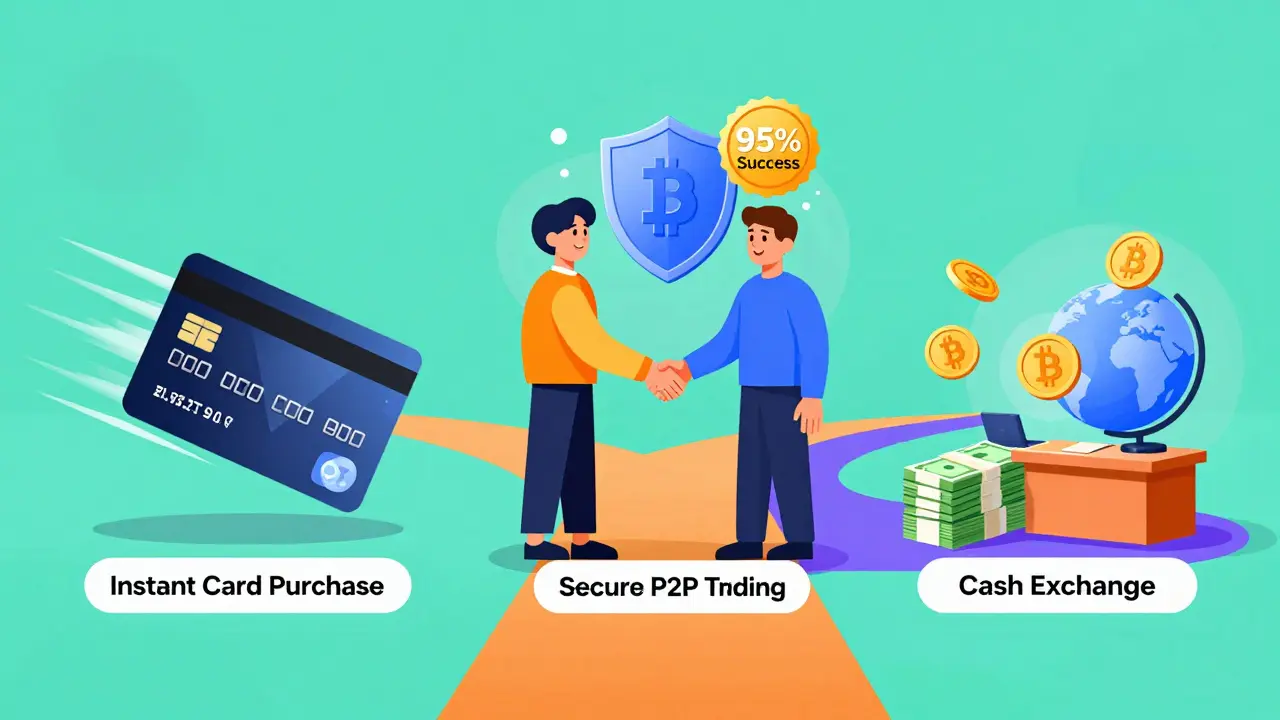
Method 3: Cash Exchanges & Local Banks (Highest Trust)
For those who prefer not to use digital banking or need to move large sums physically, local exchanges with cash offices are an option. Bitbanker is a prominent example, offering physical locations in Moscow, Dubai, and Bishkek.
Bitbanker integrates directly with 17 Russian banks and allows deposits and withdrawals via SWIFT and physical cash. A Trustpilot review from October 2025 highlighted a user withdrawing 1,200,000 RUB in Bitcoin at their Moscow office in just 15 minutes. This eliminates the anxiety of online payment reversals.
Pros:
- No reliance on volatile online banking systems.
- High trust factor with face-to-face interaction.
- Support for large volumes.
Cons:
- Requires full KYC verification.
- Geographically limited (must be near a branch).
- Slightly higher average fees (1.8%) compared to top-tier P2P deals.
Note that Bitbanker received 327 user complaints about withdrawal delays in Q3 2025, so always check current status before visiting.
Platform Comparison Table
| Platform | Type | Avg. Fee | Speed | KYC Required? | Best For |
|---|---|---|---|---|---|
| ChangeNOW | Instant Swap | 1.5% - 3.9% | 5-10 mins | No (for small amounts) | Speed & Privacy |
| Bybit | P2P Marketplace | 0.5% - 2.0% | 10-30 mins | Yes | Best Rates & Volume |
| Bitbanker | Local Exchange | ~1.8% | 15+ mins | Yes | Cash Transactions |
| Bitget Wallet | Non-Custodial | 2.5% | 5-15 mins | Yes | Beginners & Security |

Step-by-Step Guide: Buying USDT via Bybit P2P
Since P2P is the most common method, here is a detailed walkthrough for buying USDT with RUB on Bybit:
- Create & Verify Account: Sign up on Bybit and complete KYC. Upload your Russian passport and INN. Verification takes 12-48 hours.
- Navigate to P2P: Click "Buy Crypto" then "P2P Trading".
- Select Filters: Choose "Buy", select "USDT", and set currency to "RUB". Filter by your preferred bank (e.g., Tinkoff/T-Bank for yellow card).
- Choose a Seller: Look for a seller with >95% completion rate and >50 orders. Check recent reviews for mentions of quick releases.
- Enter Amount: Type the amount of RUB you want to spend. The system will show the estimated USDT you’ll receive.
- Make Payment: Transfer the exact amount to the seller’s provided bank details. Do not add comments like "Crypto" or "USDT" in the payment description-this can trigger bank blocks.
- Confirm & Wait: Click "Transferred, Notify Seller". Wait for the seller to confirm receipt. Once confirmed, USDT lands in your Bybit wallet.
Risks, Regulations & Future Outlook
While buying crypto is legal in Russia, the regulatory environment remains complex. Federal Law No. 115-FZ requires exchanges to implement Travel Rule compliance for transactions over $1,000 equivalent. This affects 37% of all RUB-to-crypto conversions. Failure to comply can result in frozen funds.
Taxation is another gray area. The Blockchain Association of Russia reported that 78% of users are confused about declaring crypto assets. Currently, there are no clear tax guidelines, but keeping detailed records of all transactions is wise. With Federal Bill No. 45877-8 under review, clearer tax treatments may emerge soon.
Looking ahead, the integration of the Digital Ruble with private crypto networks could reduce transaction costs significantly. Deloitte Russia projects 22% annual growth in crypto-to-fiat transactions through 2027, driven by remittance needs and inflation hedging. However, Gartner rates the ecosystem’s sustainability at 3.7/5, citing regulatory uncertainty that could disrupt operations if unfavorable legislation passes.
Frequently Asked Questions
Is it legal to buy cryptocurrency in Russia?
Yes, owning and buying cryptocurrency is legal in Russia. However, using crypto for payments within the country is restricted. You must comply with KYC regulations and declare assets for tax purposes if required by future laws.
Which bank card works best for P2P trading?
Tinkoff (now T-Bank) cards, marked as "Yellow" in P2P systems, have the highest success rate (92%). Sberbank (Green) is widely used but has a higher rate of transaction holds or rejections (87% success rate).
What are the transaction limits for unverified accounts?
Unverified accounts are typically limited to 600,000 RUB per day. Verifying your identity with a passport and INN increases this limit to 5,000,000 RUB per day on most major platforms.
Can I buy crypto with cash in Russia?
Yes, through local exchanges like Bitbanker, which have physical offices in Moscow, Dubai, and Bishkek. This method requires full KYC but avoids online banking risks.
How do I avoid scams on P2P platforms?
Only trade with sellers having >95% completion rates and >50 orders. Never communicate outside the platform’s chat. Ensure your bank account name matches your KYC profile exactly. Be wary of sellers asking for unusual payment methods.
Will the Digital Ruble replace Bitcoin?
No. The Central Bank of Russia states the Digital Ruble will operate alongside private cryptocurrencies. It is designed for domestic use, while private cryptos like Bitcoin remain popular for cross-border transactions and savings.

Write a comment