

Have you ever watched your trade get eaten alive by slippage? You click 'buy' on a centralized exchange, but the price jumps before the order fills. Or worse, you try to withdraw your profits from a DEX, only to realize the liquidity pool is too shallow, and the spread costs you more than the profit itself. It’s frustrating. It’s expensive. And for years, it has been the standard way of trading.
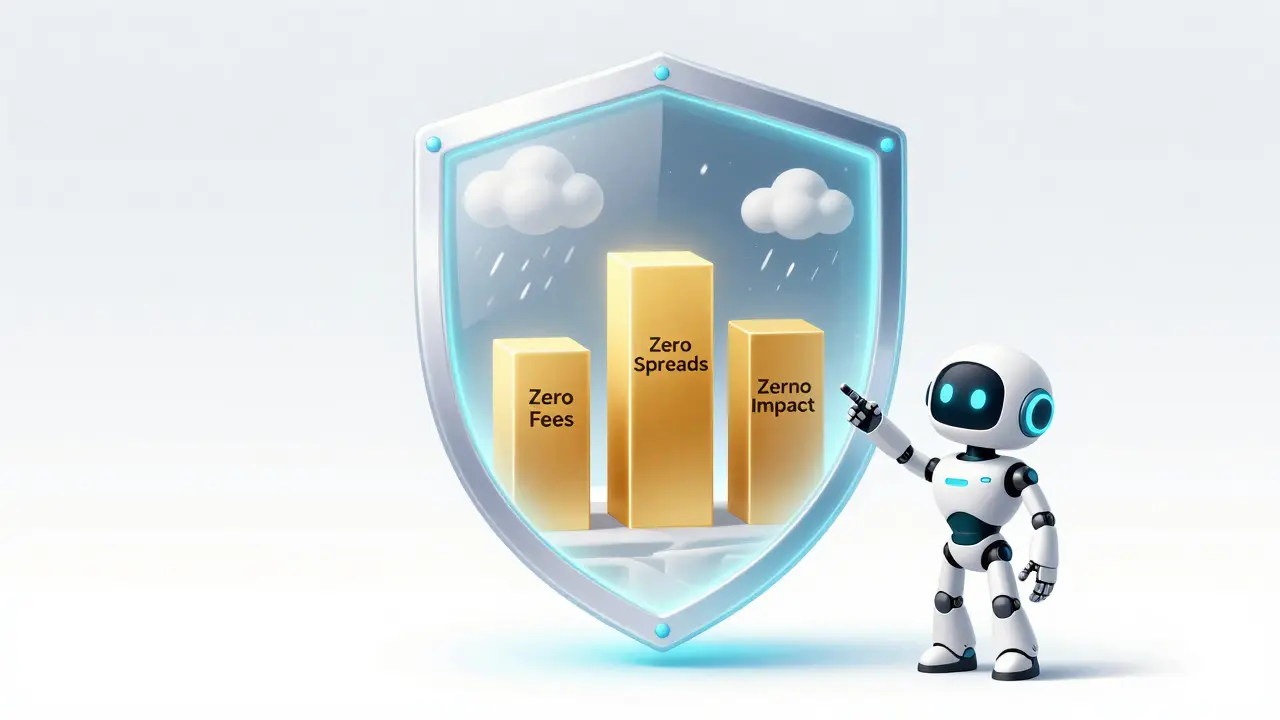
Enter FXDX, a decentralized derivatives exchange that promises zero trading fees, zero spreads, and zero price impact. Launched with the explicit goal of fixing the broken incentives in both Centralized Exchanges (CEXs) and existing Decentralized Exchanges (DEXs), FXDX claims to offer an institutional-grade experience without forcing you to trust a middleman with your funds. But does it actually work, or is it just another shiny new protocol promising the moon?
In this review, we break down how FXDX operates, whether its "triple-zero" model holds up under pressure, and if it’s safe enough for your capital. We’ll look at the tech, the risks, and how it stacks up against giants like dYdX.
What Is FXDX and How Does It Work?
FXDX is a non-custodial, permissionless platform designed specifically for trading derivatives, primarily perpetual futures contracts. Unlike traditional spot trading where you buy and hold an asset, derivatives allow you to bet on the future price of an asset using leverage. FXDX lets you use up to 30x to 50x leverage on these positions.
The core problem FXDX solves is the conflict between traders and liquidity providers (LPs). In most DEXs, LPs charge high fees to cover their risk, which eats into trader profits. FXDX flips this script. It uses a hybrid liquidity mechanism that combines traditional order books with Virtual Automated Market Maker (vAMM) pools. This setup allows for faster settlement-often in seconds-and theoretically eliminates the need for traders to pay opening or closing fees.
Here is the catch: if there are no fees for traders, who pays? The system relies on a unique reward structure. All generated fees on the platform are distributed to liquidity providers in stablecoins. This protects LPs from the volatility of the assets they provide, encouraging them to keep deep liquidity available. For you, the trader, this means deeper markets and less slippage when entering or exiting large positions.
The "Triple-Zero" Promise: Fees, Spreads, and Impact
The headline feature of FXDX is its "triple-zero" value proposition. Let’s dissect what this actually means for your wallet.
- Zero Trading Fees: Whether you open a $100 position or a $100,000 position, you pay nothing to open or close it. This is a massive deviation from CEXs like Binance or Coinbase, which charge maker/taker fees ranging from 0.02% to 0.1%. Over hundreds of trades, those savings add up significantly.
- Zero Spreads: The spread is the difference between the highest price a buyer is willing to pay and the lowest price a seller is willing to accept. In illiquid markets, spreads can be wide, meaning you start every trade at a loss. FXDX’s vAMM design aims to collapse this spread to near zero.
- Zero Price Impact: This is the holy grail for large traders. Usually, buying a large amount of an asset pushes the price up against you. FXDX claims its passive liquidity provider structure absorbs this impact, allowing you to execute large orders without moving the market price.
Is this sustainable? Critics argue that someone always pays for liquidity. FXDX offsets this through its tokenomics and the stablecoin rewards for LPs. However, as a user, you should monitor the depth of the order book. If liquidity dries up, even the best tech can’t prevent slippage.
Security and Technology: Trustless but Complex
When you trade on a CEX, you are trusting the company not to hack your funds or freeze your account. With FXDX, you are trusting code. The platform is non-custodial, meaning your assets remain in your own wallet until the moment of trade execution. You connect via Web3 wallets like MetaMask or WalletConnect. If the exchange goes bankrupt, your funds are still yours.
The security architecture relies heavily on its oracle pricing system. Oracles feed real-world price data into the blockchain. FXDX uses a "battle-tested outlier detection" system described as a "black box function." This function is designed to be secure even from the development team after deployment, preventing manipulation of prices during volatile market swings.
However, complexity brings risk. The smart contracts powering FXDX 2.0 are intricate. While the platform promotes its security features, independent audit reports from top-tier firms like CertiK or OpenZeppelin were not prominently featured in early documentation. Always check for recent audits before depositing significant capital. Smart contract bugs are the leading cause of losses in DeFi.
FXDX vs. The Competition: dYdX and Others
To understand where FXDX fits, we need to compare it to the current leader in decentralized derivatives: dYdX.
| Feature | FXDX | dYdX |
|---|---|---|
| Trading Fees | Zero (for traders) | Maker/Taker fees apply |
| Leverage | Up to 50x | Varies by pair (up to 20x-90x) |
| Liquidity Model | Hybrid Order Book + vAMM | Central Limit Order Book (on StarkEx L2) |
| Collateral Types | Multi-collateral (any asset in pool) | Specific collateral per market |
| User Interface | Institutional-grade UI | Clean, user-friendly DEX interface |
| Token Utility | Staking for fee discounts | Governance only |
dYdX is the established giant. It has higher volume, more established liquidity, and a proven track record. Its fees are low, but not zero. FXDX’s advantage lies in its multi-collateral functionality. On dYdX, you often need specific tokens to trade specific pairs. On FXDX, you can use any asset from the liquidity composition as collateral. This flexibility is huge for portfolio management-you don’t need to swap assets first; you can trade directly.
Another competitor to watch is GMX. GMX offers low fees and high yields for LPs, but it uses a different oracle-based pricing model that can suffer from impermanent loss. FXDX attempts to solve this by paying LPs in stablecoins, reducing their exposure to volatility.
Tokenomics and Staking Rewards
The FXDX Token has a fixed total supply of 999.86 million tokens, with approximately 38.39 million in circulation as of late 2025. This suggests a significant portion of the supply is reserved for future ecosystem growth, team allocations, or community incentives.
Why should you care about the token? Currently, staking FXDX tokens offers rewards. More importantly, the roadmap includes "fee discounts on staking." While traders currently pay zero fees, this feature may expand to other areas of the platform or provide additional yield benefits. Holding the token aligns you with the health of the protocol. If the platform grows, the demand for staking increases, potentially driving up the token price.
Be aware of the circulating supply ratio. With only ~4% of tokens in circulation, inflationary pressure could exist if large unlocks occur. Check the vesting schedule on platforms like TokenUnlocks before making long-term bets on the token price.

Risks and Considerations Before Trading
No investment is without risk. Here is what you need to watch out for with FXDX:
- Liquidity Depth: While the model promises zero impact, this depends on sufficient capital in the vAMM pools. During extreme market volatility, if LPs pull out, slippage can return. Always test with small amounts first.
- Smart Contract Risk: As a newer protocol, FXDX’s codebase has had less time to be stress-tested by the market compared to Uniswap or Aave. Bugs can happen.
- Regulatory Uncertainty: FXDX plans to support derivatives for stocks, bonds, and carbon credits. This ambitious scope attracts regulatory scrutiny. Derivatives trading is heavily regulated in jurisdictions like the US and EU. Ensure the platform complies with your local laws.
- Complexity: The interface is described as "institutional-grade." This is great for pros but might overwhelm beginners. Take time to learn the dashboard before leveraging 50x.
Final Verdict: Is FXDX Worth Your Time?
FXDX represents a bold attempt to fix the economic inefficiencies of decentralized trading. By eliminating fees for traders and protecting LPs with stablecoin rewards, it creates a theoretically superior environment for high-frequency and leveraged trading.
If you are an active trader frustrated by CEX withdrawal limits and DEX slippage, FXDX is worth exploring. Start with small positions to gauge the liquidity depth yourself. Use it for its multi-collateral flexibility-it’s a genuine innovation that saves you gas fees and time on asset swaps.
However, do not treat it as a set-and-forget vault. The lower circulating supply and newer status mean it carries higher risk than established platforms like dYdX. Diversify your exposure. Use FXDX for active strategies, and keep long-term holdings in more mature protocols or cold storage.
The future of derivatives is decentralized. FXDX is betting big on being the fastest and cheapest route there. Whether it wins depends on whether it can attract and retain the liquidity needed to keep those "zero" promises intact.
Is FXDX a centralized or decentralized exchange?
FXDX is a decentralized exchange (DEX). It is non-custodial, meaning you retain control of your funds in your Web3 wallet until the trade is executed. There is no central authority holding your assets.
Does FXDX really have zero fees?
Yes, for traders, FXDX employs a zero trading fee model. There are no opening or closing fees for positions. The cost of liquidity is covered by rewards paid to Liquidity Providers in stablecoins, rather than fees charged to traders.
What is the maximum leverage on FXDX?
FXDX offers leverage capabilities ranging from 30x to 50x on perpetual futures contracts. This allows traders to amplify their exposure to price movements, but also increases the risk of liquidation.
How does FXDX handle price feeds and security?
FXDX uses a robust oracle pricing system with outlier detection. It employs a "black box function" that secures pricing against manipulation, ensuring that prices are accurate even during high volatility. This helps prevent unfair liquidations.
Can I use multiple assets as collateral on FXDX?
Yes, FXDX supports multi-collateral functionality. You can use any asset from the liquidity composition as collateral to open positions. This provides greater flexibility compared to exchanges that require specific tokens for specific markets.
What is the total supply of the FXDX token?
The total fixed supply of FXDX tokens is 999.86 million. As of late 2025, the circulating supply was approximately 38.39 million, indicating that a significant portion of tokens are yet to be released into the market.

Write a comment