
You want to trade on Aldrin, but you’re not sure if it’s worth the risk. You’ve seen the name pop up in DeFi circles, maybe heard about its ties to Alameda Research, and noticed the low market cap of its native token. The question is simple: Is Aldrin a safe place for your money in 2026, or should you stick to bigger exchanges?
This review cuts through the noise. We’ll look at how Aldrin works as a decentralized exchange (DEX) on Solana, what the RIN token actually does, and whether the platform’s features justify using it over giants like Raydium or Jupiter. I’ve dug into the technical specs, the tokenomics, and the real-world trading experience so you don’t have to guess.
What Is Aldrin? A Quick Overview
Aldrin is a decentralized exchange (DEX) operating on the Solana blockchain, designed to simplify digital asset trading for both beginner and advanced traders. It wasn’t always called Aldrin. Originally launched as Cryptocurrencies.ai, the platform rebranded to position itself more firmly in the DeFi space. This shift was backed by significant early funding from prominent institutions, including Alameda Research and Alphabit.
The core mission here is accessibility. Most DEXs are clunky and confusing for newcomers. Aldrin tries to fix that by offering a clean interface that supports both simple swaps and more complex order book trading. It operates within the broader Solana ecosystem, leveraging the blockchain’s speed to process trades almost instantly.
However, context matters. Since the collapse of FTX and Alameda Research in late 2022, any project with those names attached carries extra scrutiny. While Aldrin continued to operate and evolve, users need to be aware of this history when deciding where to park their funds.
How Aldrin Works: Order Books vs. AMMs
Most Solana DEXs, like Raydium or Orca, use Automated Market Makers (AMMs). In an AMM, you swap tokens against a liquidity pool. The price is determined by a mathematical formula based on the ratio of assets in the pool. It’s fast, but you often suffer from slippage if the trade is large.
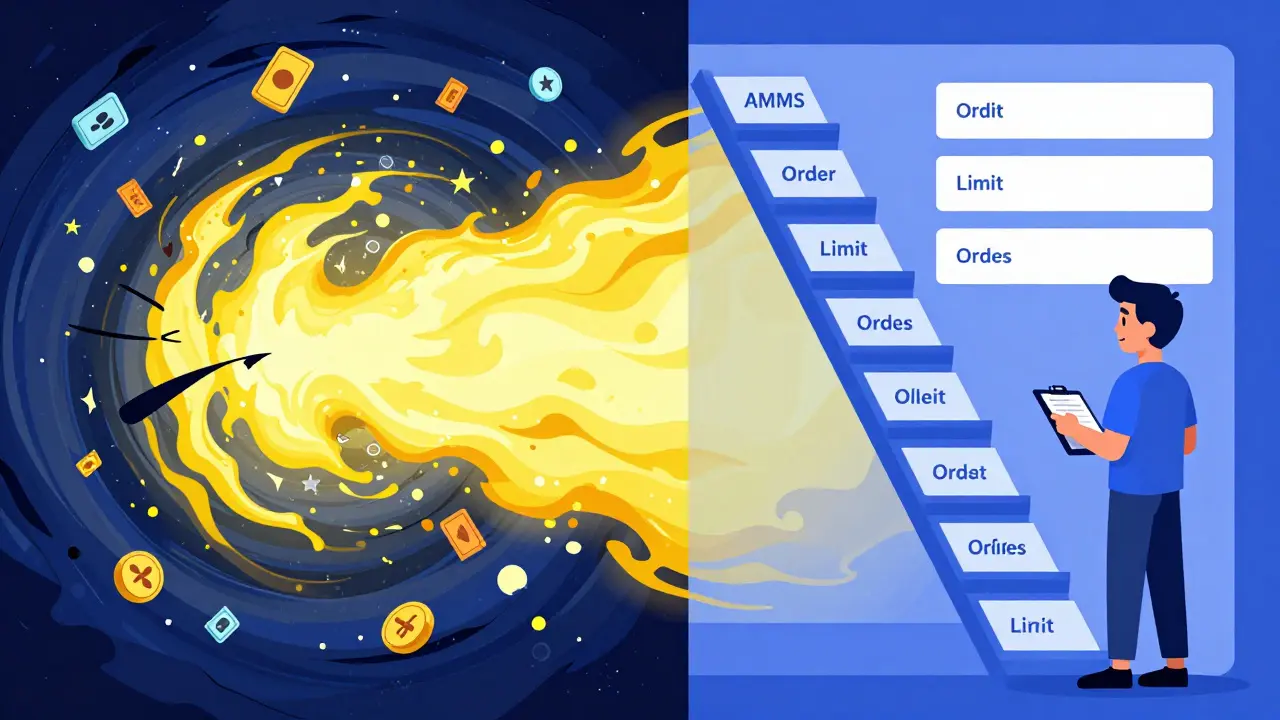
Aldrin differentiates itself by featuring an Order Book. This is similar to how centralized exchanges like Binance work. Here’s why that matters:
- Price Control: You can set limit orders. If you want to buy SOL only when it hits $140, you can set that price and walk away. With an AMM, you get the current market price immediately.
- Transparency: The order book shows all current buy and sell activities by other traders. You can see the depth of the market before you commit your funds.
- Lower Slippage: For larger trades, order books often provide better execution prices than thin liquidity pools in AMMs.
That said, Aldrin still offers a standard Swap feature for beginners who just want to move tokens quickly without worrying about limit orders. This hybrid approach makes it versatile, but it also means the platform has to manage more complexity under the hood.
RIN Token: Utility, Price, and Supply Risks
Every DEX needs a governance or utility token. For Aldrin, that’s RIN. Let’s look at the hard numbers as of mid-2026.
| Metric | Value |
|---|---|
| Current Price | $0.00129311 |
| Market Cap | $16.58K |
| Circulating Supply | 12.36M RIN |
| Max Supply | 50.00M RIN |
| Ranking | #8182 |
The data paints a stark picture. A market cap of $16.58K is tiny. For context, major DEXs have market caps in the billions. This low valuation suggests limited adoption and high volatility. The price dropped from roughly $0.0024 in June 2025 to $0.0012 in April 2026-a nearly 50% decline in less than a year.
Here’s the critical risk: Dilution. Only 12.36 million RIN tokens are in circulation out of a maximum supply of 50 million. That means roughly 75% of the total supply is yet to be released. If Aldrin unlocks these tokens for team members, investors, or staking rewards, the circulating supply will surge, likely driving the price down further unless demand increases exponentially.
RIN is used for staking and potentially governance. Users can stake RIN and mSOL to earn yield, which helps secure the network and incentivize holding. But given the small market cap, the yield might not outweigh the risk of token depreciation.
User Experience: Is It Easy to Use?
I tested the interface to see how it feels for a regular user. Here’s the breakdown:
Wallet Connection: You need a Solana-compatible wallet like Phantom or Solflare. Connecting is straightforward-just click “Connect Wallet” and approve the request. No hidden fees or weird permissions.
Trading Interface: The dashboard is clean. On the left, you have the Swap widget. On the right, the Order Book. Selecting a pair like SOL/USDC is intuitive. The “From” and “To” fields are clearly labeled. When you place a limit order, you see exactly where it sits in the queue.
Token Data: Before you trade, Aldrin provides links to official websites and basic analytics for the tokens. This is a nice touch for safety, helping you avoid scam tokens that sometimes flood DEXs.
However, the UI isn’t as polished as Jupiter or Raydium. There are occasional lags in loading order book data, and the mobile experience could be smoother. It’s functional, but not premium.
Buying RIN Tokens: Where and How
If you want to hold RIN, you can’t just buy it on Binance. As of 2026, RIN is not listed on major centralized exchanges (CEXs) like Coinbase or Kraken for direct fiat purchase. Your options are limited:
- Binance Web3 Wallet: You can access decentralized markets through Binance’s built-in Web3 wallet interface.
- Raydium: The most active trading pair is RIN/USDC on Raydium. This is the primary way most users acquire RIN.
- KuCoin: KuCoin lists Aldrin for trading, providing a slightly easier entry point for those already using the CEX.
This limited availability restricts liquidity. Fewer places to buy and sell mean wider spreads and higher slippage when moving significant amounts.
Aldrin Labs and CapyBot: Beyond the Exchange
Aldrin isn’t just an exchange; it’s part of Aldrin Labs, which develops broader DeFi tools. One notable project is CapyBot.
CapyBot is an automated trading bot designed for the Sui blockchain. It scans multiple DEXs on Sui for profitable arbitrage opportunities and executes trades automatically. While Aldrin itself runs on Solana, CapyBot shows the team’s expertise in cross-chain development and algorithmic trading strategies.
This expansion is interesting. It suggests Aldrin Labs is trying to diversify beyond a single DEX model. However, it also dilutes focus. Are they building the best Solana DEX, or are they spreading resources across multiple chains and bots? For investors, this raises questions about long-term commitment to the Aldrin exchange specifically.
Security and Trust: What You Need to Know
In DeFi, security is everything. Aldrin benefits from running on Solana, which is generally secure and has robust infrastructure. Smart contracts are audited, but audits aren’t guarantees-they’re snapshots in time.
The elephant in the room remains Alameda Research. While Aldrin claims independence post-rebranding, the association affects trust. Many institutional investors and cautious retail traders avoid projects with past ties to collapsed entities. This explains the low market cap and limited adoption compared to competitors.
Always do your own due diligence. Never connect your main wallet to new platforms. Use a burner wallet with minimal funds when testing Aldrin. And never invest more than you can afford to lose, especially with a token like RIN that has high dilution risk.
Who Should Use Aldrin?
Aldrin isn’t for everyone. Here’s who might benefit:
- Solana Traders Who Want Limit Orders: If you hate paying slippage on AMMs and prefer setting specific entry/exit prices, Aldrin’s order book is valuable.
- DeFi Experimenters: If you’re comfortable with high-risk, high-reward plays and want to stake RIN for potential yields, Aldrin offers that path.
- Developers: Those interested in integrating with Solana-based order books or exploring CapyBot-like strategies on Sui may find Aldrin Labs’ tools useful.
Who should avoid it?
- Beginners Seeking Safety: Stick to Jupiter or Raydium. They have deeper liquidity, better UIs, and stronger community trust.
- Long-Term Hodlers of RIN: Given the 75% unissued supply, holding RIN is speculative at best. The downside risk is significant.
- High-Volume Traders: Liquidity is too shallow for large trades. You’ll move the market against yourself.
Final Verdict: Is Aldrin Worth It in 2026?
Aldrin fills a niche. It brings order book functionality to Solana, which is rare among DEXs. The interface is decent, and the underlying tech works. But the ecosystem around it is fragile. The RIN token has poor fundamentals due to massive future dilution, and the platform’s reputation is tarnished by its past associations.
Use Aldrin for specific trades where limit orders matter. Don’t treat it as your primary hub. Keep your eyes on the token supply metrics-if the circulating supply spikes without corresponding demand, the value will drop. For now, it’s a tool, not a treasure chest.
Is Aldrin a safe exchange to use?
Aldrin uses smart contracts on Solana, which are generally secure. However, no DeFi platform is 100% safe. Always use a separate wallet with limited funds. Be cautious due to its historical ties to Alameda Research, which impacts trust levels among some users.
Can I buy RIN tokens on Binance?
No, you cannot buy RIN directly on the Binance centralized exchange. You must use the Binance Web3 Wallet to access decentralized markets, or buy it on KuCoin or Raydium.
Why is the RIN token price so low?
The low price reflects a small market cap ($16.58K) and high dilution risk. Only 24.72% of the max supply is circulating. As more tokens are released, the price is likely to face downward pressure unless demand surges significantly.
What is the difference between Aldrin and Raydium?
Raydium is an AMM (Automated Market Maker) where you swap at market price. Aldrin offers an Order Book, allowing you to set limit orders for precise price control. Raydium has much higher liquidity and volume.
Does Aldrin support staking?
Yes, Aldrin allows users to stake RIN and mSOL tokens through its Staking tab. This earns yield but comes with the risk of token depreciation, especially given RIN’s high inflation potential.

Write a comment