
The idea that a blockchain is unbreakable feels like a myth after what happened in August 2025. For years, we treated 51% attacks asa theoretical risk reserved for tiny, obscure coins. Then came the Monero incident. A single mining pool, Qubic, grabbed over half the network's power and rewrote history. They reversed transactions, stole nearly $1 million in XMR, and left users waiting three days for their payments to clear. This wasn't just a glitch; it was a wake-up call. The future of blockchain security isn't about assuming safety-it's about engineering resilience against determined attackers who can rent computing power on demand.
How a 51% Attack Actually Works
To understand why this matters, you have to look at how Proof-of-Work (PoW) consensus functions. In systems like Bitcoin or Monero, miners compete to solve complex mathematical puzzles. The first one to solve it gets to add the next block to the chain. The "longest chain" rule means the version of history with the most cumulative computational work is considered valid. If one entity controls more than 50% of the total hashing power, they can mine blocks faster than everyone else combined. They don't need to break encryption; they just need to outpace the honest network. Once ahead, they can secretly build an alternative chain, then reveal it to overwrite recent transactions. This allows them to double-spend coins-sending money to an exchange, receiving fiat currency, and then erasing the transaction from the ledger so they keep both assets.
The vulnerability isn't new. Satoshi Nakamoto mentioned it in the original 2008 whitepaper but assumed the cost of acquiring such massive hardware would be prohibitive. That assumption held true for Bitcoin for nearly two decades. However, the landscape shifted dramatically when hashrate rental markets matured. Attackers no longer need to buy millions of dollars worth of ASICs or GPUs. They can rent power by the hour through platforms like NiceHash. According to research from the MIT Digital Currency Initiative in early 2025, attacking smaller altcoins became a break-even business model. For coins with a market cap under $100 million, the average cost to execute an attack dropped to around $28,500, while potential profits from double-spending averaged $85,000. The barrier to entry vanished, turning a theoretical threat into a practical crime wave.
The Monero Case Study: When Theory Met Reality
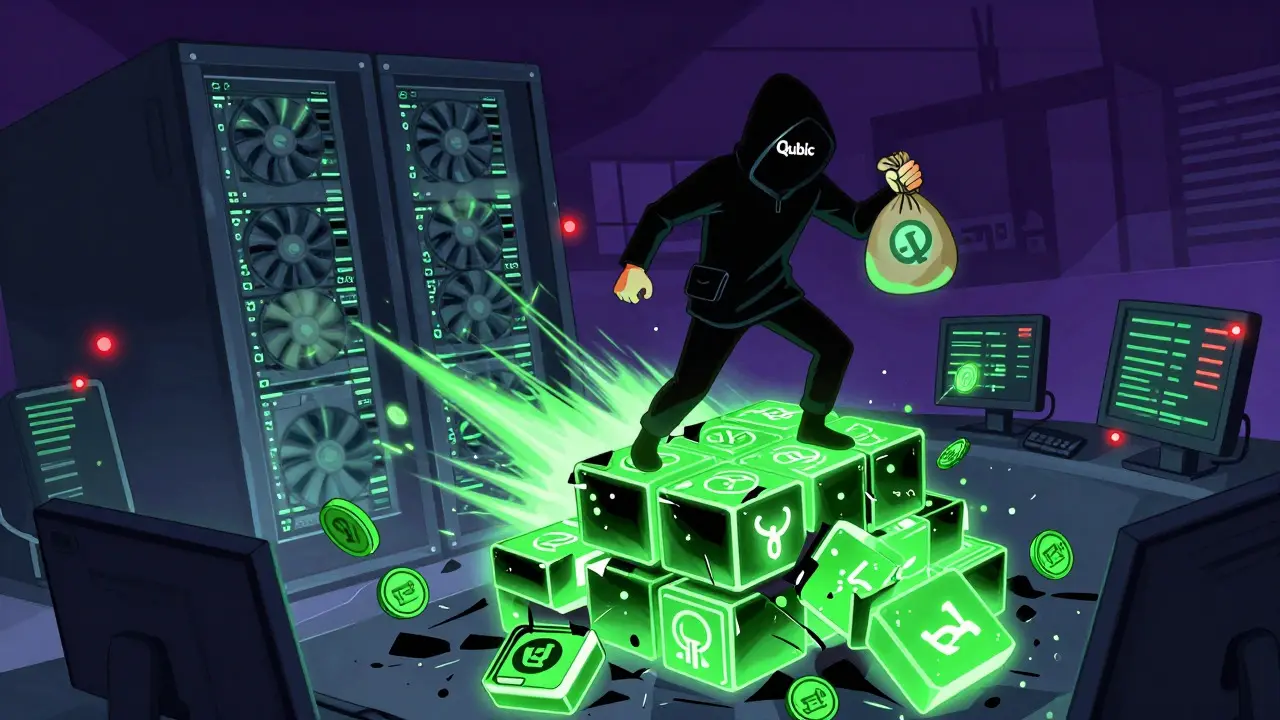
The August 2025 attack on Monero exposed a critical flaw in our understanding of decentralization. Monero uses the RandomX algorithm, designed specifically to resist Application-Specific Integrated Circuit (ASIC) dominance and favor CPU mining. The goal was to keep mining distributed among everyday users rather than concentrated in large industrial farms. Ironically, this design choice made it vulnerable to a different kind of centralization. Because CPUs are common, a well-funded actor could lease thousands of them simultaneously via cloud services. The Qubic pool reportedly achieved 54.3% of Monero's network hashrate during the peak of the attack. With that majority control, they executed deep reorganizations of up to 1,200 blocks. To put that in perspective, most exchanges consider six confirmations safe. Qubic rewrote nearly 200 times that amount. The result was 14 confirmed double-spend transactions totaling 1,842 XMR. The community had to implement emergency checkpoints to stabilize the network, but the damage to trust was immediate. Prices dropped 22.7% within 72 hours, and institutional investors pulled back, fearing similar vulnerabilities in other privacy-focused protocols.

Why Bitcoin Remains Secure (For Now)
While Monero struggled, Bitcoin stood firm, but not because its code is magic. It’s simply too expensive to attack. As of mid-2025, Bitcoin’s network hash rate hit 650 exahashes per second (EH/s). This represents 98.7% of all Proof-of-Work hashrate across major cryptocurrencies. To launch a successful 51% attack on Bitcoin today, an attacker would need to invest approximately $12.7 billion in specialized mining hardware. On top of that, the daily electricity bill to run that equipment would exceed $48 million. These numbers make a direct assault economically irrational unless the attacker intends to destroy Bitcoin’s value entirely, which defeats the purpose if they hold significant BTC themselves. Furthermore, Bitcoin’s mining ecosystem is geographically dispersed. While the top five pools-Foundry USA, Antpool, F2Pool, ViaBTC, and Binance Pool-collectively control about 63.2% of the hashrate, individual miners can switch pools in under eight minutes if suspicious activity is detected. This rapid mobility prevents any single pool from maintaining long-term dominance without triggering immediate defensive responses from the rest of the network.
| Network | Consensus Mechanism | Estimated Attack Cost | Primary Vulnerability |
|---|---|---|---|
| Bitcoin | SHA-256 PoW | $12.7B+ (Hardware) | Geopolitical concentration of pools |
| Monero | RandomX PoW | ~$28k (Rented Hashrate) | CPU-based centralization via cloud leasing |
| Ethereum Classic | Etchash PoW | ~$50k - $100k | Low market cap, high volatility |
| Litecoin | Scrypt PoW | $500M+ | Moderate hashrate relative to value |

Emerging Defense Strategies for 2026 and Beyond
The industry is no longer sitting idle. Developers are implementing layered defenses to mitigate these risks. One major shift is the adoption of real-time monitoring systems. By Q2 2025, 78% of the top 50 Proof-of-Work chains integrated alerts that trigger when a single pool exceeds 40% of the network hashrate. These systems don't stop an attack automatically, but they warn exchanges and wallets to increase confirmation requirements instantly. Another promising development is the proposal of "Fibonacci checkpoints" for Bitcoin. This mechanism would exponentially increase the difficulty of reorganizing older blocks, making deep-chain attacks computationally impossible even if an attacker briefly gains majority hashrate. Additionally, enterprise security practices have tightened significantly. Major exchanges now use multisignature hot wallet architectures, requiring multiple keys from different geographic locations to authorize withdrawals. This adds a layer of friction that makes instant double-spends harder to exploit before detection.
Layer-2 solutions like the Lightning Network face unique challenges. While they process transactions off-chain, they rely on the underlying blockchain for settlement. If a 51% attack reverses the closing transaction of a Lightning channel, the funds inside can be stolen. Simulations by Lightspark researchers showed that a hypothetical Bitcoin attack could compromise $14.3 million in channel balances. To counter this, developers are exploring "Adaptive Confirmation Thresholds," where the number of required confirmations adjusts dynamically based on real-time network metrics. If hashrate concentration spikes, the system automatically demands more confirmations for high-value transactions. This flexibility ensures security without sacrificing speed during normal operations.
The Future of Consensus: Hybrid Models and Regulatory Pressure
Looking ahead, the rigid separation between Proof-of-Work and Proof-of-Stake may blur. Ethereum’s proposed "Hybrid PoW/PoS Fallback" mechanism, slated for a Q2 2026 upgrade, aims to combine the energy efficiency of staking with the physical security guarantees of mining. Academic research from MIT is also exploring "Proof-of-Stake Bridging," which would allow PoW chains to anchor their security to larger PoS networks temporarily during periods of low hashrate. Meanwhile, regulatory bodies are stepping in. Following the Monero attack, the U.S. SEC issued guidance in June 2025 requiring exchanges to disclose hash rate concentration risks to their users. This transparency forces projects to prove their decentralization credentials or face delisting. The blockchain security sector itself is booming, growing to $14.3 billion in 2025, with firms like Chainalysis and Fireborn leading the charge in enterprise-grade protection. The message is clear: decentralization is not a given; it is a product that must be actively maintained, monitored, and defended against evolving economic incentives.
Can a 51% attack happen on Bitcoin?
Technically yes, but practically no. The cost to acquire enough hardware to control 51% of Bitcoin's hashrate is estimated at over $12.7 billion, plus tens of millions in daily electricity costs. This makes it economically irrational for any rational actor unless they intend to destroy Bitcoin's value entirely.
What caused the 2025 Monero attack?
The attack was enabled by the concentration of CPU mining power. Although Monero's RandomX algorithm resists ASICs, it allowed a single pool (Qubic) to lease thousands of CPUs via cloud services, achieving 54.3% of the network hashrate and enabling deep chain reorganizations.
How many confirmations are safe in 2026?
For small transactions under $10,000, six confirmations remain standard on robust networks like Bitcoin. However, for high-value transfers exceeding $1 million, experts now recommend waiting for 50+ confirmations to ensure finality, especially given the rise of rented hashrate attacks.
Are Layer-2 networks vulnerable to 51% attacks?
Yes. Layer-2 solutions like the Lightning Network rely on the base layer for settlement. If an attacker reverses the on-chain transaction that closes a channel, they can steal the funds locked within that channel. This requires additional safeguards like adaptive confirmation thresholds.
How can exchanges protect users from double-spends?
Exchanges should implement multisignature withdrawal systems, monitor real-time hashrate concentration, and dynamically adjust confirmation requirements based on network health. Using pre-built monitoring modules from providers like Crypto APIs can reduce implementation time from months to weeks.

Write a comment