

You’ve probably seen the videos. A tiny piglet, rescued from a difficult start, now living her best life with hundreds of thousands of fans watching every snuffle and trot. That’s Princess Petunia, a viral TikTok star who became an internet sensation after being rejected by her birth mother and finding a loving home. But here’s the twist: her fame didn’t just stop at cute videos. It spawned a cryptocurrency.
Enter Petunia (PETUNIA), a Solana-based memecoin launched to celebrate the piglet’s journey from rescue to stardom. If you’re wondering what this token actually is, how it works, and whether it’s worth your attention, you’re in the right place. We’ll break down the tech, the community vibe, the risks, and the reality behind this "joyful movement" in the crypto world.
The Story Behind the Token
Meme coins usually start with a joke, a dog, or a cat. Sometimes it’s a political figure or a random phrase that catches fire on Twitter. But PETUNIA is different. It’s built around a real-life narrative of resilience and cuteness. Princess Petunia gained over 100,000 followers on TikTok simply by being adorable and surviving against the odds. Her story resonated with people who love wholesome content in a digital space often dominated by cynicism.
The creators of the PETUNIA token decided to channel that positive energy into a digital asset. They positioned it not as a high-tech utility token with complex use cases, but as a "joyful movement." The goal? To create a community-driven celebration of positivity, internet culture, and, yes, pigs. It’s less about revolutionizing finance and more about leveraging the power of viral storytelling in the age of social media.
How PETUNIA Works Technically
Under the hood, PETUNIA isn’t magic. It’s a standard SPL token built on the Solana blockchain. This means it inherits all the technical characteristics of Solana, which is crucial for understanding its performance and cost.
- Speed: Solana can handle up to 65,000 transactions per second (TPS). For a memecoin where users might want to buy, sell, or trade quickly during hype cycles, this speed is a major advantage over slower networks like Ethereum.
- Cost: Transaction fees on Solana average around $0.00025. This makes microtransactions viable. You don’t need to spend hundreds of dollars to move a few tokens; the gas fees won’t eat up your entire portfolio.
- Compatibility: As an SPL token, PETUNIA works seamlessly with popular Solana wallets like Phantom and Solflare. It also integrates with decentralized exchanges (DEXs) like Raydium, allowing for peer-to-peer trading without intermediaries.
This infrastructure allows the token to support the fast-paced, low-stakes trading culture typical of memecoins. However, it’s important to remember that Solana has had its share of reliability issues. The network experienced a notable 15-hour downtime in February 2024. While rare, such outages can freeze trading and impact time-sensitive meme trades, so keep that risk in mind.
Market Performance and Volatility
If you’re looking at PETUNIA from an investment angle, you need to understand one thing: volatility is the norm. Memecoins are notorious for wild price swings driven by sentiment rather than fundamentals. Let’s look at the numbers.
| Metric | Value |
|---|---|
| Circulating Supply | ~997.8 million PETUNIA |
| Approximate Price | $0.000076 - $0.000094 USD |
| 24-Hour Volume | $222,391 USD (varies by source) |
| Market Cap | ~$75,000 - $93,000 USD |
| Ranking | #5955 among cryptocurrencies |
As of recent data, the token trades at fractions of a cent. Some sources report prices around $0.000076, while others show slightly higher figures near $0.000094. The market cap sits in the range of $75,000 to $93,000, indicating it’s still a relatively small player in the vast crypto ecosystem. Trading volumes fluctuate daily, reflecting the speculative nature of the asset.
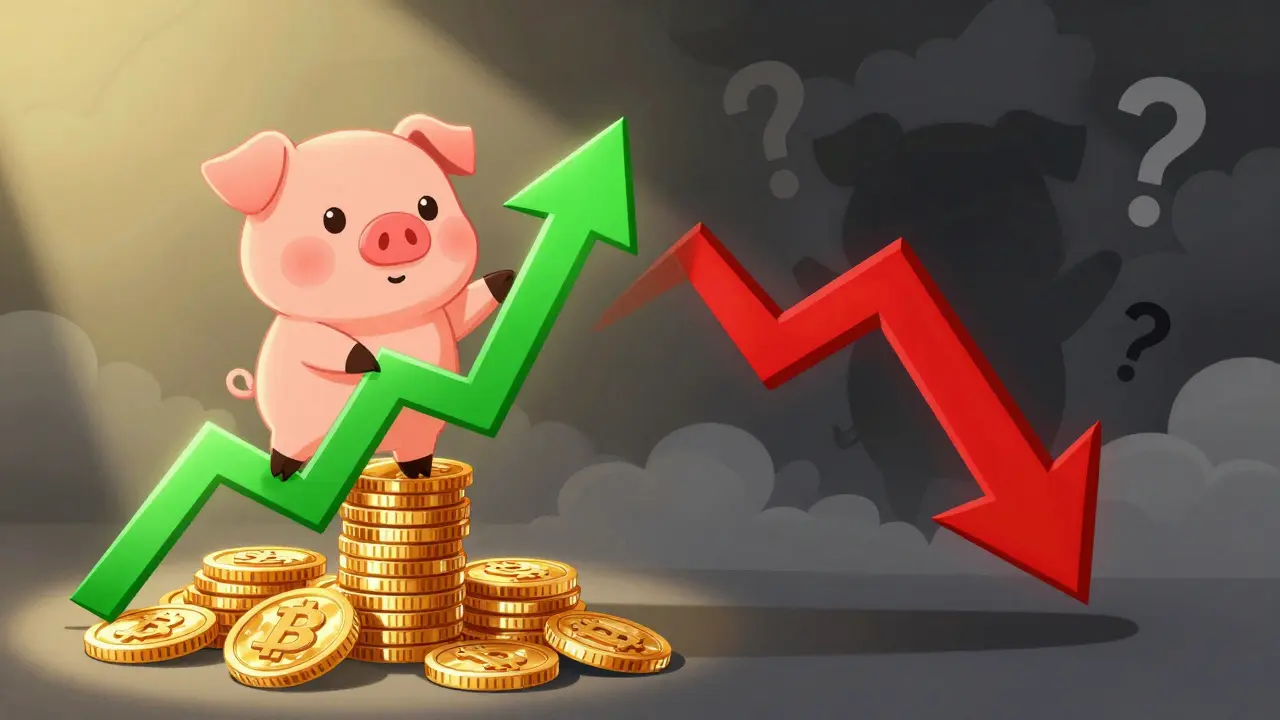
Historical performance shows extreme swings. In July 2025, the token saw a massive +278% monthly gain, only to suffer a -48% drop in a single day. This pattern is classic memecoin behavior: rapid pumps followed by sharp corrections. Analysts using tools like CoinCodex have issued bearish forecasts, predicting potential drops of over 25% in the short term. Technical indicators like the RSI (Relative Strength Index) hovering around 43 suggest the market is neither overbought nor oversold, but sentiment remains cautious.
Community and Culture: The Real Value Proposition
Unlike Bitcoin, which aims to be digital gold, or Ethereum, which powers smart contracts, PETUNIA’s value proposition is entirely cultural. It’s about belonging to a community that celebrates Princess Petunia’s story. The token serves as a badge of participation in this "wholesome" internet subculture.
The community engagement centers heavily on social media. Fans of the piglet interact across platforms, sharing memes, updates, and support for the cause. This organic growth is powerful because it doesn’t rely on paid marketing campaigns or celebrity endorsements in the traditional sense. Instead, it leverages the genuine affection people feel for the animal.
However, this reliance on virality is a double-edged sword. Social media algorithms change constantly. What’s trending today might be forgotten next month. If Princess Petunia’s popularity fades, or if the community loses interest, the demand for the token could plummet. There’s no underlying utility-no staking rewards, no governance rights, no exclusive access to services-to hold the value if the hype dies down.
Risks and Considerations Before Buying
Before you rush to buy some PETUNIA tokens, let’s talk about the risks. Crypto investing, especially in memecoins, is high-risk. Here’s what you need to watch out for:
- Lack of Utility: The token doesn’t provide any functional benefit beyond speculation and community membership. If the narrative shifts, there’s nothing fundamental to catch the price.
- Viral Dependency: The project’s success is tied directly to Princess Petunia’s online presence. If her account gets banned, shadow-banned, or if she passes away (a dark but real possibility), the token could lose its primary driver.
- Market Volatility: Prices can swing wildly based on tweets, trends, or broader market sentiment. You could see significant gains or losses in hours.
- Liquidity Risks: With a market cap under $100k, liquidity can be thin. Large sell orders could crash the price significantly, making it hard to exit positions smoothly.
- Regulatory Uncertainty: Governments worldwide are cracking down on cryptocurrencies, particularly those deemed speculative or lacking clear utility. Future regulations could impact trading availability.
Experts warn that many memecoins fail to sustain momentum beyond their initial launch window. PETUNIA exemplifies the high-risk/high-reward model where infrastructure enables rapid speculation, but long-term viability is uncertain.
How to Buy and Store PETUNIA
If you decide to proceed, here’s how you can get involved. Since PETUNIA is a Solana token, you’ll need a compatible wallet and some SOL (Solana’s native currency) to pay for transaction fees.
- Set Up a Wallet: Download a Solana-compatible wallet like Phantom or Solflare. Create a new wallet and securely store your seed phrase offline. Never share this phrase with anyone.
- Buy SOL: Purchase SOL from a centralized exchange like Coinbase, Binance, or Kraken. Transfer the SOL to your wallet address.
- Access a DEX: Go to a decentralized exchange like Raydium or Jupiter. Connect your wallet to the platform.
- Swap for PETUNIA: Search for the PETUNIA token contract address to ensure you’re buying the correct asset. Swap your SOL for PETUNIA tokens. Be mindful of slippage settings due to low liquidity.
- Store Securely: Once acquired, keep your tokens in your non-custodial wallet. Avoid leaving large amounts on exchanges.
For those interested in automated strategies, platforms like TradeSanta offer bot compatibility, allowing you to set up buy/sell rules based on price movements. However, given the volatility, manual trading or careful strategy setup is recommended for beginners.
Is PETUNIA a Good Investment?
That depends on your definition of "investment." If you’re looking for a stable store of value or a technology with clear utility, PETUNIA is likely not for you. It’s a speculative asset driven by internet culture and community sentiment.
On the other hand, if you enjoy participating in viral trends, believe in the longevity of Princess Petunia’s brand, and are willing to risk losing your entire principal in exchange for the chance of high returns, then it might fit your portfolio. Just remember: never invest more than you can afford to lose. Treat it like buying a lottery ticket, not a retirement plan.
The future of PETUNIA hinges on sustained community engagement and the continued relevance of its mascot. While Solana provides a robust technical foundation, the token’s fate is written in the hearts of its fans and the whims of social media algorithms.
What is the main purpose of the PETUNIA token?
The PETUNIA token serves as a community-driven memecoin celebrating Princess Petunia, a viral TikTok piglet. It has no traditional utility like staking or governance; its value is derived from social media engagement, community support, and speculative trading.
Which blockchain does PETUNIA run on?
PETUNIA is built on the Solana blockchain as an SPL token. This allows for fast transactions (up to 65,000 TPS) and low fees (around $0.00025), making it suitable for microtransactions and quick trading.
Where can I buy PETUNIA tokens?
You can buy PETUNIA on decentralized exchanges (DEXs) like Raydium or Jupiter using a Solana wallet. It may also be listed on some centralized exchanges, but DEXs are the primary venue for trading this specific memecoin.
Is PETUNIA a safe investment?
No, PETUNIA is considered a high-risk investment. Like most memecoins, it lacks fundamental utility and is highly volatile. Its value depends entirely on community sentiment and viral trends, which can change rapidly. Only invest what you can afford to lose.
What happens if Princess Petunia stops posting on social media?
If Princess Petunia’s social media presence declines or disappears, the primary driver of PETUNIA’s value would vanish. Without ongoing viral content and community engagement, demand for the token could drop significantly, leading to a decrease in price.
How much does it cost to transact with PETUNIA?
Transaction fees on the Solana network are extremely low, averaging around $0.00025 per transaction. This makes it affordable to send and receive small amounts of PETUNIA without worrying about high gas costs.

Write a comment