
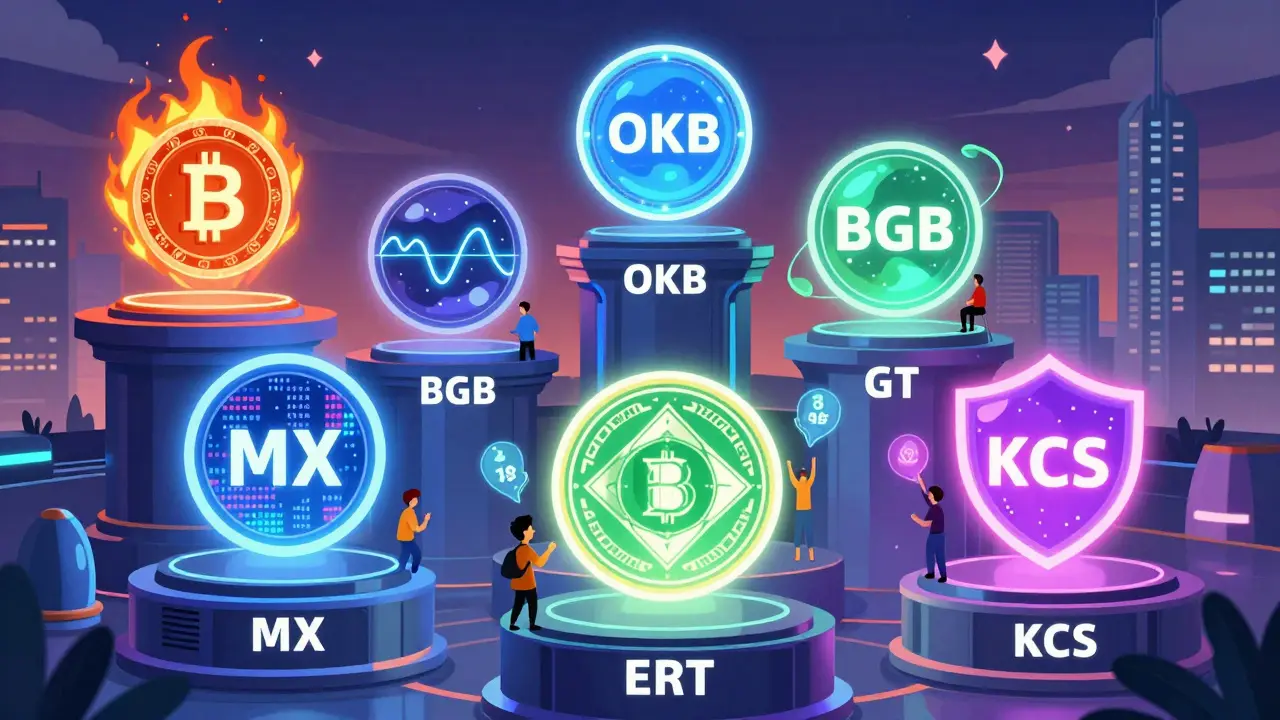
Exchange tokens aren’t just another crypto coin. They’re the lifeblood of centralized exchanges - and if you trade crypto regularly, you’re probably already using one without realizing it. In 2026, six major tokens dominate this space: BNB, OKB, BGB, MX, GT, and KCS. Each one works differently, offers unique perks, and ties directly to the exchange you’re already on. This isn’t about speculation. It’s about understanding what you’re actually getting when you hold these tokens - and which one gives you the most bang for your buck.
What Exactly Are Exchange Tokens?
Exchange tokens are native cryptocurrencies issued by centralized crypto platforms like Binance, OKX, or KuCoin. They’re not meant to be just another asset to trade. They’re designed to make you stick around. Hold them, and you get discounts on trading fees, access to staking rewards, early token sales, and sometimes even voting rights on platform decisions. The whole idea started with Binance’s BNB in 2017. Since then, every major exchange has followed suit.
By December 2025, these six tokens had a combined market cap of $120 billion. That’s nearly 9% of the entire crypto market. And it’s growing fast. The sector’s grown at 34.2% a year for the last three years. What’s changed? These tokens aren’t just fee discounts anymore. They’re now gateways to entire ecosystems - blockchains, DeFi apps, NFT marketplaces, and even staking pools.
BNB: The Undisputed Leader
BNB still rules the roost. It holds 45.2% of the entire exchange token market cap, and Binance processes 40% of all global crypto trading volume. Why? Because BNB isn’t just a token - it’s the key to a whole universe.
Here’s what you get:
- 25% discount on trading fees
- Staking yields up to 15% APY
- Access to BNB Chain, which handles 3.2 million transactions daily
- Quarterly burns that destroy 20% of Binance’s profits until 50% of the original supply is gone - 45.6% has already been burned
BNB is also the backbone of Binance’s ecosystem: BNB Greenfield (decentralized storage), Binance Launchpad (new token sales), and even Binance Pay. Over 87% of Binance users hold BNB - not because they think it’ll skyrocket, but because it saves them real money.
But there’s a catch. Binance settled with U.S. regulators in November 2024 for $4.3 billion. That sent shockwaves through the market. While BNB itself isn’t classified as a security, its close ties to Binance mean regulatory pressure is always looming. If Binance gets hit again, BNB could take a hit too.
OKB: The Scarcity Play
OKB is the quiet challenger. It doesn’t have BNB’s volume, but it has something better: a fixed supply. Only 21 million OKB will ever exist. No more. No less.
Here’s how it works:
- 40% trading fee discount
- 30% of OKX’s profits go into buybacks - reducing circulating supply
- 8.5% average APY on OKX Earn
- 412 dApps live on OKC (OKX Chain)
OKB’s value proposition is simple: scarcity + utility. Unlike BNB, which keeps printing new tokens (though burning some), OKB’s total supply is locked. That’s why Dr. Garrick Hileman from Blockchain.com says OKB’s model has “stronger scarcity dynamics.”
Since 2023, OKB’s circulating supply has dropped 12.3% due to buybacks. That’s not just marketing - that’s real deflation. OKB holders also get governance rights on the OKX DEX, which moves $2.8 billion monthly. The downside? OKB isn’t available everywhere. MiCA regulations in Europe have forced OKX to restrict access in some countries. If you’re in the EU, check local rules before buying.
BGB: The Asian Copy-Trading King
BGB is the dark horse. It’s not the biggest, but it’s the fastest-growing. Bitget’s focus on copy-trading - letting users auto-copy top traders - has made it a monster in Southeast Asia.
Here’s why BGB stands out:
- 20% trading fee discount
- Staking yields up to 12% APY
- 50% of Bitget’s revenue funds quarterly burns - 2.5 billion BGB already burned
- Morph blockchain integration supports 42 dApps with $847 million TVL
BGB leads in Southeast Asia with 63.2% market share there. Why? Because Bitget’s platform is built for beginners. The copy-trading interface is dead simple. You pick a trader, hit “follow,” and your portfolio mirrors theirs. It’s like TikTok for crypto trading.
But if you’re not in Asia, BGB’s ecosystem feels limited. Most of its dApps are in Chinese or local languages. English documentation is thin. For global traders, it’s a solid pick - but not a full ecosystem replacement.
MX: The Altcoin King
MX is the wild card. MEXC has the most trading pairs of any exchange: 2,690 spot pairs. That’s more than Binance, Coinbase, and Kraken combined.
Here’s the deal:
- 50% trading fee discount - the highest in the industry
- 50% of MEXC’s revenue funds buybacks - $487 million worth of MX bought back since launch
- $34 billion in new asset volume since January 2025
- MX-powered NFT marketplace launched in December 2025
If you’re trading obscure altcoins, MX is your home. It’s where new tokens go live before they hit Binance. And the fee discount? 50% is insane. For heavy traders, that’s thousands saved per year.
The catch? The interface is overwhelming. New users report a learning curve of 8-12 hours just to navigate it. It’s built for pros, not beginners. Also, MEXC has faced criticism for listing low-quality tokens. If you’re not careful, you can get burned.
GT: The Middle East Player
GT is the quiet powerhouse with a global footprint. Gate.io has a massive presence in the Middle East and Latin America, thanks to its VARA license in Dubai.
Here’s what GT offers:
- 20% trading fee discount
- 1.8 billion GT burned since 2018
- 2,664 trading pairs
- Integration with GateChain for cross-chain swaps
- Formula 1 sponsorship with Oracle Red Bull Racing
Gate.io’s sponsorship boosted GT visibility by 37% in late 2025. That’s rare for a crypto token. It’s not just about utility - it’s about brand recognition.
GT’s biggest strength? Simplicity. Onboarding takes just 3-4 hours. The interface is clean. The documentation? Less so. Non-Asian users report 31% of English resources are outdated or incomplete. But if you’re in the Middle East or want a no-fuss, reliable exchange, GT is a strong contender.
KCS: The Security-Focused Token
KCS is the underdog with a safety net. KuCoin’s $2 billion protection fund is the biggest in the industry. If the exchange gets hacked, this fund covers losses. That’s huge.
Here’s the breakdown:
- 20% trading fee discount
- 50% of daily trading fees fund burns - 387 million KCS destroyed by December 2025
- Apple Pay integration for KuCard
- AI trading bots and GemSlot/GemPool launchpad
Since January 2025, 317 new tokens launched via GemSlot. Projects using KCS got 47% higher liquidity than others. That’s real value.
But KCS has a vulnerability. In February 2025, KuCoin had a 12-hour outage. Sentiment dropped 42%. It recovered quickly, but it showed how dependent KCS is on KuCoin’s uptime. If the exchange goes down, KCS loses utility.
Who Should Hold Which Token?
There’s no one-size-fits-all. Your choice depends on how you trade.
- BNB - Best if you’re already on Binance. High utility, deep ecosystem, but regulatory risk.
- OKB - Best for long-term holders. Fixed supply, strong burns, governance rights. Avoid if you’re in the EU.
- BGB - Best for copy-traders in Asia. High yields, growing ecosystem, but limited outside Asia.
- MX - Best for altcoin hunters. Highest fee discount, biggest pair selection. Only for experienced traders.
- GT - Best for Middle East users or those who want simplicity. Strong brand, good security, decent utility.
- KCS - Best for risk-averse users. The $2B fund is unmatched. But watch for exchange outages.
Most people hold one. A few hold two - like BNB and KCS - for diversification. But holding five? That’s overkill. Stick to the one tied to your main exchange.
The Bigger Picture
Exchange tokens are evolving. By 2027, 68% of exchanges plan to move to DAO governance. That means token holders will vote on fees, listings, and even security protocols. Right now, they’re still centralized. But that’s changing.
Regulation is the elephant in the room. The SEC’s November 2025 guidance says exchange tokens could be classified as securities if their utility is “insufficiently developed.” That could hit up to 40% of current tokens. Tokens with verifiable burns - like BNB, OKB, and KCS - are safer. They’ve proven they’re not just fundraising tools.
And don’t forget: these tokens are only as good as the exchange behind them. If Binance shuts down, BNB becomes worthless. If KuCoin gets hacked again, KCS crashes. The token is just the wrapper. The exchange is the product.
Final Thoughts
Exchange tokens aren’t investments. They’re membership cards. You don’t buy them to get rich. You buy them to save money, access features, and stay loyal. The best one for you isn’t the one with the biggest market cap - it’s the one tied to the exchange you use every day.
Check your trading habits. Are you a beginner? Go for GT or KCS. An altcoin trader? MX or BGB. A long-term holder? OKB. A Binance user? BNB. No need to overthink it. Use what you already use. The discounts alone make it worth it.
Are exchange tokens a good investment?
Exchange tokens aren’t designed as speculative assets. Their value comes from utility - fee discounts, staking rewards, and ecosystem access. While some have gained value over time, their primary purpose is to reduce trading costs and incentivize platform loyalty. If you trade frequently, holding the token tied to your exchange makes financial sense. But betting on price spikes alone is risky, especially with regulatory uncertainty looming.
Which exchange token has the highest fee discount?
MX (MEXC) offers the highest discount at 50% for holders. This is significantly more than BNB (25%), OKB (40%), and KCS (20%). However, this benefit only matters if you trade frequently enough to make the savings meaningful. For light traders, even a 20% discount can add up over time.
Do all exchange tokens have burn mechanisms?
Most major ones do, but not all. BNB, OKB, KCS, BGB, and GT all use regular burns to reduce supply. MX uses buybacks funded by revenue. The key difference is transparency. Tokens with public burn trackers - like BNB and KCS - are more trustworthy because anyone can verify the process. Tokens without clear burn data should be treated with caution.
Can I use exchange tokens outside their platform?
Yes, but rarely. Most exchange tokens are accepted on their native chains - like BNB Chain or OKC - and a few DeFi platforms. You can’t use BNB to pay for coffee or GT to buy a Netflix subscription. Their utility is mostly confined to crypto ecosystems. Some, like KCS, are integrated into debit cards (KuCard), but even those only work with crypto-to-fiat conversions.
Which token is safest from regulatory risk?
OKB and KCS are currently the safest. OKB’s fixed supply and transparent buybacks show it’s not just a fundraising tool. KCS’s $2 billion protection fund and clear utility (staking, burns, AI tools) make it harder to classify as a security. BNB faces the most risk due to Binance’s past legal issues. Tokens with vague utility - like those without burns or staking - are most at risk of being targeted.
Should I hold multiple exchange tokens?
Only if you trade on multiple exchanges. Holding BNB on Binance, OKB on OKX, and KCS on KuCoin doesn’t give you extra benefits - each token only works on its own platform. It’s better to consolidate your trading on one exchange and hold its native token. Spreading across platforms increases complexity without meaningful upside.
What happens if an exchange shuts down?
The token loses nearly all its value. Exchange tokens rely entirely on the platform’s operations. If Binance closed tomorrow, BNB would become a speculative coin with no utility. Same for OKB, MX, or any other. They’re not decentralized assets like Bitcoin or Ethereum. They’re tied to corporate entities. Always remember: the exchange is the product. The token is just the key.

Write a comment