

Imagine proving you are over twenty-one without showing your driver’s license. Or verifying a bank transaction without revealing the amount or the recipient. This is the promise of Zero-Knowledge Proofs (ZKPs), a cryptographic protocol that allows one party to prove a statement is true to another party without revealing any underlying data. For years, this technology lived in academic papers and niche crypto projects. But as we move through 2026, it has become the backbone of modern blockchain infrastructure.
We are no longer talking about theoretical math. We are looking at a system that solves the two biggest headaches in digital finance: privacy and scalability. If you have followed the space, you know Ethereum was slow and expensive. You also know that public ledgers expose every detail of your financial life. ZK technology fixes both. It compresses data so networks can handle thousands of transactions per second, and it wraps that data in a cryptographic shield that keeps your business private.
From Theory to Mainstream Infrastructure
The journey began in 1985 when Shafi Goldwasser, Silvio Micali, and Charles Rackoff published their seminal paper on interactive proof systems. Back then, it was pure mathematics. The first real-world application appeared in 2016 with Zcash, the first cryptocurrency to implement privacy-preserving transactions using zk-SNARKs. But for a long time, ZKPs were seen as too complex and computationally heavy for widespread use.
That changed dramatically between 2023 and 2024. The market valuation of zero-knowledge projects exploded from $3.2 billion to over $21 billion. Why? Because major players realized that traditional scaling methods were hitting a wall. Optimistic rollups, which rely on fraud proofs and challenge periods, were good, but they required users to wait days before their funds were fully secure. ZK rollups offered instant finality with mathematical certainty.
By mid-2024, platforms like zkSync Era, an Ethereum Layer 2 scaling solution using ZK technology, Starknet, a decentralized ZK-Rollup network powered by STARKs, and Polygon zkEVM, a validity rollup that uses zero-knowledge proofs to scale Ethereum were processing real transaction volume on the Ethereum mainnet. They weren't just test nets anymore; they were handling billions of dollars in value. This marked a shift from speculative assets to foundational infrastructure.
The Technical Battle: SNARKs vs. STARKs
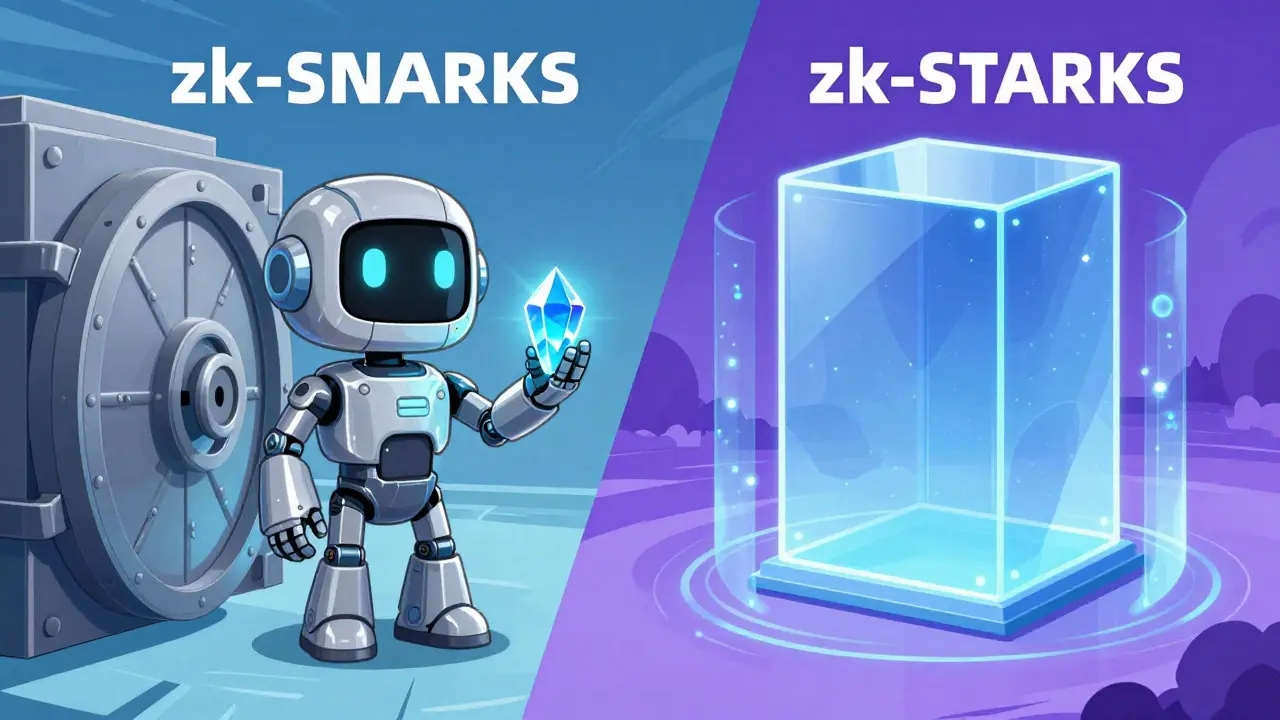
To understand where this tech is going, you need to know how it works under the hood. There are two dominant approaches: zk-SNARKs and zk-STARKs. Both achieve the same goal-proving knowledge without revealing it-but they take different paths.
| Feature | zk-SNARKs | zk-STARKs |
|---|---|---|
| Full Name | Succinct Non-Interactive Argument of Knowledge | Scalable Transparent Arguments of Knowledge |
| Proof Size | Small (~200 bytes) | Larger (~45 KB) |
| Trusted Setup | Required (potential security risk) | Not Required (transparent) |
| Quantum Resistance | Vulnerable | Resistant |
| Efficiency | Faster verification | Slower verification, faster proving |
zk-SNARKs, used by Zcash and zkSync, are compact and fast to verify. However, they require a "trusted setup" phase. If the initial cryptographic keys are not destroyed properly, someone could forge proofs. This has been a sticking point for purists. On the other hand, zk-STARKs, pioneered by StarkWare behind Starknet, don't need a trusted setup. They are "transparent" and quantum-resistant, meaning they will hold up even if quantum computers break current encryption standards. The trade-off? Larger proof sizes, which cost more to store on-chain.
In 2026, the industry is moving toward hybrid models. Developers are choosing based on specific needs: SNARKs for high-throughput payment apps where speed is king, and STARKs for enterprise-grade applications where long-term security and auditability matter most.
Hardware Acceleration: The Game Changer
The biggest bottleneck for ZK technology has always been computation. Generating a proof is incredibly CPU-intensive. In early implementations, creating a single proof could take minutes and require massive amounts of RAM (16-32 GB). This made it impractical for mobile devices or small-scale operations.
Enter hardware acceleration. By 2025, specialized processors began changing the landscape. NVIDIA announced its "ZK Coprocessor," designed to leverage tensor cores for cryptographic calculations. Early benchmarks showed a 50x improvement in proving times. What took minutes now takes seconds. More importantly, the cost dropped significantly. Dr. Eli Ben-Sasson, co-founder of StarkWare, predicted that proving costs would fall below $0.001 per transaction by Q2 2025. That prediction largely came true, making private transactions economically viable for everyday users.
This hardware shift means ZK proofs are no longer just for big exchanges. Soon, you might generate a ZK proof on your smartphone to verify your identity for a login or to pay for coffee without sharing your location history. The barrier to entry is crumbling.
Enterprise Adoption and Regulatory Compliance
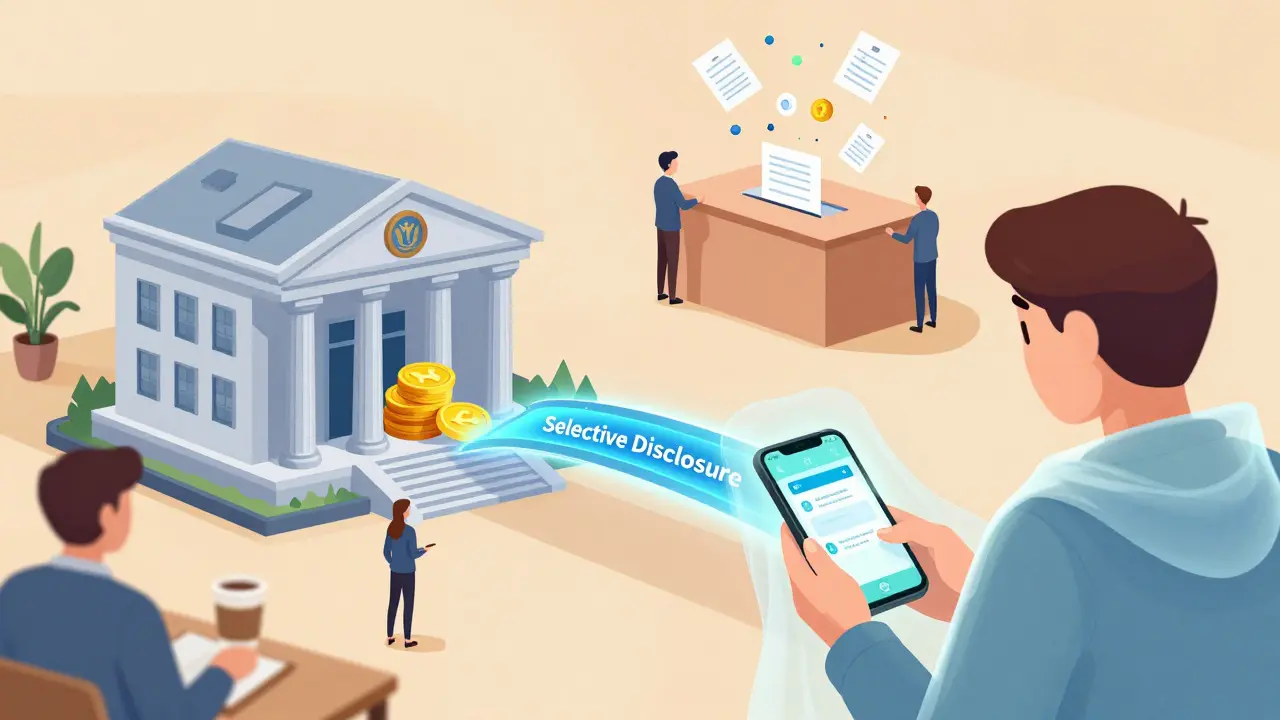
You might think privacy and regulation are opposites. In the world of ZK, they are becoming partners. Regulators want transparency to prevent money laundering. Users want privacy to protect their data. ZKPs offer a middle ground: "selective disclosure."
Consider BlackRock's BUIDL Fund. In 2024, they tokenized $240 million in US Treasuries on Ethereum. How did they ensure only accredited investors could buy in? They used ZK verification. Investors proved they met the income requirements without revealing their actual income or identity to the public ledger. This solved a massive compliance hurdle.
Similarly, HSBC reported a 73% reduction in settlement times for their tokenized gold trading platform by using ZK proofs for confidential price discovery. Banks hate inefficiency, and they love privacy. ZK delivers both. With the EU's MiCA framework formally recognizing ZK-proofs as compliant privacy technology in July 2024, European institutions moved quickly. Estonia even implemented ZK-based voting systems in municipal elections, processing over 200,000 private votes with full auditability.
This trend suggests that the future of ZK isn't just about crypto. It's about secure, private, and scalable digital interactions across all industries, from healthcare records to supply chain logistics.
The Developer Challenge
Despite the hype, building with ZK is hard. Very hard. Traditional Solidity developers cannot simply switch to ZK circuits overnight. You need to learn new languages like Circom or Cairo, and understand finite field arithmetic and elliptic curve cryptography.
A survey by HackerRank found that only 12% of traditional blockchain developers possess the necessary skills for ZK circuit design. The learning curve spans 4-6 months for experienced engineers. Reddit threads from r/ethdev show developers spending over 100 hours debugging a single circuit. GitHub issue trackers for frameworks like zkSync's SE show hundreds of open issues related to compilation errors.
This talent gap is the primary constraint on growth. While the demand for ZK solutions is exploding, the supply of skilled engineers is lagging. Companies are paying premium salaries for ZK specialists, and universities are starting to introduce dedicated courses. Until tooling improves and abstraction layers get better, development will remain a bottleneck.
Looking Ahead: 2026 and Beyond
Where do we go from here? Three trends are shaping the immediate future:
- Cross-Chain Privacy: Projects like zkBridge are enabling private asset transfers between disparate networks like Bitcoin and Ethereum. This breaks down silos and creates a unified, private liquidity layer.
- AI Integration: As AI models grow larger, verifying their outputs becomes crucial. ZKPs can prove that an AI model ran correctly on specific data without revealing the data or the model weights. This is emerging as a key use case for "verifiable AI."
- Standardization: We are seeing a move away from custom, opaque circuits toward standardized templates. This reduces the risk of critical vulnerabilities, which Dr. Matthew Green warned account for 63% of audited ZK circuit flaws.
Vitalik Buterin has called ZK-proofs the "single most important cryptographic primitive for scaling Ethereum." He predicted a 100x improvement in performance by 2025, and while we are still refining the edges, the trajectory is clear. By 2027, analysts predict that ZKP won't be a separate layer but the standard architecture for 70% of blockchain applications.
The technology is transitioning from a niche tool for privacy advocates to essential infrastructure for the entire digital economy. It is the bridge between the open nature of blockchains and the private nature of human interaction. And that bridge is finally open for business.
What is the main difference between zk-SNARKs and zk-STARKs?
The main differences lie in proof size, trust assumptions, and quantum resistance. zk-SNARKs produce smaller proofs (~200 bytes) and verify faster but require a trusted setup ceremony. zk-STARKs produce larger proofs (~45 KB), do not require a trusted setup (they are transparent), and are resistant to quantum computing attacks.
Why are Zero-Knowledge Proofs important for blockchain scalability?
ZKPs enable "rollups," which bundle thousands of transactions into a single proof. Instead of the blockchain processing each transaction individually, it only verifies the single proof. This drastically reduces data storage and computational load, allowing networks like Ethereum to handle thousands of transactions per second with low fees.
Can Zero-Knowledge technology be used outside of cryptocurrency?
Yes. ZK technology is applicable anywhere privacy and verification are needed. Examples include secure voting systems (used in Estonia), private healthcare data sharing, confidential corporate settlements, and identity verification without exposing personal details.
Is ZK development difficult for programmers?
Currently, yes. Developing ZK circuits requires specialized knowledge in cryptography and finite field arithmetic, distinct from standard programming. Languages like Circom and Cairo have steep learning curves, often taking experienced developers 4-6 months to master.
How does hardware acceleration impact ZK technology?
Hardware acceleration, such as specialized GPUs or ASICs, drastically reduces the time and energy required to generate ZK proofs. This lowers costs (potentially below $0.001 per proof) and makes real-time ZK verification feasible on consumer devices like smartphones.

Write a comment