

Imagine trying to fix a flat tire on a car while the engine is running at full speed and the GPS is screaming directions. That’s essentially what early blockchains tried to do. They attempted to handle every single task-processing transactions, agreeing on who owns what, storing data, and keeping the network secure-all in one go. This "do-it-all" approach worked for a while, but as networks grew, they hit a wall. Transactions got slow, fees skyrocketed, and upgrades became risky gambles.
This is where blockchain modularity steps in. It’s not just a buzzword; it’s a fundamental shift in how we build distributed ledgers. Instead of forcing one chain to do everything, modularity breaks the system into specialized pieces. Think of it like moving from a general practitioner who tries to treat every ailment to a hospital with specialists for heart surgery, radiology, and emergency care. Each part does one thing exceptionally well, and together, they create a system that is faster, cheaper, and more flexible than any single chain could be alone.
The Four Pillars of Modular Architecture
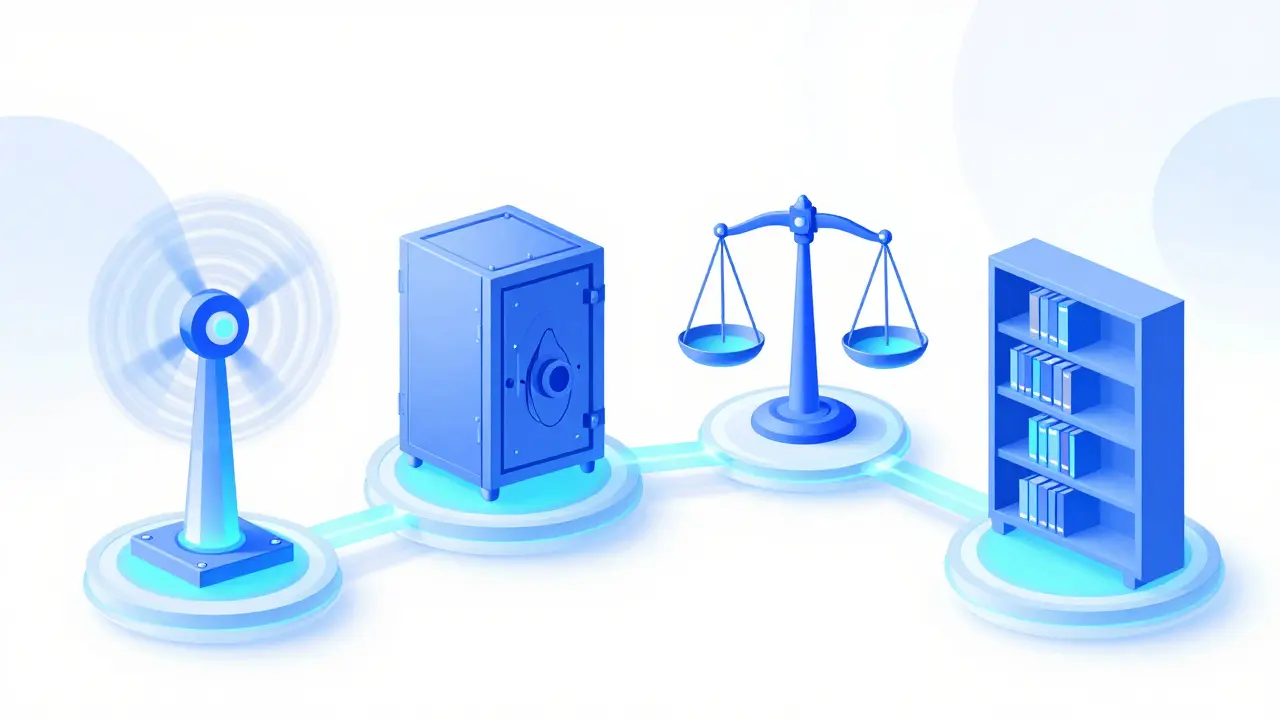
To understand how this works, you have to look under the hood. A traditional monolithic blockchain bundles four critical functions into one layer. Modular blockchains split these up. According to technical analyses from industry leaders like Visa and Chainstack, these four functions are Execution, Settlement, Consensus, and Data Availability. Let’s break down what each one actually does.
- Execution Layer is the engine room where transactions are processed and smart contracts run. This is where your money moves or your NFT changes hands. In a modular setup, this layer can be optimized purely for speed and efficiency without worrying about consensus rules.
- Settlement Layer is the final arbiter that ensures transactions are irreversible and disputes are resolved. It processes proofs from other chains and guarantees that once a transaction is settled, it stays settled. This is crucial for trust across different networks.
- Consensus Layer is the decision-making body where nodes agree on the validity and order of transactions. It acts like a security council, ensuring fairness and preventing fraud. By separating this from execution, networks can choose consensus mechanisms that fit their specific security needs.
- Data Availability Layer is the storage system that ensures transaction data is accessible to all network participants. It distributes data so that no single point of failure can hide information, maintaining network integrity even if some nodes go offline.
When these layers are separated, developers can upgrade one without breaking the others. Want faster execution? Swap out the execution module. Need better security? Upgrade the consensus mechanism. This independence is the core power of modularity.
Monolithic vs. Modular: The Architectural Divide
Before modularity became the trend, most major blockchains were Monolithic Blockchains are systems that handle all core functions within a single unified layer. Bitcoin, Solana, and Ethereum (before its recent sharding upgrades) are classic examples. They are straightforward to understand because everything happens in one place. But this simplicity comes at a cost.
In a monolithic chain, if you want to increase transaction speed, you often have to compromise on decentralization or security. Why? Because every node in the network has to process every transaction and store every piece of data. As the network grows, the hardware requirements for running a node skyrocket, pushing out smaller participants and centralizing power. Modular blockchains solve this by offloading tasks. You don’t need every node to execute every transaction; you only need them to verify the proof that the transaction was executed correctly.
| Feature | Monolithic Blockchain | Modular Blockchain |
|---|---|---|
| Structure | Single layer handles all functions | Multiple specialized layers |
| Scalability | Limited by node capacity | High, via parallel processing |
| Flexibility | Low, rigid "one-size-fits-all" | High, customizable components |
| Complexity | Simpler to design and maintain | Higher complexity, requires advanced security |
| Examples | Bitcoin, Solana, Pre-shard Ethereum | Polkadot, Cosmos, EigenLayer, Polygon CDK |
The trade-off is clear. Monolithic chains are easier to grasp and build initially, but they struggle to scale. Modular chains are inherently more complex, requiring sophisticated security protocols to ensure the layers talk to each other safely. However, that complexity buys you scalability and adaptability that monolithic systems simply cannot provide.
Real-World Examples of Modular Implementation
You might wonder if this is just theory. Not at all. Several major projects have already embraced modular or semi-modular architectures. These implementations show different ways to slice the pie.
Polkadot is a multi-chain network that allows multiple blockchains to operate simultaneously. It uses a Relay Chain for consensus and security, while individual Parachains handle execution. This means apps can run on their own customized chains while sharing the security of the main network.
Cosmos is an ecosystem of independent blockchains connected through an inter-blockchain communication protocol. It focuses heavily on sovereignty, allowing each chain to define its own governance and execution rules while remaining interoperable.
Then there’s the emerging polylithic model, which sits somewhere between pure modularity and monoliths. Projects like Avalanche Subnets are customizable blockchains built on the Avalanche network that share infrastructure but operate independently. Similarly, Polygon CDK is a development kit that allows creators to launch custom chains with shared security and tooling. Starknet’s Appchains and zkSync Era’s Hyperchains follow similar patterns, offering a foundational layer that supports a variety of specialized subnetworks.
These examples prove that modularity isn’t a single blueprint. It’s a spectrum. Some chains separate only data availability, while others distribute all four core functions across independent networks. The key takeaway is that developers now have choices. They aren’t forced into a rigid structure anymore.
Why Modularity Matters for Developers and Users
For developers, modularity is a game-changer. In a monolithic world, if you wanted to change how transactions were processed, you had to convince the entire network to upgrade. That’s hard, slow, and often contentious. With modularity, you can upgrade or replace individual components with minimal disruption. You can integrate new consensus mechanisms, networking protocols, or execution environments without tearing down the whole stack.
For users, the benefits are tangible. Faster transactions mean less waiting. Lower fees mean using blockchain doesn’t cost a fortune. And a more seamless experience means you don’t have to worry about network congestion ruining your day. When each module is optimized for its specific task, the whole system runs smoother. It’s like having a dedicated server for video streaming and another for file storage, rather than one overloaded computer trying to do both.
Innovation also thrives in modular ecosystems. Because modules can be developed and maintained independently, teams can experiment freely. If a new idea fails, it doesn’t crash the entire network. This freedom encourages a cohesive ecosystem of interoperable chains, where developers pick and choose the best tools for their specific project. It’s the difference between building with Lego bricks versus pouring concrete. One allows for creativity and adaptation; the other locks you in.

The Trade-Offs: Complexity and Security Challenges
It’s important to be honest about the downsides. Modularity introduces significant complexity. Designing a system where multiple layers communicate securely is much harder than building a single chain. There are more points of failure, more interfaces to secure, and more coordination required. As Bitstamp notes, this makes modular blockchains more difficult to design and build.
Security is the biggest concern. In a monolithic chain, security is centralized in one place. In a modular chain, you have to ensure that the execution layer talks truthfully to the settlement layer, and that the data availability layer isn’t hiding anything. This requires advanced security protocols, such as zero-knowledge proofs or fraud proofs, to validate cross-chain interactions. If these mechanisms fail, the entire system’s integrity is at risk.
Additionally, balancing scalability, security, and decentralization remains a challenge. While modularity helps address the "Blockchain Trilemma," it doesn’t solve it entirely. Developers still have to make trade-offs. For example, relying on a small number of validators for consensus might speed up settlement but reduce decentralization. Investors and users need to understand these nuances to evaluate specific implementations critically.
Looking Ahead: The Future of Distributed Ledgers
The industry is clearly moving toward modularity. Major players are investing heavily in modular solutions, recognizing that monolithic systems face inherent constraints. As blockchain technology matures, the focus is shifting from raw throughput to architectural elegance and flexibility.
We can expect to see more hybrid models emerge, combining the simplicity of monolithic designs with the scalability of modular ones. Polylithic architectures like Avalanche Subnets and Polygon CDK are likely to become more common, offering a middle ground that balances ease of use with customization. Security innovations will continue to evolve, making cross-layer communication safer and more efficient.
Ultimately, understanding blockchain modularity is essential for anyone involved in the space. Whether you’re a developer building the next big dApp, an investor evaluating projects, or a user seeking better performance, knowing how these pieces fit together gives you a clearer picture of where the technology is heading. It’s not just about faster transactions; it’s about building a resilient, adaptable, and truly scalable digital infrastructure.
What is the main difference between monolithic and modular blockchains?
Monolithic blockchains handle all core functions-execution, consensus, settlement, and data availability-in a single layer. Modular blockchains separate these functions into independent, specialized layers, allowing for greater scalability, flexibility, and customization.
Why is data availability important in modular blockchains?
Data availability ensures that transaction data is accessible to all network participants. In modular systems, where execution might happen on one chain and settlement on another, guaranteeing that data is available and verifiable is critical for security and network integrity.
Are modular blockchains more secure than monolithic ones?
Not necessarily. While modularity allows for specialized security optimizations, it also increases complexity and attack surface. Security depends on the robustness of the protocols connecting the layers, such as fraud proofs or zero-knowledge proofs.
What are some examples of modular blockchains?
Prominent examples include Polkadot, Cosmos, and EigenLayer. Polylithic models like Avalanche Subnets, Polygon CDK, Starknet Appchains, and zkSync Era Hyperchains also represent variations of modular architecture.
How does modularity improve scalability?
By separating tasks, modular blockchains can process transactions in parallel across different layers. Each layer can be optimized for its specific function, reducing bottlenecks and increasing overall network throughput compared to monolithic chains.

Write a comment