
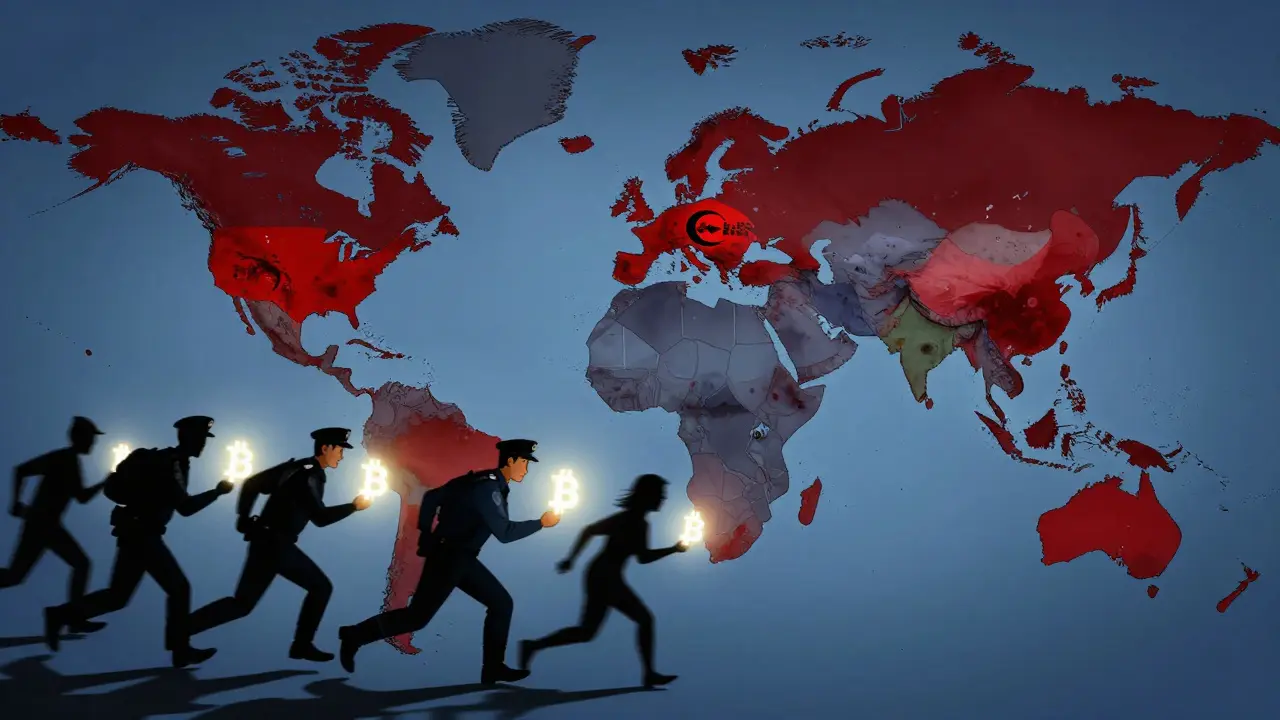
You might think holding Bitcoin makes you invisible to the law. In most places, it does. But in specific corners of the world, simply owning a digital wallet can land you in handcuffs. The global landscape for cryptocurrency enforcement is the varying legal strategies governments use to punish or regulate digital asset usage has fractured into two distinct camps by 2025 and 2026. On one side, you have nations that treat crypto like a criminal conspiracy. On the other, you have democracies that only go after major money launderers.
If you are traveling, living abroad, or even just sending money across borders, knowing which jurisdiction you are under matters more than your private key. I’ve looked at the data from 2024 through early 2026, and the difference between getting a tax bill and getting a prison sentence comes down to geography. Let’s look at where the boots hit the ground hardest.
The Total Ban Zone: Where Ownership Is Illegal
In a small but aggressive group of countries, the government doesn’t just dislike crypto; they actively hunt users. These jurisdictions do not distinguish between a casual trader and a sophisticated hacker. If you hold assets, you break the law.
China is the global leader in comprehensive cryptocurrency prohibition and active user prosecution remains the strictest regime on earth. Since banning exchanges and initial coin offerings (ICOs) in 2017, Beijing has systematically dismantled mining operations and peer-to-peer trading networks. Chinese authorities actively pursue individuals engaged in any crypto activity. This isn't just about stopping large banks; it extends to regular citizens using P2P platforms to move value. The risk here is existential for users. There is no "gray area." You are either compliant with fiat currency laws, or you are a target.
Following China, Algeria and Bolivia represent the most extreme enforcement positions outside of Asia. Algeria has declared all crypto-related activities illegal with strict penalties for violations. The Central Bank of Bolivia similarly implemented a complete prohibition, citing concerns over financial stability and fraud. In both these nations, the state actively prosecutes crypto users under existing financial crime statutes. If you are caught trading in Algiers or La Paz, you aren't looking at a fine; you are looking at criminal charges.
Bangladesh strictly prohibits cryptocurrency use and trading, classifying them as illegal under anti-money laundering and counter-terrorism financing laws. Authorities have issued clear warnings that involvement in crypto transactions can lead to fines or criminal prosecution. The country's approach combines regulatory prohibition with criminal penalties for violators, making it a high-risk zone for anyone attempting to access decentralized finance tools.
The Tax Trap: De Facto Enforcement Without Prison
Not every hostile environment sends you to jail. Some countries use financial pressure as their primary enforcement tool. This creates a chilling effect similar to criminalization but operates through civil mechanisms rather than police raids.
India applies significant financial penalties rather than direct criminal prosecution for simple ownership. The government implemented a 30% flat tax on all crypto gains and imposed a 1% tax deducted at source (TDS) on every transaction. While ownership is not technically illegal following the Supreme Court overturning a banking ban in 2020, these policies create a challenging environment for crypto traders. This operates as de facto enforcement through taxation. For many users, the administrative burden and financial drain act as a deterrent stronger than vague threats of prosecution.
Ecuador maintains a cautious stance without outright bans, though the Central Bank of Ecuador does not recognize cryptocurrencies as legal tender. Crypto payments are discouraged, and the government has launched a state-backed digital currency, the Sistema de Dinero Electrónico. This represents regulatory discouragement rather than active prosecution. You won't be arrested for holding Bitcoin in Quito, but you will find the banking system working against you if you try to cash out.

Targeted Strikes: How the US and Europe Hunt Whales
In democratic nations, the narrative shifts dramatically. The average retail investor buying $500 worth of Ethereum faces zero prosecution risk. Instead, enforcement agencies focus their resources on massive criminal enterprises, ransomware groups, and sanctioned entities. However, this targeted approach means that if you cross the line into illicit activity, the hammer falls hard.
The United States has adopted a selective enforcement approach focused on major criminal enterprises rather than individual users. In September 2024, the Office of Foreign Assets Control (OFAC) sanctioned Russia-based crypto exchange Cryptex and its operator Sergey Sergeevich Ivanov for laundering funds linked to fraud shops, ransomware, and darknet markets. Cryptex processed over $5.88 billion in transactions since 2018. The U.S. State Department issued a $10 million reward for information leading to Ivanov's arrest. This demonstrates serious enforcement commitment for major cases. However, the political climate has reduced enforcement pressure on individual users, with fewer regulatory protections but also decreased prosecution risk for average holders.
Operation Endgame highlights this coordinated international effort. This operation between U.S. and European authorities resulted in Dutch and U.S. law enforcement seizing related domains and infrastructure. Dutch law enforcement, with support from Chainalysis and Tether, seized €7 million worth of funds. The operation targeted UAPS, a payment processor that funneled over $97 million to Cryptex in 2024 alone. This shows that while your personal trade is safe, mixing your funds with illicit streams puts you in the crosshairs of global task forces.
Europe has implemented increasingly aggressive oversight through the new Anti-Money Laundering Authority (AMLA is a centralized EU body responsible for coordinating anti-money laundering supervision across member states). AMLA launched in July 2025 with expansion plans scaling from 30 to over 400 employees by 2028. European exchanges face much stricter oversight, providing better protection against fraudulent projects based in the EU and increased chances of fund recovery in European jurisdictions. The EU's Fifth Anti-Money Laundering Directive (AMLD5) requires cryptocurrency exchanges and custodian wallet providers to implement customer due diligence and transaction monitoring. This means your identity is tied to your wallet more tightly than ever before in the EU.
Regulatory Compliance vs. Criminal Prosecution
Some Asian and Latin American economies have chosen a third path: heavy regulation without criminalization of users. These countries want the innovation and tax revenue but fear the chaos.
Singapore operates under the Payment Services Act (2020) with a mature regulatory regime through the Monetary Authority of Singapore (MAS). In August 2023, MAS published a new stablecoin regulatory framework requiring issuers to ensure full reserve backing and hold reserves with regulated institutions. Singapore focuses on regulatory compliance rather than criminal prosecution, representing a more business-friendly enforcement approach. Users are safe, provided they use licensed exchanges.
South Korea's "Act on Protection of Virtual Asset Users" (VAUPA) took effect on July 19, 2024. It imposes wide-ranging protections requiring crypto exchanges to segregate client assets, maintain insurance and operational oversight, and report suspicious activity. The Financial Services Commission announced that exchanges enhanced their compliance systems in anticipation of VAUPA. This indicates a regulatory compliance approach rather than aggressive prosecution of users. If you trade on a Korean exchange, you are protected. If you trade off-ramp without reporting, you may face administrative penalties, but not typically prison time for simple possession.
Brazil passed a national crypto law in 2023, with its Central Bank dividing implementation into phases and draft rules expected by end-2024. Brazil's approach emphasizes regulatory framework development rather than enforcement through prosecution. This creates a stable environment for long-term holders who comply with reporting requirements.
| Country/Region | Enforcement Style | User Risk Level | Primary Target |
|---|---|---|---|
| China | Total Prohibition | Extreme | All Users & Miners |
| Algeria / Bolivia | Criminal Ban | High | Traders & Holders |
| Bangladesh | Financial Crime Statute | High | Transaction Participants |
| India | Taxation Penalty | Moderate | Profitable Traders |
| United States | Selective Sanctions | Low (for users) | Money Launderers & Ransomware |
| European Union | Strict Compliance (AMLA) | Low (for users) | Non-compliant Exchanges |
| Singapore / South Korea | Regulatory Oversight | Minimal | Unlicensed Platforms |
| Portugal | Friendly/Lenient | Negligible | Fraudsters Only |

The Data Behind the Crackdowns
Why are some countries so aggressive? The numbers tell a story of scale. Sanctioned jurisdictions and entities received $15.8 billion in cryptocurrency in 2024, accounting for approximately 39% of all illicit crypto transactions. This statistic highlights the scale of enforcement challenges facing global authorities. Countries like China and Bangladesh view this volume not as economic opportunity, but as an existential threat to their monetary sovereignty.
Global enforcement cooperation continues strengthening despite regulatory differences. Better blockchain tracking tools help recover stolen funds, leading to more successful prosecutions of major crypto criminals. International cooperation focuses on major criminal enterprises rather than individual users. However, platforms like Tether moving offshore to avoid oversight create regulatory arbitrage opportunities that frustrate local enforcement agencies. This cat-and-mouse game drives stricter domestic laws in authoritarian regimes, as they cannot rely on international cooperation to catch offenders operating outside their borders.
How to Stay Safe Across Borders
Understanding these patterns allows you to make informed decisions. If you live in a total ban zone, self-custody offers little protection because the mere act of transacting is the crime. In tax-heavy zones like India, keeping meticulous records is your best defense against audits. In the US and EU, avoiding unregistered exchanges and ensuring your source of funds is clean keeps you out of trouble.
The key takeaway is simple: your location dictates your risk. A strategy that works in Lisbon could get you arrested in Dhaka. Always check the current status of local regulations before engaging in significant crypto activity, especially when traveling or managing remote assets.
Is it illegal to own cryptocurrency in China?
Yes. China maintains the most comprehensive prohibition globally. All domestic crypto trading is prohibited, and the government actively pursues individuals engaged in cryptocurrency activities, including mining and peer-to-peer trading. Ownership itself carries significant legal risk.
Will the US government prosecute me for buying Bitcoin?
No. The United States adopts a selective enforcement approach focused on major criminal enterprises, money laundering, and ransomware groups. Average individual users face minimal prosecution risk, provided they report gains for tax purposes and do not engage in illicit transactions.
What is AMLA and how does it affect crypto users in Europe?
AMLA (Anti-Money Laundering Authority) is a centralized EU body launched in July 2025. It enforces strict oversight on exchanges and custodians, requiring customer due diligence and transaction monitoring. For users, this means stricter KYC requirements but better protection against fraud and higher chances of fund recovery.
Which countries have completely banned cryptocurrency?
China, Algeria, Bolivia, and Bangladesh have implemented complete bans or severe prohibitions on cryptocurrency use, holding, and trading. These countries actively prosecute users under financial crime statutes or specific crypto bans.
How does India enforce its crypto regulations?
India enforces regulation primarily through taxation rather than criminal prosecution. It imposes a 30% flat tax on crypto gains and a 1% tax deducted at source (TDS) on every transaction. This creates a heavy financial burden that acts as a deterrent to trading.
Is South Korea friendly to crypto users?
Yes, South Korea is relatively friendly. The "Act on Protection of Virtual Asset Users" (VAUPA), effective July 2024, focuses on protecting users through exchange compliance, asset segregation, and insurance. It emphasizes regulatory oversight rather than prosecuting individual users.

Write a comment