
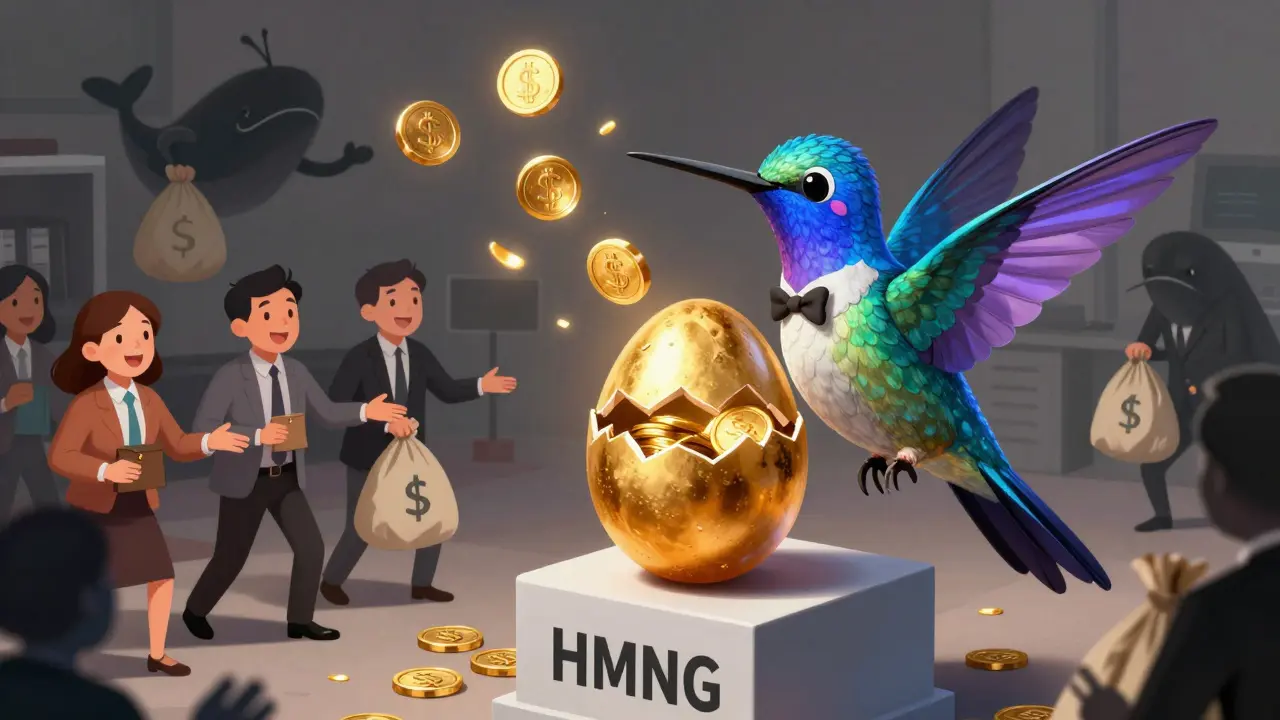
Remember the wild days of early 2021? That was when Hummingbird Finance (Old) (HMNG) launched as a BEP-20 reward token on Binance Smart Chain promising passive USDT income without staking. It sounded too good to be true. You just hold the token, and magic happens. Unfortunately, in the world of decentralized finance, if it sounds like free money, it usually isn't. Today, that original HMNG token is essentially dead, serving as a stark warning about the dangers of unsustainable tokenomics.
The Promise: Passive Income Without Staking
When Hummingbird Finance (Old) dropped on April 12, 2021, it positioned itself as a smarter version of its predecessors. It was a fork of SafeMoon and Reflection Finance (RFI), two projects that had captured imaginations with their 'reflection' models. But HMNG tweaked the formula. Instead of the hefty 10% transaction fee SafeMoon charged, HMNG proposed a much leaner 3% fee structure. The idea was simple: lower fees meant less friction for traders.
Here is how the mechanism was supposed to work:
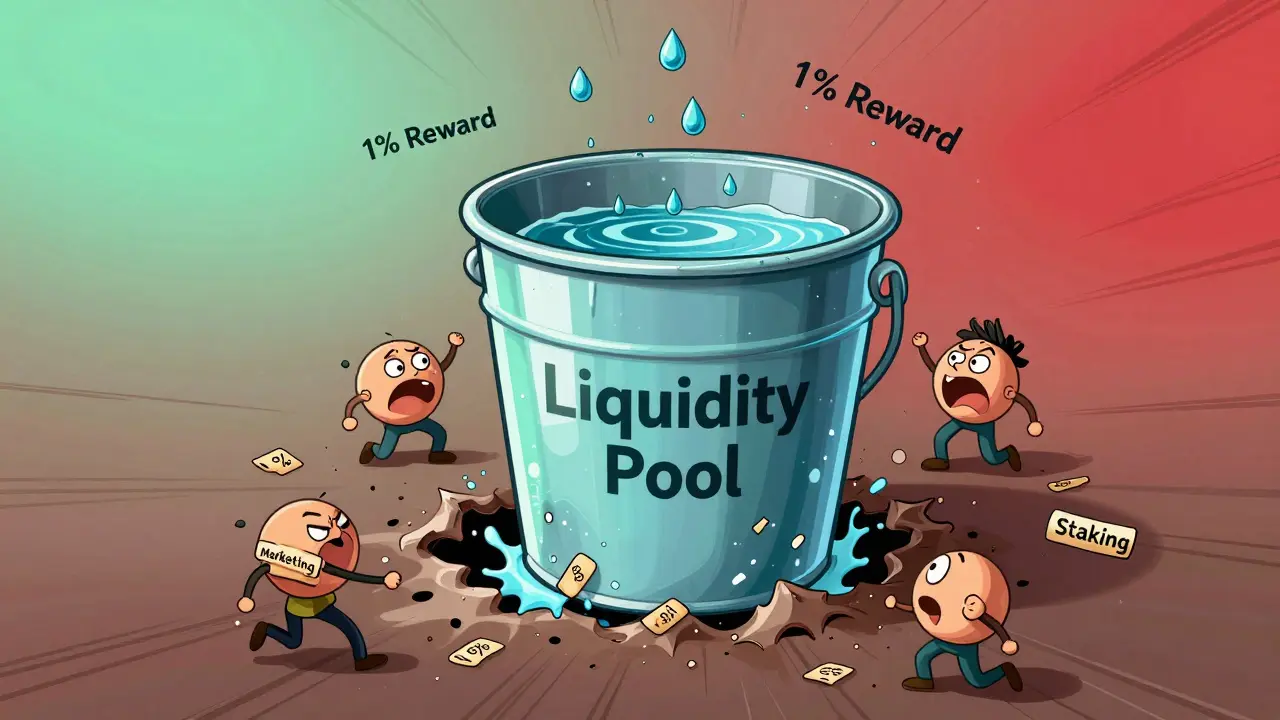
- 1% went directly to holders as USDT rewards.
- 1% was allocated to marketing efforts.
- 1% was added to the liquidity pool to stabilize the price.
The pitch was compelling. You didn't need to stake your tokens in a smart contract or lock them up for months. Just holding HMNG in your wallet would automatically distribute stablecoin rewards. For many retail investors tired of complex DeFi protocols, this felt like the holy grail. The project also wrapped itself in a noble cause, claiming to support hummingbird habitat conservation, which added an emotional hook to the financial promise.
The Reality: A Mathematical Death Spiral
The problem wasn't the ambition; it was the math. Dr. Evelyn Torres, a blockchain economist at Delphi Digital, pointed out a fatal flaw in her January 2022 research. She called it the 'impossible trilemma.' To sustain those USDT rewards, the token needed one of three things: exponentially increasing transaction volume, continuous massive buy pressure, or direct developer intervention. None of these are sustainable long-term.
Jack Bowers from CryptoSlate nailed it back in April 2021. He noted that the 1% USDT reward created immediate sell pressure. When people received rewards, they didn't reinvest them; they cashed out. This constant selling drained the liquidity pool faster than the 1% allocation could replenish it. It was a leaky bucket where the hole got bigger every second.
By September 2021, the situation had become economically irrational. Crypto.com calculated that the average gas fee on Binance Smart Chain was $0.35. At that time, the value of the rewards you might earn was fractions of a cent. You were paying more to check your balance than you were earning in rewards. The model collapsed under its own weight.
Red Flags: Centralization and Security Risks
Beyond the bad economics, there were serious security concerns. If you look at the contract address 0x851944049dfdd189725b136c5ae3fb83cc62b28d on platforms like GoPlus, a major warning appears. The contract creator retained the ability to make changes to the token contract. This included disabling sells, changing fees, or minting new tokens. In a truly decentralized system, once the code is deployed, it should be immutable. Here, the developers held the keys to the kingdom.
This centralization risk turned into reality. In August 2021, reports surfaced that developers disabled sells for retail holders. Early buyers could exit, but everyday investors found themselves trapped. This is a classic hallmark of a honeypot scam. User 'BlockchainVeteran69' on CoinGecko summarized the experience perfectly, noting how retail investors got trapped while whales exited with massive gains.
| Feature | Hummingbird Finance (Old) | SafeMoon | Reflection Finance (RFI) |
|---|---|---|---|
| Total Transaction Fee | 3% | 10% | Variable |
| Reward Type | USDT (Stablecoin) | SafeMoon Tokens | RFI Tokens |
| Staking Required? | No | Yes (for bonuses) | No |
| Contract Mutability | High Risk (Mutable) | Medium Risk | Low Risk |
| Current Status (2026) | Abandoned/Zombie | Active (Restructured) | Active |
User Experience: Phantom Rewards and Broken Support
If you actually tried to use Hummingbird Finance (Old), the experience was frustrating. Adding the token to MetaMask required manual entry of the contract address and setting decimals to 9. Get that wrong, and your wallet would display incorrect balances, leading to confusion and potential losses.
Support vanished quickly. By August 2021, the official website's support page returned 404 errors. The Telegram group, which once boasted 12,000 members, fell silent by October. On Reddit, user u/DeFi_Disaster shared a story that echoed thousands of others: losing $1,200 in promised USDT rewards that never materialized despite holding millions of tokens. Trustpilot reviews from early 2022 are filled with complaints about 'phantom rewards'-numbers that looked right on screen but couldn't be withdrawn.
The documentation was equally poor. CoinCodex rated the whitepaper a 1.2 out of 10, describing it as 'marketing fluff' with zero technical specifications. There was no roadmap for the promised NestSwap DEX or NFT marketplace. Those features never existed beyond buzzwords.

Market Collapse and Current Status
Hummingbird Finance (Old) hit its all-time high of $0.084705 in December 2024, but this was a ghost of its former self. From its launch peak, the token has suffered a decline of over 99.99%. As of February 2026, CoinPaprika lists the price at effectively $0.00000000 USD. The market capitalization sits at a mere $92,800, with trading volume near zero.
The project has been superseded by 'Hummingbird Finance (New),' a separate entity with different tokenomics. The original HMNG V1 contract has seen zero development activity on GitHub since September 2021. It serves now only as a cautionary tale. Blockworks cited HMNG specifically in a 2026 article titled 'Reflection Tokens: A $10 Billion Lesson,' highlighting how even 'low fee' variants cannot overcome the mathematical impossibility of perpetual reward generation without exponential growth.
Why Did Reflection Tokens Fail?
Hummingbird Finance (Old) was part of a larger wave. In April 2021 alone, over 2,000 reflection tokens launched on Binance Smart Chain. They all suffered from the same core issue: inflationary supply mechanics without fundamental utility. When the market turned bearish, these tokens crashed harder than anything else because their value was entirely dependent on new money entering the system. Once buying pressure stopped, the death spiral began.
Regulatory scrutiny also played a role. SEC Chair Gary Gensler's statement in June 2021 suggesting many reflection tokens were unregistered securities caused a 67% market-wide collapse in the sector. Projects like HMNG, which lacked clear utility or legal compliance, were left stranded.
Is Hummingbird Finance (Old) still a valid investment?
No. The original HMNG token is considered abandoned and has lost virtually all its value. The project has migrated to a new version (Hummingbird Finance New), but the old token carries significant risks including disabled sell functions and zero development activity.
How did Hummingbird Finance differ from SafeMoon?
Hummingbird Finance (Old) featured a lower 3% transaction fee compared to SafeMoon's 10%. Additionally, HMNG distributed rewards in USDT (a stablecoin) rather than its own token, aiming to provide more predictable passive income without requiring users to stake their assets.
What happened to the promised USDT rewards?
The reward mechanism became unsustainable due to low transaction volume and high gas fees. Many users reported receiving 'phantom rewards' that could not be withdrawn. Eventually, the liquidity pool dried up, and the developers ceased operations, leaving holders unable to claim any remaining funds.
Is the HMNG contract safe to interact with?
Security audits have flagged the HMNG V1 contract as highly risky. The contract creator retains the ability to disable sells, change fees, and mint new tokens. This centralization risk makes it unsafe for any meaningful interaction, as developers can manipulate the token at will.
Why did reflection tokens like HMNG fail?
Reflection tokens relied on continuous buy pressure to fund rewards. When new investment slowed, the lack of fundamental utility caused prices to crash. The mathematical model required exponential growth to sustain payouts, which is impossible in a finite market, leading to inevitable collapse.

Write a comment