
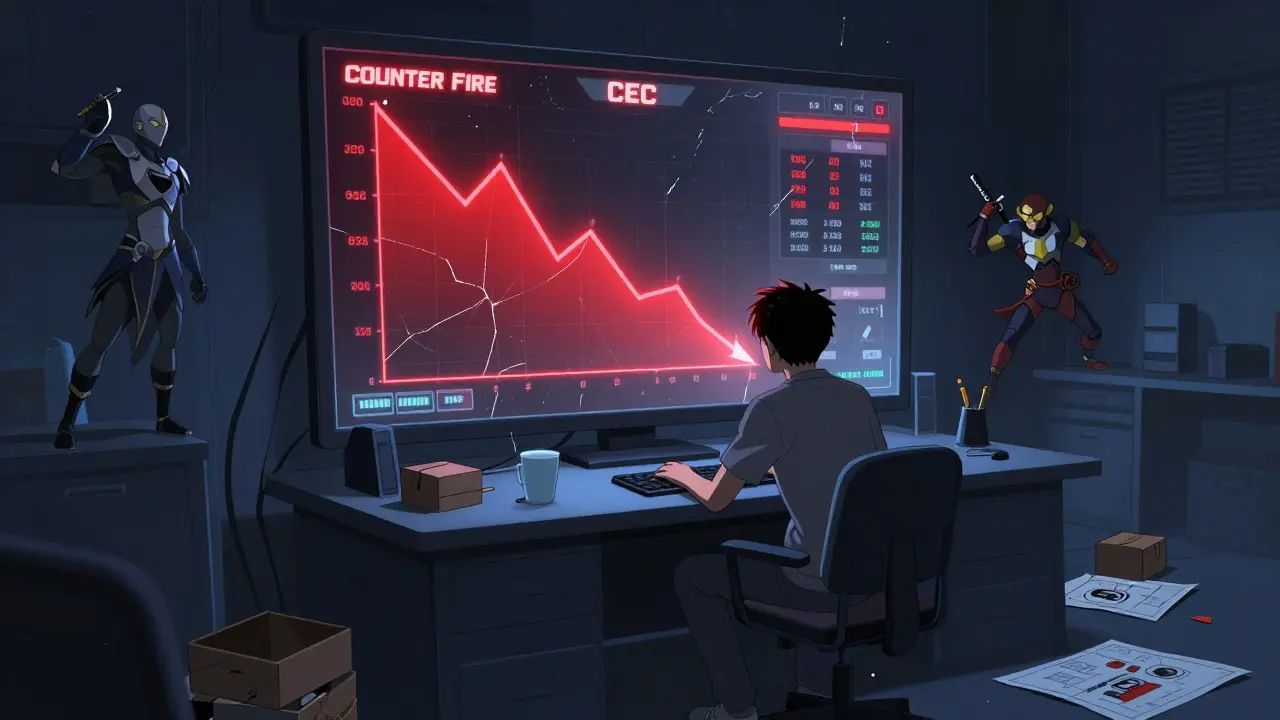
Counter Fire (CEC) isn’t just another crypto coin. It’s tied to a mobile game - a battle royale MOBA with anime-style graphics - and promises players the chance to earn while they play. But here’s the truth most guides won’t tell you: Counter Fire is struggling. Hard.
The token launched in September 2024 at $0.0650. That was the price investors paid during its Initial Exchange Offering (IEO). Fast forward to March 2026, and the price is hovering around $0.0012. That’s a drop of over 98%. If you bought in at launch, you’d need a miracle to break even. And there’s no sign of that miracle coming.
What Exactly Is Counter Fire (CEC)?
Counter Fire is a blockchain-based mobile game built by CEBG Studio - a team of over 30 developers with backgrounds at big names like Lilith Games, NetEase, and Shanda Group. They’re not newcomers. They’ve made hits before. But this time, the game didn’t catch fire.
The game itself is a 5v5 MOBA with Battle Royale elements. Think heroes with special abilities, last-man-standing rounds, and team-based objectives - all wrapped in anime visuals. Players earn $CEC tokens by winning matches, completing challenges, or just logging in daily. The idea is simple: play more, earn more. It sounds like a good model - until you look at what’s happening outside the game.
The $CEC token is the engine of this whole system. It’s used to buy in-game items, unlock skins, enter tournaments, and even trade with other players. Without the token, the whole play-to-earn engine stops. But right now, the token has almost no value.
Token Supply and Distribution
There are 1 billion $CEC tokens in total. Only 100 million are in circulation - that’s 10% of the total. The rest are locked up, either for future game rewards, team allocations, or investor vesting. That’s not unusual. What is unusual is how little of the circulating supply is actually being traded.
Most of the trading happens on Gate.io, where CEC/USDT is the only real pair. Over 99% of all volume flows through this single pair. That’s a red flag. When one exchange handles almost all the trading, it means the market is fragile. A big sell-off there could crash the price fast. And it’s already happened.
The project raised $40,000 during its IEO. Not millions. Not tens of millions. Forty grand. That’s not a sign of massive investor confidence. It’s the kind of funding you’d expect from a small indie studio testing the waters - not a team with ex-Giant Interactive and Lilith Games pedigree.
Why Is the Price Plummeting?
The numbers don’t lie:
- Price since launch: -97.4%
- 30-day decline: -45%
- 90-day decline: -52.5%
- 1-year decline: -85%
Even the most optimistic forecasts now predict another 25% drop. The Fear & Greed Index for CEC sits at 37 - firmly in "Fear" territory. That’s not just a bad sign. It’s a warning.
Why is this happening? Three reasons:
- Too many competitors. Every month, three new play-to-earn games launch. Most are better designed, have bigger teams, or already have 100,000+ active players. Counter Fire has 11,030 token holders. That’s not a community. That’s a spreadsheet.
- No real utility. The game doesn’t require $CEC to play. You can play for free. The token only unlocks cosmetic upgrades or entry into tournaments. That’s not enough to keep people buying it.
- Market distrust. Investors are burned. When a token drops 98%, people assume it’s a rug pull. Even if it’s not, perception becomes reality. And right now, perception is all about exit.
Trading and Liquidity: A Thin Market
The 24-hour trading volume for CEC is around $12,000. That’s less than what a single popular NFT collection makes in a day. For comparison, Axie Infinity’s daily volume was over $20 million at its peak. Counter Fire isn’t even close.
Low volume means high slippage. If you try to sell 10,000 CEC tokens, you’ll likely get a worse price than expected. The market is too shallow to absorb even small trades. That’s why most holders just sit on their tokens - they know they can’t sell without losing more.
Technical indicators show the same story. The 14-day RSI is 37.77 - technically oversold. But oversold doesn’t mean it’ll bounce. It just means sellers are still in control. The 50-day moving average is $0.001756. The current price is below that. The 200-day is $0.004571. The price is trading at less than a quarter of that. That’s a classic bearish pattern.
Who’s Behind It? And Does It Matter?
CEBG Studio has real credentials. They’ve worked on games that made millions. But that doesn’t guarantee success here. Building a game is one thing. Building a sustainable token economy is another.
The project got backing from Youbi Capital, A&T Capital, GSR Ventures, and a few others. But these are Tier 3-4 investors - not the heavyweights like a16z or Sequoia. That tells you something: the big players didn’t see enough potential to bet big.
There’s no whitepaper update in months. No major feature drop. No community push. The last social media post was in November 2024. That’s not a project on the rise. That’s a project on pause.
Should You Buy Counter Fire (CEC)?
Here’s the honest answer: No, unless you’re ready to lose it all.
If you’re looking for a play-to-earn game to earn real value, look elsewhere. Games like Guild of Guardians or Splinterlands have active player bases, clear tokenomics, and real revenue streams. Counter Fire has none of that.
If you’re speculating - betting that the price will rebound - you’re gambling. And the odds are stacked against you. The token is trading at 2% of its launch price. It’s been down for 18 months straight. No recovery signal. No news. No momentum.
Even if the game gets a major update tomorrow, it’s too late. The market has moved on. Players have moved on. Investors have moved on.
What’s Next for Counter Fire?
There are two paths:
- Path A: Fade out. The team quietly stops updates. The Discord goes quiet. The website stops loading. The token becomes a ghost - listed on exchanges but never traded. This is the most likely outcome.
- Path B: A surprise revival. A new studio takes over. They rebuild the game from scratch. They burn the old token and launch a new one. They bring in real marketing. This is possible - but extremely unlikely. No signs of it happening.
Right now, Counter Fire is a cautionary tale. It’s not about bad code. It’s not about bad design. It’s about bad timing, bad execution, and worse market conditions. The play-to-earn hype is over. And projects like this didn’t survive the crash.
If you’re still holding CEC, the best move isn’t to buy more. It’s to cut your losses and move on.

Comments
Brenda White
cecs dead. just accept it. i bought at 0.05 and now im at 0.0012. no recovery coming. move on.
Carol Lueneburg
I know it hurts but honestly? This is why you don’t invest in crypto games without real utility 😔💔 I mean, if you can play for free and the token just unlocks skins... why would anyone hold it? I’m sending you all virtual hugs and maybe a coffee if you’re in the US 🤗☕
Zachary N
Let’s be real - this isn’t about bad code. It’s about ecosystem design. Play-to-earn only works if the token has *demand* outside speculation. Here? No one needs CEC to play. No one needs it to upgrade. It’s a cosmetic add-on with a broken economy. The devs didn’t build a token economy - they built a lottery ticket with a game attached. And lotteries don’t sustain themselves when the jackpot’s gone. You need revenue streams, not just rewards. Guild of Guardians? They have actual in-game purchases that require the token. CEC? Just vanity. That’s why the price died.
Ernestine La Baronne Orange
I’ve been watching this collapse for months - and I swear, every time I think it’s hit bottom, it finds a new way to sink lower. 98%? That’s not a correction - that’s a funeral. The team hasn’t posted since November. The Discord is a graveyard. The trading volume is less than my weekly Starbucks habit. And the worst part? The people still holding it? They’re not investors - they’re emotionally attached. Like they’re waiting for a text from an ex who ghosted them. Wake up. The game is dead. The token is dead. The project is dead. Stop throwing good money after bad. It’s not a ‘buy the dip’ - it’s ‘buy the coffin.’
Lucy de Gruchy
The fact that they raised only $40k speaks volumes. Anyone with a lick of sense would’ve walked away after seeing the IEO numbers. And yet, here we are - 11,030 token holders. Not a community. A statistical anomaly. The real crime? This isn’t even a rug pull. It’s a slow, bureaucratic death. No malice. Just incompetence. And that’s worse. At least a rug pull respects your time.
George Hutchings
I’ve seen this movie before. Team with good creds. Cool visuals. Tokenomics that sound good on paper. Then… silence. No updates. No community growth. No real reason to keep playing. It’s not that the game is bad. It’s that nobody cares anymore. And in crypto? Nobody caring = zero value. Period.
Manali Sovani
The project lacks fundamental viability. The tokenomics are structurally unsound. The liquidity is insufficient. The community engagement is negligible. The team has not demonstrated adaptive capacity. The market has rendered its judgment. There is no ambiguity.
S F
USA has better crypto projects. This is why we need to stop letting indie teams with Lilith alumni names fool people into thinking they’re legit. This is a joke. A global joke. And we’re the punchline.
sai nikhil
I respect the dev team's background. But blockchain games need more than pedigree. They need players. And players need reasons to stay. CEC has none. That’s the truth.
Sahithi Reddy
If you still hold CEC you're either brave or delusional
Henrique Lyma
The real tragedy isn't the 98% drop. It's that this was entirely preventable. A team with this pedigree could’ve built a sustainable token economy - integrated real revenue from merch, cosmetics, or subscriptions. Instead, they slapped a token on a game that didn’t need it and assumed the hype would carry them. It didn’t. And now we’re left with a corpse dressed in anime aesthetics. The market doesn’t reward aesthetics. It rewards utility. And CEC has none.
Steph Andrews
I think people forget that crypto games are about community more than code. If the devs stopped talking, the players left. Simple as that. No drama. No conspiracy. Just a quiet fade-out. And honestly? That’s the most common way these things die.
Prakash Patel
I actually think this could come back. Not because of the token - but because the game’s mechanics are solid. Someone else could buy the IP, burn the old token, and relaunch. It’s happened before. Maybe not this year. But someday.
Elizabeth Kurtz
I’ve been in crypto since 2017. I’ve seen dozens of these. The pattern is always the same: big promise, weak utility, no real roadmap. CEC is textbook. The devs didn’t fail because they were bad - they failed because they didn’t listen. The community was never built. The token was never needed. And now? It’s just digital dust. Don’t chase dead money. Find something that actually moves.
john peter
The moral failing here is not financial - it is philosophical. To tokenize play is to commodify joy. And when joy becomes a commodity, it ceases to be joy. The CEC token is not a failure of economics. It is a failure of spirit. We have turned a game into a gamble. And in doing so, we have lost something irreplaceable.
Marc Morgan
I’ve watched this coin die in slow motion. Honestly? I’m impressed. Most projects crash in a week. This one took 18 months to fully collapse. That’s like a tortoise winning a funeral race. Congrats, CEC. You’ve achieved peak mediocrity.
Anastasia Thyroff
I still remember the day I bought CEC… I thought it was going to be my ticket out… I even told my mom… she said ‘are you sure?’… I said ‘yes mom’… now I just stare at my wallet… and cry…
Kira Dreamland
I think the devs just got distracted by another project. Happens all the time. Maybe they’re working on something better now. I’m not mad. Just disappointed. We all thought this could’ve been something.
Sarah Hammon
I know i spelled some words wrong but i just had to say this - CEC is not dead it’s just sleeping. I still believe. I still play. I still log in. I still hold. Maybe one day it wakes up. Maybe not. But i’ll be here.
Tobias Wriedt
People who still hold this are either brainwashed or idiots. This isn’t investing. It’s emotional hoarding. You’re not a ‘long-term holder.’ You’re a hostage.