
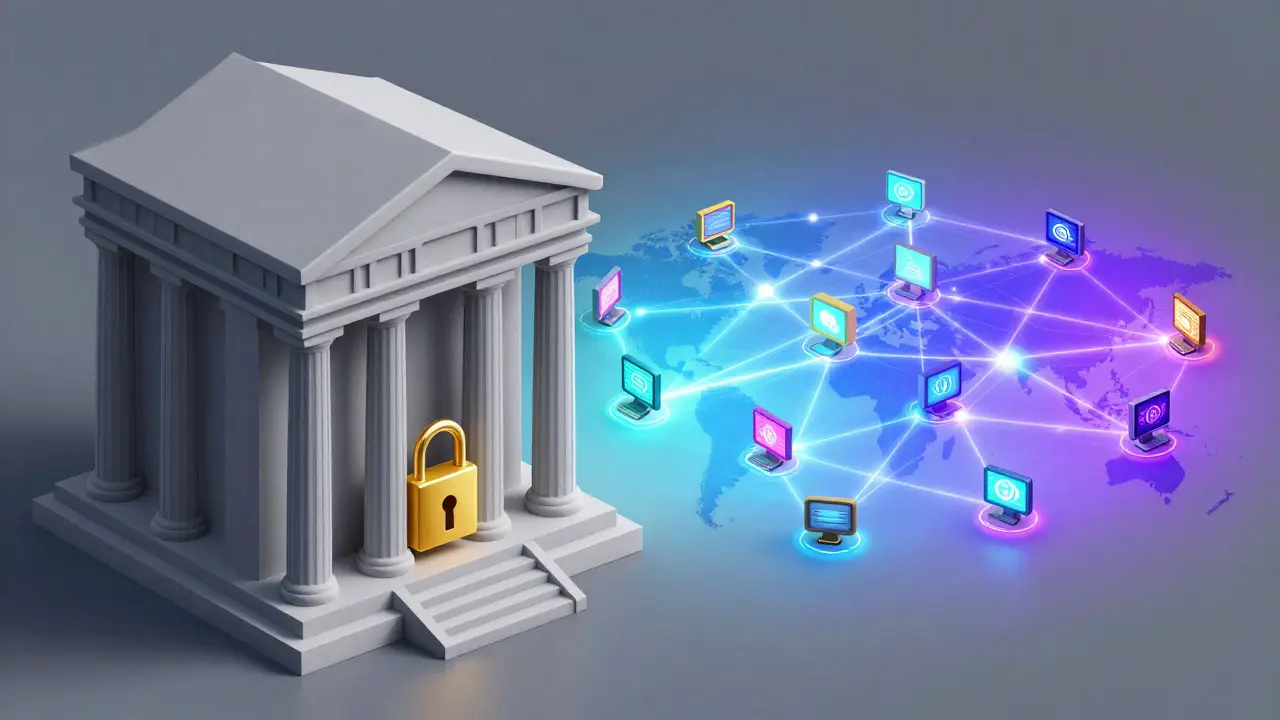
Imagine a world where your bank decides your account is "problematic" and freezes your funds without a clear reason. You have no one to appeal to because the bank owns the servers, the data, and the rules. That is the reality of centralized systems. Now, imagine a system where the rules are written in code, and thousands of independent computers around the world all hold a copy of the truth. If one computer tries to lie, the other 9,999 call it out instantly. That is the power of a decentralized network, and it only works if people actually run the hardware that makes it happen.
When people talk about blockchain node operation, they aren't just talking about technical chores. They are talking about the actual heartbeat of a decentralized system. Without nodes, a blockchain is just a fancy database controlled by a few people. To understand why this matters, we have to look at what a node actually does and how it stops the "big players" from taking over.
What Exactly Is a Blockchain Node?
Blockchain Node is an individual computer or server that runs a specific piece of software to communicate with other computers on a blockchain network. These nodes form a Peer-to-Peer (P2P) network, meaning there is no central hub. Instead, every node talks directly to its neighbors.
Think of a node as a digital accountant. In a traditional system, the bank has one master ledger. In a blockchain, every Full Node maintains a complete, identical copy of the entire transaction history. If you run a full node, you aren't trusting a third-party service to tell you your balance; you are checking the math yourself using your own copy of the ledger.
Depending on the network, the requirements vary. For instance, a node on the Bitcoin network requires a decent amount of storage (hundreds of gigabytes) and a steady internet connection to stay synchronized. While it sounds like a lot of work, this redundancy is exactly what prevents the system from crashing if a few servers go offline.
Stopping the "Single Point of Failure"
In the old-school web, if Amazon Web Services (AWS) has a major outage, half the internet disappears. That is a "single point of failure." Blockchains solve this by distributing the data across thousands of nodes globally. If a government shuts down all nodes in one country, or a massive power outage hits a specific region, the network doesn't even blink. The remaining nodes in other parts of the world keep the ledger alive.
But it's not just about uptime; it's about security. To successfully hack a well-distributed blockchain, an attacker would need to control more than 50% of the network's nodes to push through a fraudulent transaction. This is the famous "51% attack." In a network with thousands of independent operators, the cost and coordination required to pull this off are practically impossible. When you run a node, you are essentially adding another brick to the wall that keeps hackers out.
Trustless Validation and the Death of the Middleman
Why do we usually trust a bank? Because they act as the intermediary that verifies we actually have the money we're sending. Blockchain nodes replace that middleman with a Consensus Mechanism. Whether it's Proof of Work (PoW) or Proof of Stake (PoS), the nodes are the ones doing the auditing.
| Node Type | Data Held | Role in Decentralization | Hardware Demand |
|---|---|---|---|
| Full Node | Complete Ledger | Validates every transaction; enforces rules | High |
| Light Node | Headers Only | Relies on full nodes for data; improves accessibility | Low |
| Mining/Validator Node | Complete Ledger | Creates new blocks; secures the network | Very High |
This creates a "trustless" environment. You don't have to know the person you're trading with, and you don't have to trust the company providing your wallet app. As long as your node confirms the transaction follows the network rules, it's legitimate. This shifts the power from a central authority back to the individual user.

Governance: Voting With Your Hardware
Running a node often gives you more than just security-it gives you a voice. In many networks, node operators are the ones who decide how the software evolves. This is where the "decentralized" part of a DAO (Decentralized Autonomous Organization) really comes into play.
For example, the Dash network uses masternodes to vote on development proposals. Similarly, Decred employs a hybrid model where stakeholders use their nodes to vote on policy changes. If only a few companies ran the nodes, they could decide to change the rules to benefit themselves. When thousands of regular people run nodes, the network evolves based on the community's needs, not a boardroom's profit margin.
The Shield Against Censorship
Censorship is easy when there is a central switch to flip. If a government wants to block a specific service, they just tell the ISP to block the IP address of the central server. But how do you block a network that is everywhere and nowhere at once?
Because nodes are distributed globally, information stored on a blockchain is nearly impossible to erase. If a regime tries to censor a transaction or a piece of data, it doesn't matter-the data still exists on thousands of other nodes in other jurisdictions. This makes blockchain nodes a critical tool for freedom of information and financial sovereignty, especially in places where traditional banking is used as a tool for political control.
The Economic Side: Incentives for Participation
Let's be real: running a computer 24/7 costs money in electricity and hardware. To keep the network healthy, many blockchains offer rewards. While full nodes are often run by enthusiasts for the sake of security, Validator Nodes in Proof of Stake networks receive cryptocurrency rewards for their work.
These incentives create a cycle of ownership. When you have a financial stake in the network's health, you are more likely to ensure your node is running correctly and securely. It turns network maintenance into a viable economic activity, ensuring that there are always enough people willing to keep the "lights on" for the rest of the world.
Real-World Impact: From Finance to Identity
The ripple effects of node decentralization go beyond just trading coins. We are seeing this move into Decentralized Identity systems. Instead of Google or Facebook owning your digital identity, a distributed network of nodes can verify your attributes without ever storing your private data in one central, hackable honeypot.
In supply chain management, nodes run by different companies (shipping, manufacturing, customs) can all maintain a shared ledger. This removes the need for a third-party auditor to verify where a product came from, as the nodes themselves provide the verifiable proof. This doesn't just make things more secure-it makes them faster by cutting out the paperwork and the middleman.
Do I need to be a programmer to run a node?
No, you don't need to be a coder. Many blockchain projects now offer user-friendly software with graphical interfaces (GUIs) that allow you to set up a node with a few clicks. The hardest part is usually managing the hardware and storage requirements.
What is the difference between a full node and a miner?
A full node validates and stores the entire blockchain to ensure rules are followed. A miner (or validator) is a specific type of node that competes to add new blocks to the chain. All miners must run full nodes, but not all full nodes are miners.
Will running a node slow down my internet?
It can. Nodes constantly communicate with other peers to propagate transactions and blocks. Depending on your bandwidth, this might impact other activities on your network. Using a dedicated machine or a VPS (Virtual Private Server) is often the best way to avoid this.
Why can't I just use a wallet app instead of a node?
Wallet apps usually connect to "remote nodes" run by the app developer. This means you are trusting the developer's node to tell you the truth about your balance. Running your own node allows you to verify that data independently without relying on a third party.
Is it expensive to run a node?
It depends on the blockchain. For some, a basic home PC and a large SSD are enough. For others, like high-performance validator nodes, you might need professional-grade hardware and high-speed fiber internet. Always check the specific hardware requirements of the network you want to support.
Next Steps for Aspiring Node Operators
If you're ready to stop trusting and start verifying, here is how to move forward based on your goals:
- The Security Enthusiast: Look into setting up a Full Node on a dedicated Raspberry Pi or an old laptop. Focus on networks like Bitcoin or Ethereum to help harden the overall infrastructure.
- The Income Seeker: Research Proof of Stake (PoS) networks. Look into "staking" and the requirements for becoming a validator. Be aware that this often requires a minimum amount of tokens to be locked up.
- The Privacy Advocate: Explore decentralized identity projects or smaller, privacy-focused blockchains. Running these nodes helps ensure that the infrastructure for digital autonomy remains censorship-resistant.

Comments
Jason Davis
Seting up a node is actuly way easier than most peple think. I've seen a lot of newbis get scard by the terminal, but once you get a Raspbery Pi runing, it's basically set and forget. Just make sure you have a good quality SSD because SD cards will burn out fast with all the read/write cycles from the ledger updates. Its a grate way to really understand how the peer-to-peer mesh works in real time.
Tracie and Matthew Hartley
idk why everyone acts like this is some huge revolution lol. most ppl just use a wallet and dont care. who actually has time to keep a computer running 24/7 just to prove a point about decentralizashun? sounds like a lot of effort for zero payoff for the average jo.
Artavius Edmond
I can totally see where you're coming from, but there's something really satisfying about knowing your own data is safe! It's kind of like gardening for the internet. Even if most people don't do it, the ones who do make the whole ecosystem stronger for everyone. I'm all for it!
EDOZIEM MICHAEL
truth is a shared dream we all agree on and nodes are just the anchors holding that dream to the earth if we let a few people hold the anchors then we are just dreaming their dream not our own
Samson Selleck
The systemic reliance on naive trust in third-party API endpoints is a cognitive failure of the masses. Most participants in this space are merely speculating on price action without any conceptual grasp of Byzantine Fault Tolerance or the actual cryptographic primitives that ensure state consistency. The sheer lack of intellectual rigor in the 'just use a wallet' crowd is exhausting. If you aren't validating the state transitions yourself, you are simply playing a game of musical chairs with a centralized database masquerading as a distributed ledger. It's frankly pathetic how many people mistake a GUI for actual sovereignty.
Tyler Webb
I hear you, it can feel overwhelming to start 😅. Maybe we can find some guides for people who are just starting out? 😊
Alan Seiden
This is utter rubbish. The electricity waste alone is a crime against the environment. Only an idiot would think that running a redundant server in their bedroom is 'freedom.' It's a glorified hobby for people with too much time and not enough common sense.
Adam Auksel
Actually, there are some really cool low-energy options now! ⚡️ Checking out some of the newer PoS networks is a great way to get involved without melting the ice caps 🌍✨. Everyone can contribute in their own way! 🚀
jennelle williams
it feels like taking back a little piece of ourselves. just simple steps to be free.
Chidinma Sandra okafor
Oh wow, such a lovely explanation of how to waste electricity. I'm sure the 'decentralized' future is just great while some of us are actually dealing with real world power grids that fail every two hours. Truly revolutionary stuff here.
Prasanna Shembekar
omg the drama if the nodes go down we all lose everything imagine the chaos lol
Jessie Tayaban
I TRIED to set up a node once and my laptop literally sound like it was going to take off like a rocket ship!! 🚀 I was so scared it was gonna explode and i just shut it down immediately haha!! it was so intense for no reason!!
Akshay Gorad
It is good to have this information. We must maintain a balance between technical progress and personal privacy.
Lauren Abrams
Seems like a solid way to keep the network honest. I'm just watching from the sidelines for now.
aletheia wittman
imagine trusting a bank with ur life savings when u can just run a node lol what a nightmare!! i cant even imagine the stress of a frozen account honestly i would literally scream