

When you’re trading crypto, speed and cost matter more than you think. Most people assume all decentralized exchanges are the same-connect your wallet, swap tokens, wait for confirmation. But what if you could swap tokens in under three seconds, pay less than a penny in fees, and never worry about MEV attacks? That’s not a dream. That’s SaucerSwap v1.
SaucerSwap v1 isn’t just another Uniswap clone. It’s built on Hedera Hashgraph, a network most retail traders have never heard of-but one that’s quietly outperforming Ethereum in speed and cost. Launched in 2022, it was designed to fix the broken parts of DeFi: high fees, slow transactions, and front-running bots. And for users who stick to Hedera-native tokens, it delivers on that promise.
How SaucerSwap v1 Works (Without the Jargon)
SaucerSwap v1 uses the same math as Uniswap V2: the constant product formula, x × y = k. If you put 100 USDC and 1,000 WHBAR into a pool, the product (100,000) stays constant. When someone swaps USDC for WHBAR, the system adjusts the ratio automatically. No order book. No middleman. Just code.
Every trade charges a 0.30% fee. About 0.25% goes straight to liquidity providers. The rest (0.05%) is used to buy back and burn SAUCE tokens. That’s it. No hidden fees. No surprise gas spikes. And because Hedera doesn’t use proof-of-work, there’s no competition for block space. Transactions are ordered fairly by timestamp, not by who pays the most. That’s why zero MEV attacks have been recorded on v1 since launch-unlike Ethereum DEXs, which saw over 140 MEV exploits in just one quarter.
Performance That Stands Out
Let’s get real about numbers.
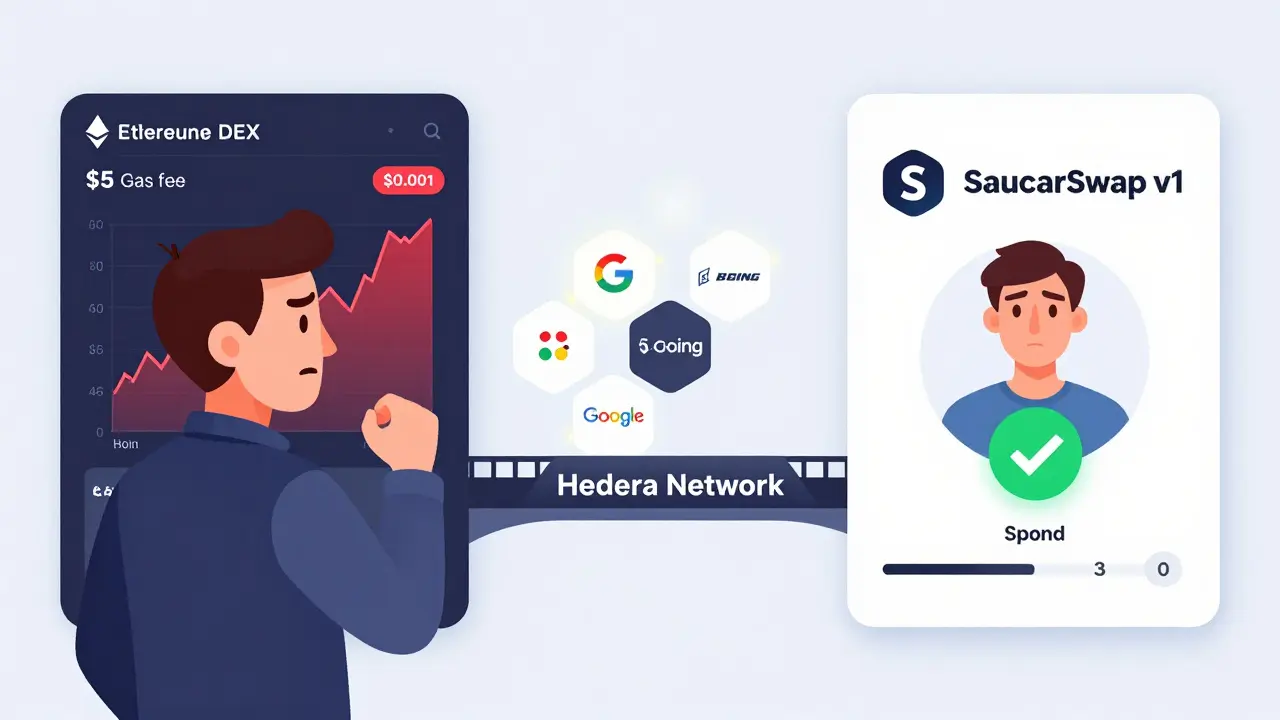
On Ethereum, swapping tokens can cost $1-$5 in gas, depending on network congestion. On SaucerSwap v1? You pay under $0.001. That’s 1,000 times cheaper. And the transaction confirms in 2.8 seconds on average, not 15-60 seconds like on older chains.
As of December 2025, SaucerSwap v1 handled $1.47 million in daily trading volume. That might sound small next to Uniswap’s $3 billion, but here’s the catch: 92% of that volume came from just five trading pairs. The top pair? USDC/WHBAR, which alone moved over half a million dollars in 24 hours. That’s not because it’s popular-it’s because it’s the most reliable. Slippage on this pair averaged just 0.12% in November 2025. For comparison, a similar pair on a lesser-known chain might have 3-5% slippage.
Liquidity providers aren’t doing badly either. Stablecoin pools like USDC/WHBAR paid out an average of 14.3% APY. More volatile pairs? Up to 28.7%. One user reported earning 0.78 WHBAR and 1.23 SAUCE in just seven days-consistent, predictable returns without the drama of Ethereum farms that crash when the market dips.
What You Can’t Trade (And Why It Matters)
SaucerSwap v1 supports 38 coins and 93 trading pairs. Sounds decent? Until you realize Uniswap supports over 2,500. PancakeSwap? Over 1,800. SaucerSwap v1 only works with assets native to Hedera. No Bitcoin. No Ethereum. No Solana tokens. No BNB. No USDT. Only WHBAR, USDC, SAUCE, and a handful of other tokens minted on Hedera’s Token Service (HTS).
This isn’t a bug-it’s a design choice. SaucerSwap v1 doesn’t bridge assets from other chains. If you want to trade ETH for SAUCE, you can’t. You have to buy HBAR on a centralized exchange, send it to your Hedera wallet, then swap it. That’s a barrier for most people. It’s why 99% of SaucerSwap’s traffic comes from users already in the Hedera ecosystem. No accidental discovery. No viral token pumps. Just a tight-knit community of early adopters.
Security and Trust
SaucerSwap v1 was audited by Hacken in August 2022. Their report gave it a 7.8/10-solid, not perfect. They praised the clean implementation of the constant product formula but flagged weak reentrancy protections. That means if someone finds a clever exploit, they could theoretically drain liquidity pools. But here’s the thing: no exploit has ever been successful. The protocol has been live for over three years. No hacks. No stolen funds. No rug pulls.
And because Hedera uses a permissioned consensus (governed by major corporations like Google, Boeing, and Deutsche Telekom), it’s harder to launch a 51% attack than on public blockchains. The network is stable. The validators are accountable. That’s why institutional adoption, while minimal, is growing slowly. Only three companies are using SaucerSwap v1 for treasury management, but they’re not small players-they’re enterprise-grade.
Who Is This For? (And Who Should Avoid It)
If you’re trading Hedera-native tokens-especially WHBAR, USDC, or SAUCE-SaucerSwap v1 is the best option on the planet. Fast, cheap, reliable. You’ll pay less than a cent per swap. You’ll get instant confirmation. You’ll earn solid yields.
But if you want to trade Solana memecoins, Bitcoin derivatives, or anything not on Hedera? You’re out of luck. SaucerSwap v1 won’t help you. And if you’re new to crypto? The setup is clunky. You need to install HashPack or Freewallet, buy HBAR on a CEX, send it over, and then navigate a UI that’s functional but outdated. Users report getting stuck for 20 minutes trying to add liquidity. The documentation is accurate but dry. No video tutorials. No beginner guides. You’ll need to Google stuff.
That’s why 72% of new users say they had to leave SaucerSwap’s site to figure out how to use it. It’s not user-friendly. It’s not designed for beginners. It’s designed for people who already understand DeFi and want to trade on the fastest, cheapest chain available.
The Bigger Picture: Hedera’s Future Is SaucerSwap’s Future
SaucerSwap v1 is tied to Hedera’s success like a lifeline. 98% of its total value locked (TVL) is directly tied to HBAR’s price. When NVIDIA announced a partnership with Hedera in July 2025, HBAR surged 70%. SaucerSwap’s trading volume spiked 300% overnight. When HBAR dropped 15% in November, TVL fell 18%.
That’s the risk. If Hedera fails to attract mainstream users, SaucerSwap v1 will fade. It doesn’t have the brand recognition of Uniswap. It doesn’t have the liquidity of PancakeSwap. It only exists because Hedera exists.
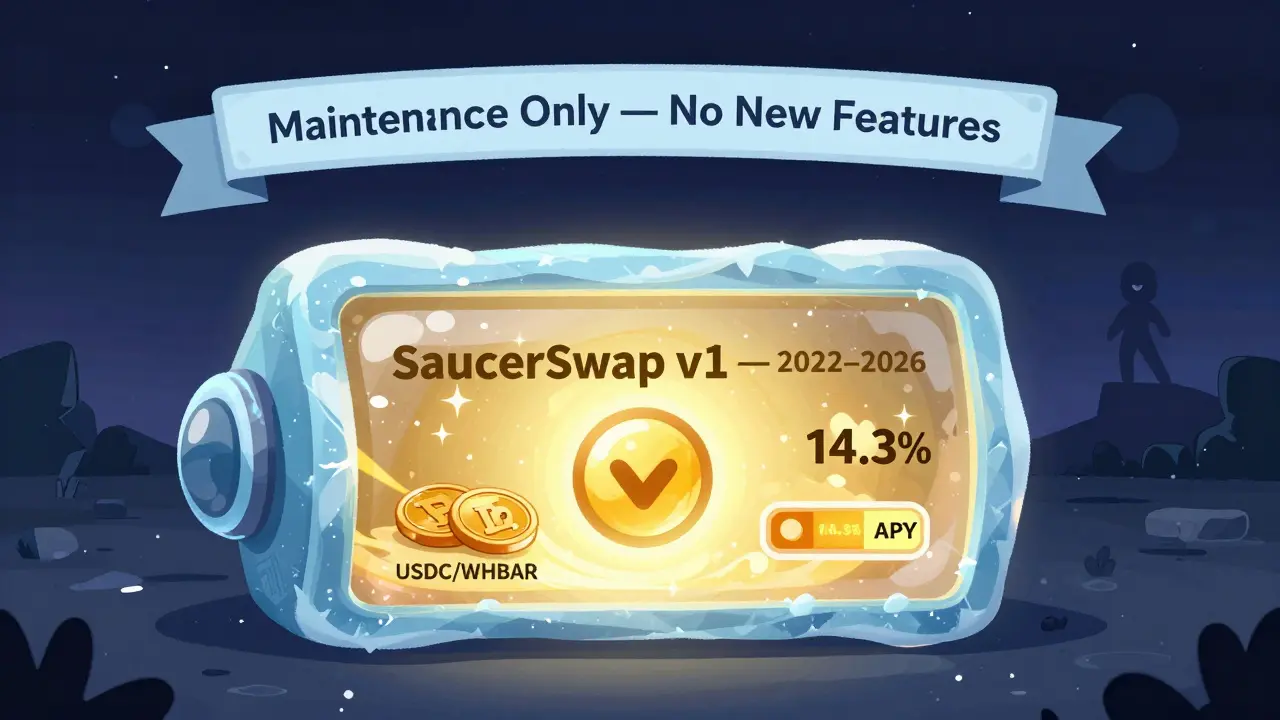
And here’s the twist: SaucerSwap v1 is no longer being developed. As of November 30, 2025, the team stopped adding new features. All focus has shifted to v2, which introduces concentrated liquidity like Uniswap V3. v1 is now in maintenance mode-security updates until Q2 2026, then it’s archived.
That means no new tokens. No UI upgrades. No integrations. It’s frozen in time. But for users who only need to swap USDC and WHBAR? It still works perfectly. The code hasn’t broken. The liquidity is still there. The fees are still tiny.
Final Verdict: A Niche Tool That Does One Thing Brilliantly
SaucerSwap v1 isn’t the future of DeFi. It’s a snapshot of what DeFi could be if speed and cost mattered more than hype. It’s not for everyone. It’s not for traders chasing the next memecoin. It’s not for people who want a pretty interface or one-click deposits.
It’s for the quiet minority-the ones who care about paying pennies, waiting seconds, and knowing their trades won’t be stolen by bots. If you’re already in the Hedera ecosystem, SaucerSwap v1 is your best tool. If you’re not? Don’t bother. Wait for v2. Or go somewhere else.
For what it is, it’s flawless. For what it isn’t, it’s irrelevant. That’s the truth.
Is SaucerSwap v1 still operational in 2026?
Yes, SaucerSwap v1 is still operational as of February 2026. The development team stopped adding new features in November 2025 and shifted focus entirely to v2. However, security updates will continue through Q2 2026, and the smart contracts remain fully functional. Users can still swap tokens, provide liquidity, and earn rewards without interruption.
Can I trade Bitcoin or Ethereum on SaucerSwap v1?
No. SaucerSwap v1 only supports tokens native to the Hedera Hashgraph network. You cannot trade Bitcoin, Ethereum, Solana, or any other cross-chain asset. All tokens must be minted using Hedera’s Token Service (HTS). If you want to trade non-Hedera assets, you’ll need to use a different DEX or a centralized exchange.
What wallets work with SaucerSwap v1?
SaucerSwap v1 only works with Hedera-compatible wallets: HashPack (most popular), Freewallet, and Ledger (via Hedera app integration). MetaMask and other Ethereum wallets won’t connect. HashPack is recommended because it has the most seamless integration with the SaucerSwap interface and supports direct HBAR purchases via fiat on-ramps.
How much does a swap cost on SaucerSwap v1?
Each swap on SaucerSwap v1 costs less than $0.001. This includes the network fee and the 0.30% trading fee. For context, a similar swap on Ethereum can cost $1-$5. The low cost is possible because Hedera uses a consensus mechanism that doesn’t require mining or staking rewards, making transaction fees negligible.
Is SaucerSwap v1 safe to use?
Yes, SaucerSwap v1 is considered safe. It was audited by Hacken in 2022 with no critical vulnerabilities found. No exploits or hacks have occurred since launch. The protocol’s design prevents MEV attacks, and Hedera’s enterprise-grade consensus adds another layer of security. However, like all DeFi platforms, you’re responsible for your own wallet security. Never share your seed phrase, and only use official links.
Why is SaucerSwap v1 being phased out?
SaucerSwap v1 is being phased out because v2 introduces concentrated liquidity-a major upgrade that allows liquidity providers to earn higher fees by placing their funds within specific price ranges. This is similar to Uniswap V3 and significantly improves capital efficiency. The team decided to stop developing v1 to focus resources on v2, which is better positioned for long-term growth. v1 will remain accessible but won’t receive any new features.

Comments
christopher luke
This is actually one of the few DeFi platforms that doesn't make me want to scream 😊 I've been using SaucerSwap v1 for months now and honestly? It's like a quiet little zen garden of trading. No drama, no gas spikes, just smooth swaps. 🙌
Mary Scott
they said hedera was secure but what if google and boeing are secretly mining hbar to manipulate prices? i mean think about it-corporate consensus? sounds like a backdoor to me. they're watching us. always are.
Shannon Holliday
I love how clean this is 😍 Like, no noise, no memecoins, just pure utility. I switched from Uniswap after losing $200 to MEV bots. SaucerSwap? Zero stress. Zero drama. Just vibes. 🌿✨
Jeremy buttoncollector
The architectural elegance of SaucerSwap v1’s implementation of the constant product invariant under a permissioned consensus layer represents a paradigmatic shift from the chaotic entropy of PoW-based DEXes. The elimination of MEV vectors via timestamp ordering is not merely an optimization-it’s an ontological correction in decentralized finance. The fact that this is being deprecated is… tragic.
Michelle Xu
For anyone considering SaucerSwap v1: if you’re already on Hedera and trading WHBAR/USDC, this is the most efficient tool out there. The fees are negligible, the speed is unmatched, and the security track record speaks for itself. Just make sure you’re using HashPack-everything else is a headache. Also, don’t expect hand-holding. This isn’t for beginners.
Amanda Markwick
I’ve been telling everyone this for months-SaucerSwap v1 is the quiet powerhouse of DeFi. People are obsessed with shiny new chains and meme coins, but the real winners are the ones who just want to swap without getting robbed. This is what DeFi should be: simple, fast, fair. V2 can’t come soon enough, but v1? Still flawless.
Sriharsha Majety
i used this for 6 months and never had a problem. hbar is underrated and saucerswap is the real deal. why do people always look for the flashiest thing when the simple one works better? just sayin
Tabitha Davis
Oh wow, another ‘Hedera is the future’ cult post. Let me guess-your wallet is 90% HBAR and you’ve never heard of Uniswap? This thing is a ghost town. The volume is laughable. And now they’re shutting it down? Classic. You’re not a visionary, you’re just stuck in a dead-end ecosystem.
Vishakha Singh
For those new to Hedera, I highly recommend starting with SaucerSwap v1 if you're focused on stable swaps. The reliability is unmatched, and the yield on USDC/WHBAR is among the most consistent in DeFi. It’s not flashy, but consistency beats hype every time. Keep learning, stay patient, and the results will follow.
Andrew Hadder
i swear i spent 20 mins trying to add liquidity and thought i broke my wallet. turns out i just needed to refresh. dumb ui but the trades work. still worth it for the cost. 0.0003? no way.
Derek Sasser
I came in skeptical but after 12 swaps and zero issues, I’m convinced. The fact that it’s in maintenance mode doesn’t bother me-I don’t need new features. I need reliability. And it delivers. Also, no one talks about how the 0.05% SAUCE burn actually helps long-term value. Quietly smart design.
Neeti Sharma
usa always thinks they have the best tech. india has better blockchain projects. hedera is just a corporate toy. saucerswap is useless outside usa. why should we care about a platform that cant even take btc? pathetic.
Nadia Shalaby
I just scroll past all the DeFi drama. SaucerSwap v1? Yeah, I use it. It works. Doesn’t need to be loud. Doesn’t need to be popular. Just… works. That’s all I ask for.
Fiona Monroe
The operational integrity of SaucerSwap v1, particularly its adherence to timestamp-based transaction ordering, represents a significant departure from the exploitable congestion models of Ethereum-based DEXes. The absence of MEV incidents over a three-year period is not accidental but a direct consequence of Hedera’s consensus architecture. That this is being deprecated without a direct migration path is a strategic misstep.
Molley Spencer
Let’s be real. SaucerSwap v1 is a museum piece. 1.47M daily volume? That’s less than a single Uniswap pool. The UI looks like it was coded in 2018. The only reason it’s still alive is because nobody with real money has left yet. And now they’re shutting it down? Good. Let it die.
John Fuller
works fine
Maggie House
I’m new to crypto and I didn’t know what Hedera was until I found this. Took me a week to figure out HashPack, but now I just swap USDC and WHBAR every weekend. It’s so chill. I don’t even check prices anymore. Just swap, earn a little, chill. Feels like crypto should be.
Dana Sikand
I just want to say thank you to whoever wrote this post. I’ve been lost in DeFi for years-every DEX feels like a casino. SaucerSwap v1? It’s the first time I’ve felt safe. I cried when I saw my first swap cost $0.0007. I didn’t know that was possible. I’m not rich, I’m not smart, but I finally feel like I’m not getting screwed. I’m so grateful.
Jeremy buttoncollector
The fact that v2 introduces concentrated liquidity is a necessary evolution, but to abandon v1’s simplicity is akin to replacing a perfectly functioning manual transmission with a glitchy automatic just because it has 'adaptive cruise control.' The elegance of x*y=k under timestamp ordering is a masterpiece of minimalist design. v2 may be more capital-efficient, but v1 was… pure.