

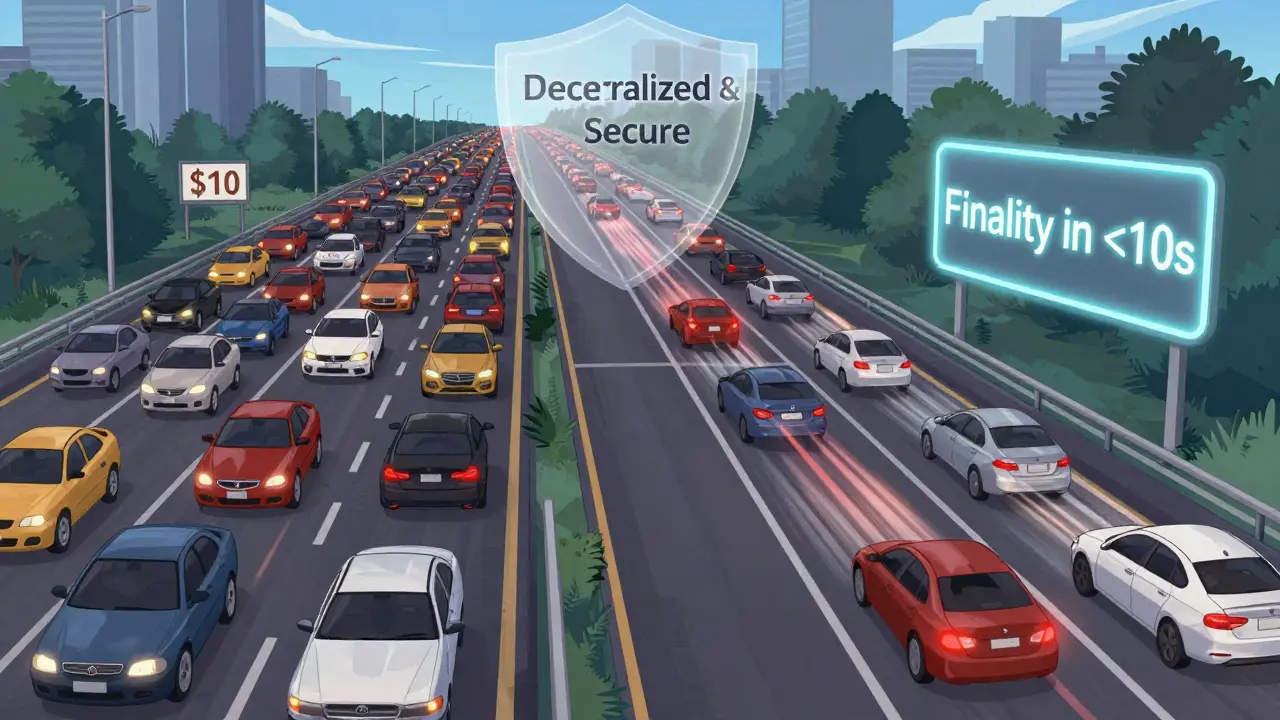
Conflux (CFX) isn't just another cryptocurrency. It's a high-performance blockchain built from the ground up to fix the biggest problems holding back mainstream crypto adoption: slow speeds, high fees, and scalability limits. If you've ever waited minutes for a transaction to confirm or paid $10 in gas fees to send $50, Conflux offers a real alternative. Unlike most blockchains that process transactions one after another like cars on a single-lane road, Conflux uses a revolutionary structure that lets thousands of transactions happen at the same time - without sacrificing security or decentralization.
How Conflux Works: The Tree-Graph Consensus
Most blockchains, including Bitcoin and Ethereum, use a linear chain. Each new block links to the one before it. This creates a bottleneck. Conflux breaks that model with something called Tree-Graph. Think of it as a tree with multiple branches, where transactions can be added to different branches simultaneously. These branches then merge back into a single, ordered history using a smart algorithm called GHAST. This isn't just theory - it’s been tested and proven to handle over 3,000 transactions per second with finality in under 10 seconds. That’s faster than Visa’s average processing speed.
The key innovation? No reorgs. In Bitcoin or Ethereum, if two miners find a block at the same time, one chain gets abandoned. That’s risky for apps needing instant confirmations. Conflux’s Tree-Graph avoids this by accepting all valid blocks and ordering them mathematically. There’s no guesswork. Your transaction either goes through or it doesn’t - and you know exactly when.
What Is CFX? The Native Token of the Network
CFX is the lifeblood of the Conflux network. Every action on the chain - sending tokens, deploying a smart contract, renting storage - costs CFX. It’s not just a currency; it’s the fuel, the voting right, and the security deposit all in one.
- Transaction fees: Paid in CFX, similar to Ethereum’s ETH. But because Conflux processes so many transactions at once, fees stay low - often under $0.01.
- Staking: Holders can lock up CFX to help validate transactions and earn rewards. Unlike some chains, there’s no minimum staking amount. You can stake 1 CFX or 10,000.
- Governance: CFX holders vote on upgrades, fee structures, and network parameters through the Conflux DAO. The more CFX you hold, the more voting power you have.
- Storage rental: Developers who need to store data on-chain pay in CFX. A portion of that payment gets burned permanently, reducing total supply over time.
Each CFX is divisible into 1,000,000,000,000,000,000 drips - the smallest unit. That’s 10^18, just like Ethereum’s Gwei. This level of precision matters for microtransactions and DeFi applications.
Why Developers Love Conflux
Conflux doesn’t force developers to start from scratch. It’s fully compatible with the Ethereum Virtual Machine (EVM). That means:
- You can deploy existing Solidity smart contracts without rewriting them.
- You can use MetaMask, Hardhat, and Remix just like you would on Ethereum.
- Tools like The Graph, Chainlink, and OpenZeppelin work out of the box.
This isn’t just convenience - it’s a massive time-saver. Developers who’ve spent months building on Ethereum can move their apps to Conflux in days. The result? A growing ecosystem of DeFi protocols, NFT marketplaces, and gaming apps that benefit from Conflux’s speed and low cost.
Conflux also separates consensus from execution. Think of consensus as deciding the order of transactions, and execution as running the code. By splitting these layers, the network avoids congestion. Even if a game server floods the chain with 500 actions per second, the consensus layer keeps ticking. No slowdowns. No crashes.

Tokenomics: Controlled Supply, Burning Mechanisms
Conflux isn’t inflationary by accident. It’s designed to be sustainable. Here’s how:
- Controlled inflation: New CFX enters circulation slowly - about 1.5% per year - to reward miners and stakers.
- Token burning: Every time someone pays for storage or a transaction, a portion of CFX is destroyed. This reduces total supply over time.
- Hard cap: The maximum supply is 1.6 billion CFX. As of early 2026, around 1.2 billion are in circulation.
The burn rate is dynamic. When network usage spikes - say, during a popular NFT drop - more CFX gets burned. This creates natural scarcity. Unlike some coins that print endlessly, Conflux’s supply shrinks as it grows.
Real-World Use Cases
Conflux isn’t a lab experiment. It’s already being used in live applications:
- DeFi: Decentralized exchanges like ConfluxSwap let users trade assets with near-instant settlement and fees under $0.02.
- Gaming: Play-to-earn games like Conflux Arena use the network to handle thousands of player actions per minute - item transfers, skill upgrades, real-time battles - without lag.
- Supply chain: Companies in Asia use Conflux to track shipments. Each scan - from warehouse to delivery - is recorded on-chain with a timestamp and location, tamper-proof and instantly verifiable.
- Enterprise: Banks and logistics firms test Conflux for cross-border settlements. Transactions settle in seconds, not days, with full audit trails.
These aren’t hypotheticals. They’re live, operational systems. Conflux’s architecture makes it one of the few Layer-1 blockchains that can handle enterprise-grade loads without compromising decentralization.
How It Compares to Other Blockchains
| Feature | Conflux (CFX) | Ethereum | Solana |
|---|---|---|---|
| Transactions per second | 3,000+ | 15-30 | 50,000 (theoretical) |
| Finality time | Under 10 seconds | 15-30 seconds | 2-4 seconds |
| Gas fees (avg.) | $0.005 | $1-$10 | $0.001 |
| EVM compatible | Yes | Yes | No |
| Consensus mechanism | Tree-Graph + GHAST | Proof of Stake | Proof of History |
| Token burn | Yes (transaction + storage) | Yes (EIP-1559) | No |
Conflux sits between Ethereum’s security and Solana’s speed. It doesn’t sacrifice decentralization for performance. It doesn’t require a new programming language. And it doesn’t rely on centralized validators - every node is permissionless.
Who Uses Conflux Today?
The community is growing fast. Over 200 dApps are live on Conflux, including:
- DeFi platforms like ConfluxSwap and Conflux Finance
- NFT marketplaces like ConfluxGallery
- Gaming studios building blockchain-based titles
- Chinese enterprises testing supply chain tracking
While Western adoption has been slower than in Asia, Conflux is actively partnering with global developers. Its team has offices in Beijing, Toronto, and Singapore, and it’s one of the few Chinese blockchain projects with full regulatory compliance - making it appealing to institutions wary of legal gray zones.
Is CFX a Good Investment?
That depends on what you’re looking for. If you want a coin that’s purely speculative, Conflux might not be your top pick. But if you’re interested in a blockchain with real engineering, real usage, and a clear path to scaling, then CFX has substance behind it.
The token’s value is tied to network activity. More transactions → more fees burned → less CFX in supply → potential price pressure upward. Unlike coins with massive inflation, Conflux’s supply is being actively reduced. And with over 1.2 billion CFX already in circulation, the remaining 400 million will be released slowly - over the next 15 years.
It’s not a get-rich-quick play. But it’s one of the few Layer-1 blockchains built for long-term utility.
Is Conflux (CFX) a scam?
No. Conflux is a legitimate, open-source blockchain developed by a team with strong academic and engineering backgrounds. It was founded in 2018 by Dr. Fan Long, a former Microsoft researcher, and has received funding from institutions like the Chinese Academy of Sciences and Sequoia Capital. The network is fully audited, transparent, and has been live since 2019. Its code is publicly available on GitHub, and its consensus mechanism has been peer-reviewed.
Can I stake CFX on exchanges?
Yes, major exchanges like Binance, OKX, and KuCoin offer staking services for CFX. You can earn rewards by staking directly on these platforms. However, for full control and maximum rewards, you can stake directly through the official Conflux Portal using a wallet like Conflux Portal or MetaMask. Direct staking gives you access to governance rights and higher APRs.
How do I buy CFX?
You can buy CFX on major exchanges such as Binance, Coinbase, KuCoin, and OKX. Search for CFX/USDT or CFX/ETH pairs. Once purchased, you can store it in any wallet that supports ERC-20 tokens - including MetaMask, Trust Wallet, or the official Conflux Portal wallet. Avoid storing large amounts on exchanges long-term.
Is Conflux faster than Ethereum?
Yes, by a large margin. Ethereum processes around 15-30 transactions per second with finality taking 15-30 seconds. Conflux handles over 3,000 transactions per second with finality in under 10 seconds. This makes it suitable for real-time applications like gaming, trading, and enterprise systems where speed matters.
Does Conflux have a future?
Conflux is positioned as a scalable infrastructure layer for Web3. With its unique consensus, EVM compatibility, and growing developer adoption, it’s one of the few Layer-1 blockchains that can compete with Ethereum on security while matching Solana on speed. As enterprise use cases grow - especially in Asia - Conflux’s role in connecting decentralized systems is likely to expand. Its technical foundation is solid, and its tokenomics are designed for long-term sustainability.
Next Steps: How to Get Started
If you’re curious about Conflux, here’s how to begin:
- Buy CFX on Binance, Coinbase, or another supported exchange.
- Download the Conflux Portal wallet (browser extension or mobile app).
- Transfer your CFX to the wallet.
- Try staking directly through the portal to earn rewards.
- Explore dApps on ConfluxScan to see what’s live - from DeFi to games.
You don’t need to be a developer to use Conflux. But if you are - its EVM compatibility means you can deploy your existing Ethereum projects with almost zero changes. The barrier to entry is low. The potential is high.

Comments
Andrew Hadder
i just read this and honestly? conflux is way more solid than most people think. i tried eth for a while and the fees killed me. cfx transactions are like $0.002 and they go through in like 5 seconds. no joke. i moved all my small trades over and never looked back.
also the tree-graph thing? it actually works. no reorgs means i dont have to stress about my swaps failing. big win.
Derek Sasser
i’ve been following conflux since 2021 and honestly, the evm compatibility is the real secret sauce. you don’t have to relearn everything. just deploy your solidity contracts like normal, and boom - 3000 tps with sub-10 second finality. it’s like getting a ferrari engine in a honda body. no need to rebuild your whole garage.
also the burn mechanics? genius. every time someone pays a fee, a little bit disappears. that’s not hype - that’s real deflation. most chains just print more. this one slowly shrinks. smart.
Neeti Sharma
usa and europe keep talking like conflux is some new thing but china has been using it for supply chain for 3 years now. you think your crypto is advanced? we moved 800k shipments on-chain last year. no lag no fees no drama. this isnt a coin its infrastructure. and you americans still arguing about gas fees like its 2021
Fiona Monroe
The technical architecture of Conflux represents a paradigm shift in blockchain scalability. Unlike proof-of-stake systems that rely on validator centralization, the Tree-Graph consensus maintains decentralization while achieving throughput rivaling centralized systems. The mathematical ordering of concurrent branches via GHAST eliminates the probabilistic finality inherent in longest-chain protocols. This is not merely an improvement - it is a foundational re-engineering.
Molley Spencer
let’s be real - conflux is just ethereum with a new coat of paint. they’re not innovating, they’re repackaging. 3000 tps? sure, but what about decentralization? how many full nodes are actually running? probably 500. and the ‘burn mechanism’? it’s a gimmick. the tokenomics are engineered to look like deflation but the inflation rate is still 1.5% - that’s not scarcity, that’s slow inflation with a side of marketing fluff.
also, ‘enterprise adoption’? you mean chinese state-backed entities? that’s not crypto. that’s surveillance with a blockchain sticker.
John Fuller
conflux is cool i guess
Lucy Simmonds
wait wait wait... this is a trap. conflux is a chinese government crypto. they’re tracking every transaction. you think those ‘supply chain’ apps are for logistics? no. they’re building a blockchain surveillance net. and you’re all just staking your coins like sheep. don’t you see? the ‘burn’ is just to make you think it’s deflationary while they quietly hoard 70% of the supply. this is how they’ll control the world. mark my words.
Maggie House
i just staked 5 cfx for the first time and got 0.07 in rewards in 2 days?? i thought staking was supposed to take weeks. this is wild. also the conflux portal wallet is so easy to use. no gas fees to even get started. i’m not even a techie and i got in. if you’ve been scared to try crypto because it’s too complicated - this is the one to start with. so chill and friendly. love it.
Dana Sikand
okay i just had to say this - i’ve been on ethereum since 2020 and i was so tired of waiting 10 minutes for a transaction to go through. i tried solana once and got my wallet hacked because of their ‘speed over security’ thing. then i found conflux. i moved my whole portfolio. the transactions are instant. the fees are practically nothing. and i can still use my metamask like normal. i cried a little. this is what crypto was supposed to be. finally. someone got it right.
also the burn? it’s beautiful. every time i pay a fee, i feel like i’m helping shrink the supply. like i’m part of the solution. not just a user. a builder.
Cameron Pearce Macfarlane
3000 tps? lol. that’s peak theoretical. real-world usage? i bet half of it’s bots. and the ‘enterprise adoption’? yeah right. chinese state agencies using it to track tofu shipments. how revolutionary. meanwhile, ethereum’s ecosystem has 10x more devs, 50x more liquidity, and actual users. this is just a glorified fork with a new logo and a chinese flag.
Elizabeth Smith
people treat crypto like it’s about technology. it’s not. it’s about morality. you want to build a system where transactions are cheap and fast? fine. but what about the people left behind? the ones who can’t afford to stake? the ones who get priced out by the ‘burn’? this isn’t progress. it’s a new kind of elitism. dressed up in whitepapers and eip numbers. we don’t need faster chains. we need fairer ones.
Daisy Boliaan
i just spent 4 hours trying to stake on conflux portal and it kept saying ‘pending’ for 20 minutes. i thought it was broken. turned out my wallet had 0.00001 eth in it and it needed a tiny gas fee to trigger the staking contract. i almost quit. then i added 0.0005 eth and boom - staked. so yeah. it works. but why does it need eth to stake cfx? that’s so dumb. why not just let me pay in cfx? this is the kind of thing that makes me wanna scream. why is everything so unnecessarily complicated?
Robert Conmy
you all think conflux is the future? nah. ethereum is the only chain that matters. everyone else is just trying to copy it. conflux? they got lucky with their tree-graph idea. but they’re not building community. they’re not building culture. they’re just building code. and code doesn’t last. communities do. you can’t buy loyalty. you can’t code trust. and until conflux has a moonboy meme, it’s just another blockchain with a nice whitepaper.